Coordination, control & how ShoulderBack Pro works
What to Expect in 30 Days With ShoulderBack Pro (No Promises, Just Patterns)
5-minute read · Published September 26, 2025 · Updated September 26, 2025
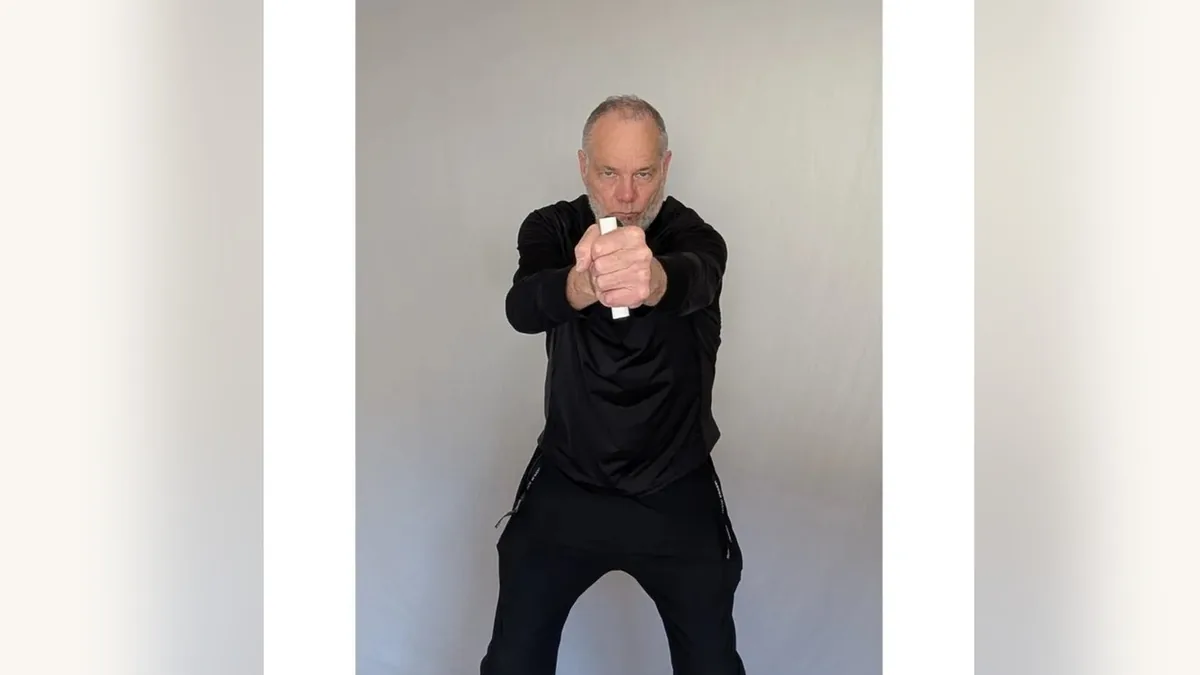
Why this happens
A 30-day window is short, but it is useful. Early changes are thought to come more from learning than from muscle size. Your brain and shoulder get better at moving in a controlled way, and that takes repetition.
Shoulder rehabilitation often follows a sequence: range of motion, then strength, then control and coordination [R16]. Some programs that teach control and coordination may do slightly better than generic exercise for disability, though researchers do not fully know why [R02]. In other words, the early weeks are often about practice and control, not instant results.
Van Hill, who designed ShoulderBack Pro, puts it this way: "I won't make medical promises; everyone's situation is different."
What the research says
- Resisted, progressive exercise probably helps shoulder pain, but the size of the pain benefit is uncertain. In one review, benefits were measured between six weeks and six months [R01].
- Programs that teach control and coordination may reduce disability slightly more than generic exercise in the short and medium term [R02].
- A 2025 review found that mobilization and stretching improved function and pain over about two months. Scapular stabilization exercise also improved pain and function [R03].
- Guidelines say every move counts. Adults are advised to do muscle-strengthening activity at least two days a week [R07].
What you can do
- Week one: learn three rituals. Practise the three 3-minute rituals: Refreshing Awareness, Greet the Morning and Vitality & Posture Perk. Keep the pace slow.
- Week two: repeat and notice. Keep the same three rituals. Note which movements feel smooth and which feel tight.
- Week three: add one movement. Add one new lesson from the 16 free videos. Choose the one that matches your main concern.
- Week four: check your pattern. Look back at your log. Did you practise most days? Did your shoulder feel better, the same or worse the next morning?
- Keep a one-line log. Write the date, how hard you worked (from 0 for none to 10 for hardest), and one sentence about your shoulder.
- Seated option every week. Do every session from an armchair if standing is hard. Sit tall with your back supported.
Where ShoulderBack Pro fits — and where it doesn't
The trainer is a 160-gram strap with two handles; one arm assists while the other resists, so you set the effort, pace and range. For a 30-day habit, Steering is a good early pick: you turn an imaginary wheel at ten-and-two, which is designed to work the deltoids and rhomboids. Around the World is a natural second choice once that feels comfortable. All 16 free video lessons are on the routines page.
It's not a medical device and not a treatment, and there is no trial evidence about it specifically. If your shoulder hurts now, see a clinician before you start. It costs $29 CAD ($87 for a four-pack), with a 30-day Living Room Guarantee; you can order online.
Related reading: how ShoulderBack Pro works covers the design in full. For more detail, read what body-controlled resistance means and why nothing snapping or dropping changes how your shoulders behave.
When to see a professional
See a doctor or physiotherapist promptly if you have: pain after a fall or injury with sudden weakness or loss of movement; a shoulder that looks deformed, very swollen or bruised; fever or feeling unwell alongside the pain; chest pain or breathlessness (call emergency services); constant pain that doesn't change with rest or activity; pain that wakes you most nights; numbness, tingling or weakness into the arm or hand; pain in several joints at once; or pain that hasn't improved after a couple of weeks of sensible self-care [R30].
If you are already in pain, your 30 days should start with a conversation with your clinician. Do not use the trainer as a substitute for that conversation.
Try this movement
All 16 video lessons →Frequently asked questions
Will ShoulderBack Pro fix my shoulder in 30 days?
No device can promise that. ShoulderBack Pro is a wellness movement trainer, not a medical device, and it is not a treatment for a diagnosed condition. A clinician can tell you what is going on and what is safe for you.
What should I track during the 30 days?
Track the days you practised, how much effort you used, and how your shoulder felt the next morning. Patterns over several weeks tell you more than any single session.
Is there a way to try it without risk?
The 30-day Living Room Guarantee gives a full refund if the trainer is not right for you.
Do I need to be seated or standing?
The trainer can be used seated in an armchair or standing, whichever is comfortable for you.
Sources
- Naunton J et al. (2020). Effectiveness of progressive and resisted and non-progressive or non-resisted exercise in rotator cuff related shoulder pain: systematic review and meta-analysis of RCTs. Clinical Rehabilitation. https://search.pedro.org.au/search-results/record-detail/61404
- Dubé M-O et al. (2024). The Efficacy of Exercise Therapy for Rotator Cuff-Related Shoulder Pain According to the FITT Principle: Systematic Review With Meta-analyses. JOSPT. https://pubmed.ncbi.nlm.nih.gov/38848304/
- Frontiers in Bioengineering & Biotechnology (2025). Specific modes of exercise to improve rotator cuff-related shoulder pain: systematic review and meta-analysis. https://pmc.ncbi.nlm.nih.gov/articles/PMC12011739/
- WHO (2020). Guidelines on physical activity and sedentary behaviour. https://www.sydney.edu.au/news-opinion/news/2020/11/26/new-global-guidelines-on-physical-activity-and-sedentary-behavio.html
- Mureşan et al. (2022). Effects of a novel proprioceptive rehabilitation device on shoulder joint position sense, pain and function. Medicina. https://www.ncbi.nlm.nih.gov/pmc/articles/PMC9505091/
- NHS Greater Glasgow & Clyde, Shoulder red flags; NHS MPFT self-help, Shoulder pain; BESS/BOA pathway summary (2021). https://www.nhsggc.scot/page_category/services/page/33
More in this topic
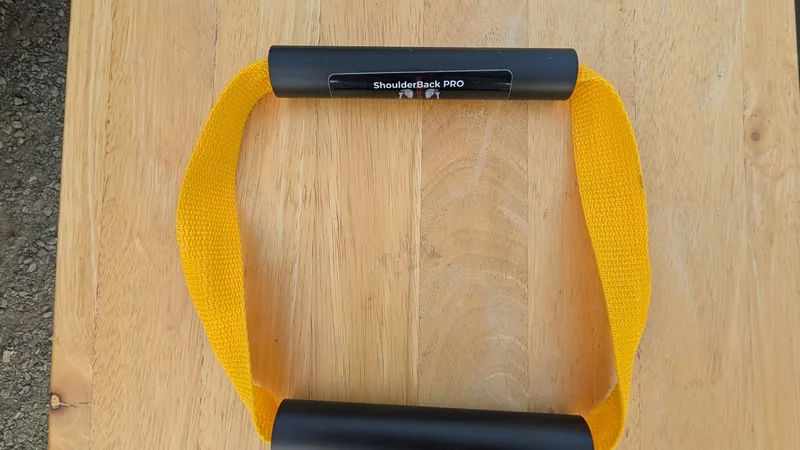 Essential guide: How ShoulderBack Pro Works: One Device, Two Connected Handles, Your Own Resistance
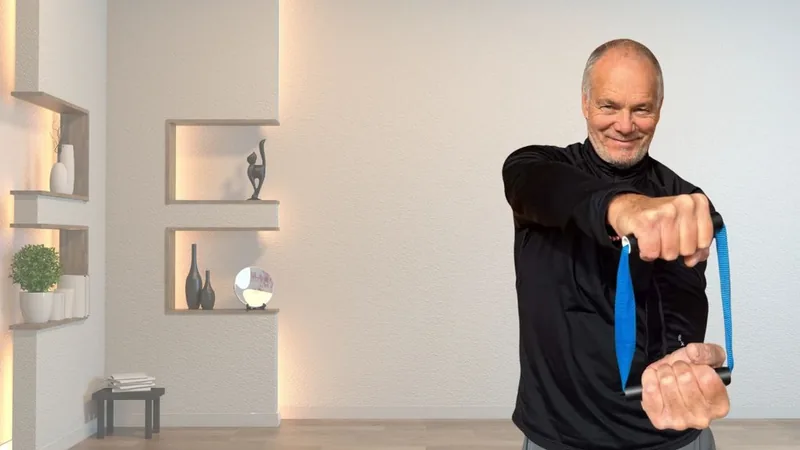 Pairing SBP With Walking: The Simplest Whole-Body Routine for Active Aging
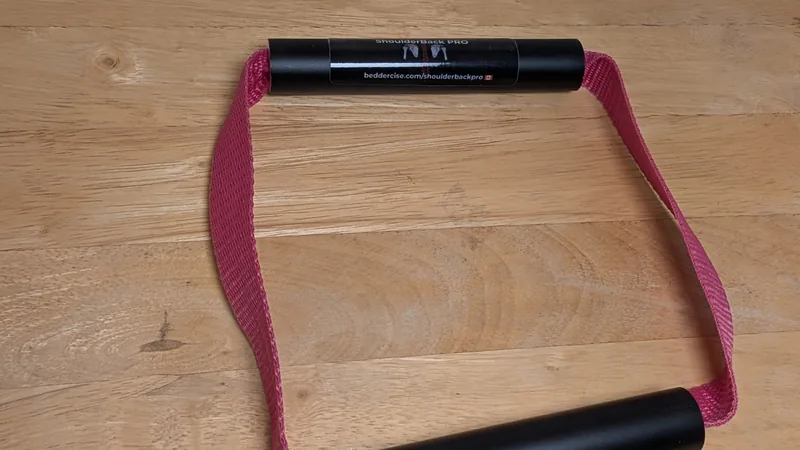 Locomotive: Rolling Circles for the Upper Back and Rear Cuff
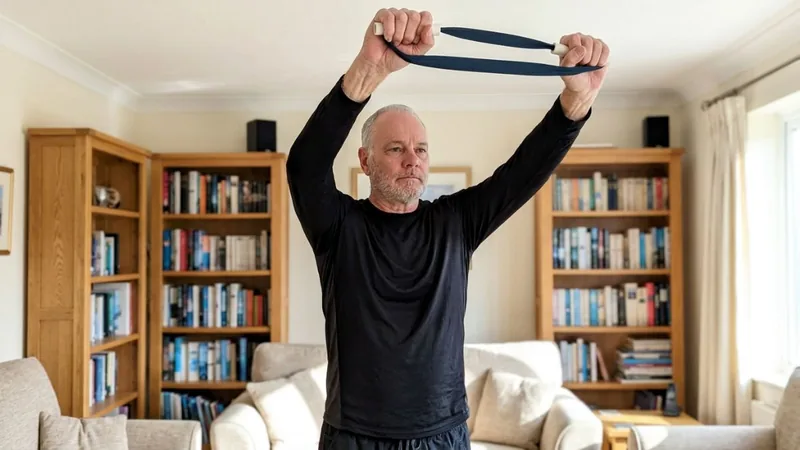 Overhead Press (High Shelf Reach): Trapezius and Deltoids Without a Weight