Coordination, control & how ShoulderBack Pro works
How ShoulderBack Pro Works: One Device, Two Connected Handles, Your Own Resistance
9-minute read · Published December 19, 2024 · Updated December 19, 2024
This guide explains how the device is built, what the idea behind it is, what the research does and does not say, and how to decide whether it fits your routine. Read the whole thing if you are the kind of person who wants the mechanism before you buy. Skim to the sections you need if you prefer a quicker read.
What the device is
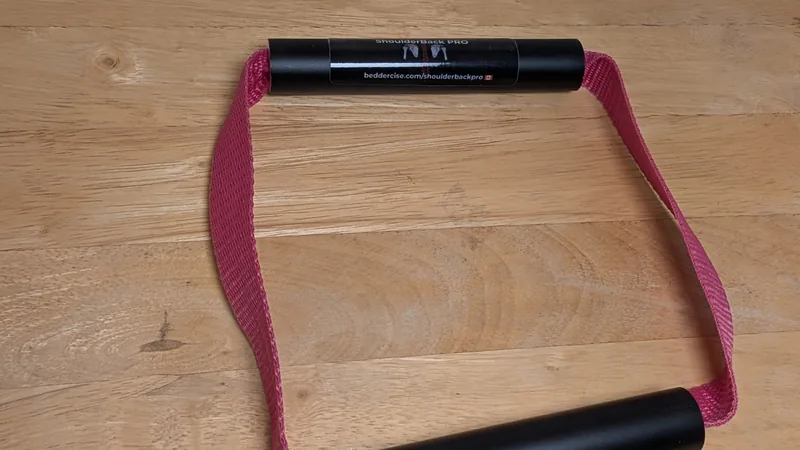
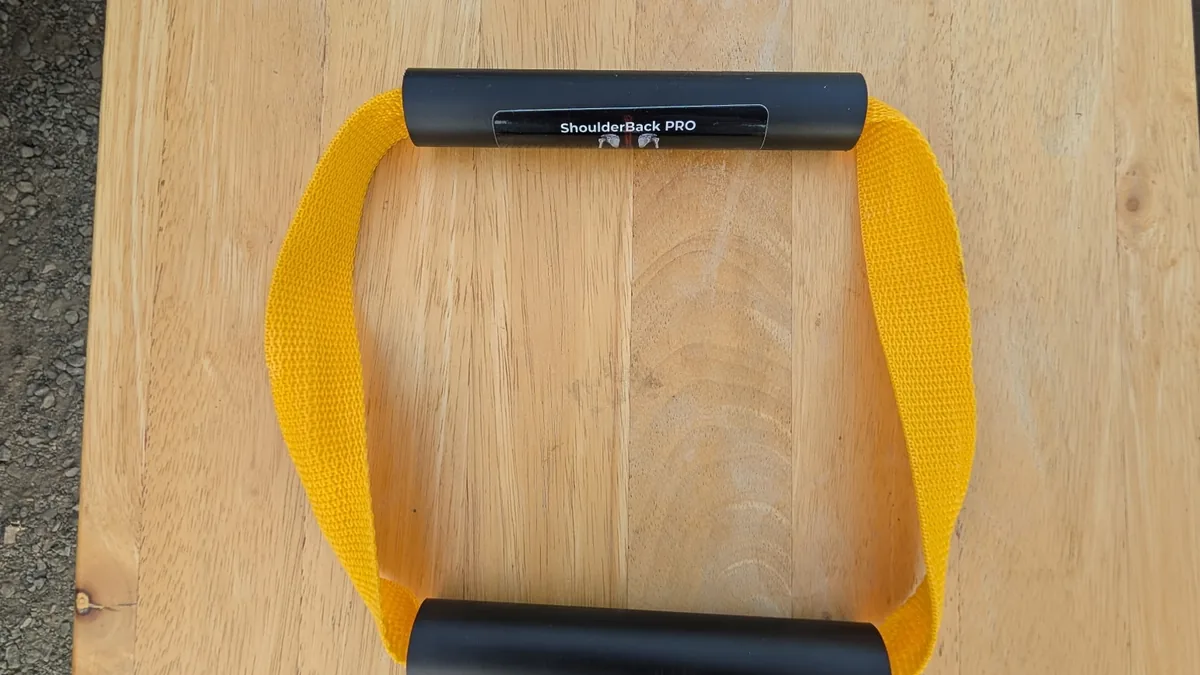
ShoulderBack Pro weighs 160 grams and is roughly 5 cm in size, which makes it pocket-size. It is designed and assembled in British Columbia, Canada.
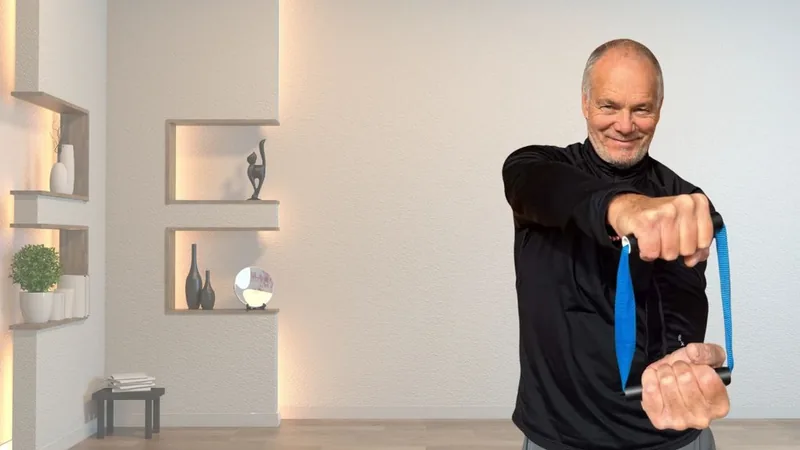
It has two handles. They are joined by a strap of fixed length. The strap does not stretch, so nothing snaps, drops or springs back. There are no door anchors, no weights and no elastic bands to set up. You can use it in an armchair or while standing.
Four strap colours are available. All four have identical resistance. The colour is a matter of taste.
How the two handles work together
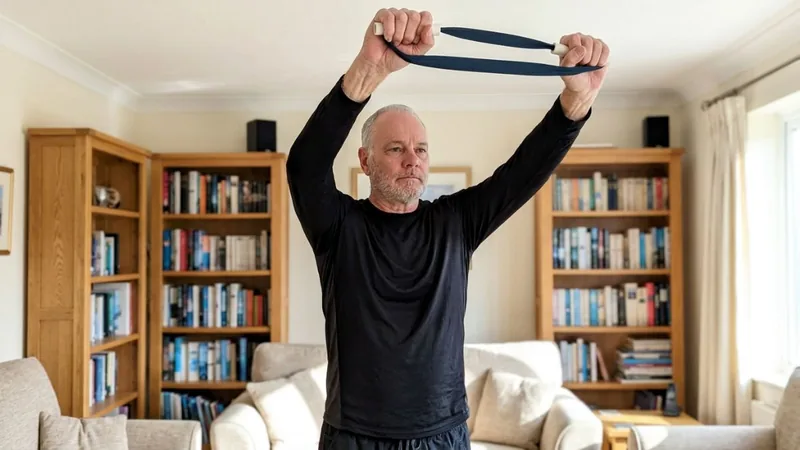
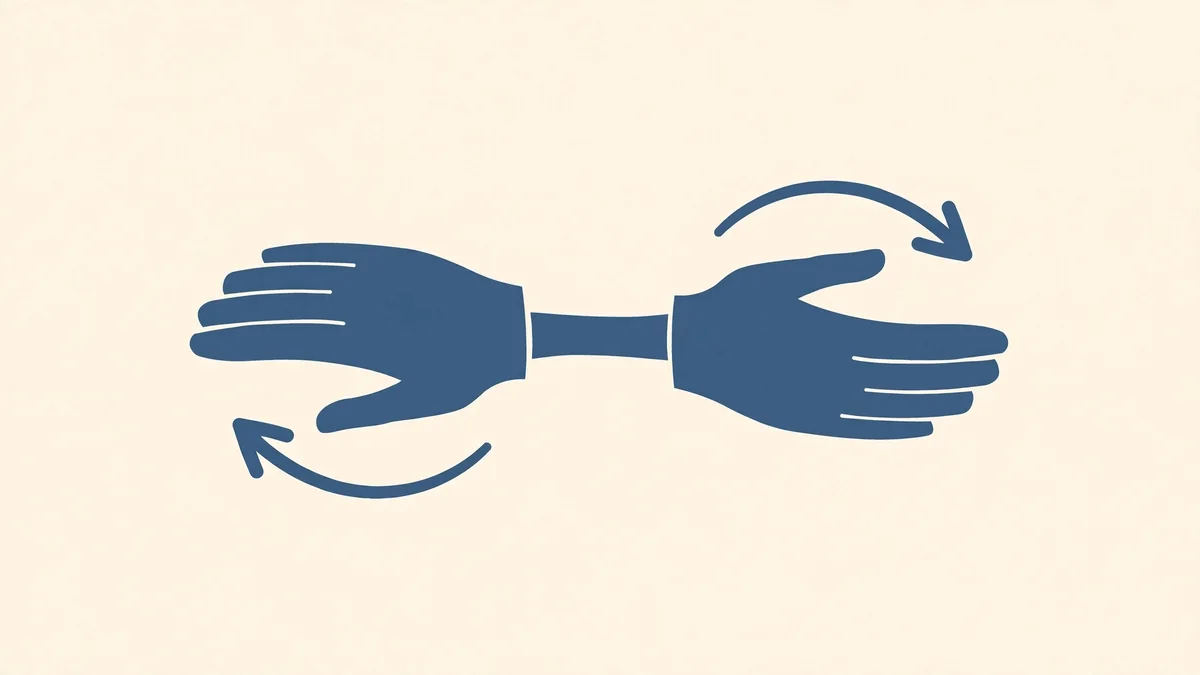
The core idea is simple. You hold one handle in each hand. One arm assists the movement while the other arm resists it. You decide how much effort to use, how fast to move, and how far to go.
Because you control those three things, the same device can feel gentle on a slow day and more demanding on a strong one. You stay in charge of the movement at all times.
Van Hill, the inventor, describes his own history this way: he "nursed back 2 rotator cuff issues on my own with persistence and patience." He is also clear about the limits of that story. In his words, "I won't make medical promises; everyone's situation is different." You can read more about him on Van's page.
What the research says
No clinical trials of ShoulderBack Pro exist. The research below is about exercise and movement in general. It is useful background for understanding why a two-arm, controlled approach might be interesting. It is not proof that the device works.
- Progressive, resisted exercise has the clearest shoulder evidence. For rotator-cuff-related shoulder pain, resisted exercise that progresses over time probably helps. Gentle movement without load probably does not move the needle on pain [R01].
- Control and coordination may edge out generic exercise. Motor-control programs reduced disability slightly more than non-specific exercise in the short and medium term. The reason is not fully known [R02].
- Two-arm training has a rationale. In stroke rehabilitation, training that uses both arms together produced more shoulder movement improvement than single-arm training [R14]. That evidence comes from stroke patients, not healthy adults, so treat it as a reason to be curious, not as proof for this device.
- Training one side can affect the other. In one study, training that challenged joint position sense improved the trained wrist and the untrained opposite wrist [R15]. The two sides of the body can learn from each other.
- Rehabilitation often moves in stages. Shoulder rehab commonly progresses from range of motion to strength, then control and proprioception, then coordination [R16]. Joint position sense, or proprioception, is the body's sense of where a joint is in space.
- Proprioception and shoulder stability are linked. In baseball players, a 12-week program improved shoulder proprioception, instability and pain [R17]. That was an athletic group, so the results may not transfer directly to every reader.
The honest summary: resisted, progressive, controlled movement has evidence behind it. The two-handle approach is a sensible way to deliver controlled movement at home, but nobody has tested this device in a trial.
The 16 lessons, grouped by what they feel like
ShoulderBack Pro comes with 16 free guided video lessons. Van Hill teaches each one. Each exercise has a target area and a one-line cue. Here are a few examples from the library:
- SeeSaw works the shoulder blade muscles. Alternate gentle reaches, with one arm guiding the other.
- Around the World works the serratus anterior and lower trapezius. Draw one large, unhurried circle in front of you.
- Windshield Wipers works the subscapularis, infraspinatus and teres minor. Make slow side-to-side arcs.
- Locomotive works the thoracic extensors and posterior rotator cuff. Roll forward through small circles, like train wheels.
- Crosscuts works the lats, obliques and scapular retractors. Glide the trainer on a diagonal, from high shoulder to opposite hip.
You do not need to do all 16. Many people pick two or three that feel right and build from there.
The three 3-minute rituals
The lessons are grouped into three short rituals. Each takes about three minutes:
- Refreshing Awareness: SeeSaw, Open The Door and Windshield Wipers.
- Greet the Morning: Around the World, Steering and Bear Hugs Me.
- Vitality and Posture Perk: Crosscuts, Overhead Press and Locomotive.
These are designed as habit-friendly short routines. They are not a treatment plan. They suit a short break in the day, a morning start or an evening wind-down.
What you can do
Here is a practical way to try the device without overdoing it:
- Check with your clinician first if you have a diagnosed shoulder condition, recent surgery, nerve symptoms or a recent injury. Seated option: This step can be done from your armchair while you read your last clinic notes.
- Start with one ritual. Pick Refreshing Awareness if you are new to controlled movement. Use the video lessons so you learn the cue.
- Keep the range small at first. Move within comfort. Increase effort only when the movement feels controlled. Because the resistance comes from your other arm, progress by resisting harder, moving through more range or doing longer sets. Seated option: Sit tall, keep your back supported, and do each movement with the trainer in your lap or at chest height.
- Stop if you feel sharp pain. A working feeling is normal. Sharp pain or pain that lingers means you stop and check with a professional.
- Repeat across the week. Short, regular sessions are easier to keep than long occasional ones.

Who it suits, and who should check first
ShoulderBack Pro is written for two readers. The first is someone over 55 who wants a simple, seated way to keep the shoulders moving within a comfortable range. Many people in this group like that they can do it from an armchair and keep the movement small.
The second is someone between 28 and 50 who sits at a desk, lifts at the gym, or helps care for a parent. They want a few minutes of controlled shoulder work between tasks, and they want the reasoning behind it.
Some people should check with a clinician before they start. That includes anyone with a diagnosed shoulder condition, recent surgery, nerve symptoms such as numbness or weakness in the hand, a recent fracture, or severe osteoporosis. Ask first, then decide.
Price, guarantee and ordering
One ShoulderBack Pro costs $29 CAD. A four-pack costs $87 CAD, which works out to buy 3, get 1 free, with free shipping.
The 30-day Living Room Guarantee offers a full refund. You can order through the shop page, or call 1-800-555-0199. Questions can go to info@shoulderbackpro.com.
Where ShoulderBack Pro fits, and where it doesn't
For slow, controlled shoulder and upper-back movement at home, two lessons are a good place to begin. Windshield Wipers is slow rotation that the site lists for the subscapularis, infraspinatus and teres minor. Around the World is one large, unhurried circle listed for the serratus anterior and lower trapezius. Both can be done seated, and both are in the lesson library.
It's a wellness tool rather than a treatment, and it has not been tested in clinical trials. If you're ready, you can order online.
When to see a professional
See a doctor or physiotherapist promptly if you have: pain after a fall or injury with sudden weakness or loss of movement; a shoulder that looks deformed, very swollen or bruised; fever or feeling unwell alongside the pain; chest pain or breathlessness (call emergency services); constant pain that doesn't change with rest or activity; pain that wakes you most nights; numbness, tingling or weakness into the arm or hand; pain in several joints at once; or pain that hasn't improved after a couple of weeks of sensible self-care.
If you have any of these, get assessed before you start a new routine, including this one.
Try this movement
All 16 video lessons →Frequently asked questions
Is ShoulderBack Pro a medical device?
No. It is a wellness product for controlled movement. It is not a medical device, and it is not intended to diagnose or treat anything.
Are there clinical trials for ShoulderBack Pro?
No. There are no clinical trials of ShoulderBack Pro. The research cited in this article is about exercise in general, not about this product specifically.
Do I need a door anchor, weights or bands?
No. ShoulderBack Pro does not need door anchors or weights. It is a single device that you can use seated in an armchair or standing.
Can I use it if I am recovering from an injury or surgery?
Ask your clinician first. After surgery, follow the surgeon's or physiotherapist's protocol, and use ShoulderBack Pro only if they approve it.
What does ShoulderBack Pro cost, and what if I am not happy?
It is $29 CAD for one, or $87 CAD for a four-pack (buy 3, get 1 free, with free shipping). A 30-day Living Room Guarantee offers a full refund.
Sources
- Naunton J et al. (2020). Effectiveness of progressive and resisted and non-progressive or non-resisted exercise in rotator cuff related shoulder pain: systematic review and meta-analysis of RCTs. Clinical Rehabilitation. https://search.pedro.org.au/search-results/record-detail/61404
- Dubé M-O et al. (2024). The Efficacy of Exercise Therapy for Rotator Cuff-Related Shoulder Pain According to the FITT Principle: Systematic Review With Meta-analyses. JOSPT. https://pubmed.ncbi.nlm.nih.gov/38848304/
- Journal of Physical Therapy Science (2016). The effects of bilateral movement training on upper limb function in chronic stroke patients. https://pmc.ncbi.nlm.nih.gov/articles/PMC5011582
- Scientific Reports (2021). Proprioceptive-focused training transfers gains to the opposite, untrained limb. https://pmc.ncbi.nlm.nih.gov/articles/PMC7935923
- Mureşan et al. (2022). Effects of a novel proprioceptive rehabilitation device on shoulder joint position sense, pain and function. Medicina. https://www.ncbi.nlm.nih.gov/pmc/articles/PMC9505091/
- Kim et al. (2020). Effect of a 12-week rehabilitation exercise program on shoulder proprioception, instability and pain in baseball players. https://www.ncbi.nlm.nih.gov/pmc/articles/PMC7554390/