Coordination, control & how ShoulderBack Pro works
What Is Body-Controlled Resistance? A Plain Explanation
6-minute read · Published November 25, 2024 · Updated November 25, 2024

If you are new to the device, our pillar guide, How ShoulderBack Pro Works, explains the basics. Two related posts, Assist and Resist and Why Training Both Arms Together Changes How the Brain Learns Movement, go deeper.
What "resistance" means
Resistance is anything that makes a muscle work harder than it would with no load. Lifting a bag of groceries is resistance. So is pushing against a wall or pulling on a band.
Most resistance training uses something outside your body, such as dumbbells, machines or elastic bands. The load is set by the object, and you adjust it by changing the object.
Body-controlled resistance is different. The load comes from your own body, usually from the other limb. You adjust it by changing how hard you push or pull, not by changing equipment.
How ShoulderBack Pro works
ShoulderBack Pro is a 160-gram, pocket-size movement trainer. It has two handles joined by a fixed-length, non-elastic strap. You hold one handle in each hand.
One arm assists while the other resists. You decide how much effort each side gives, how fast you move and how far you go. Nothing anchors to a door or a wall, and no weights are needed. You can use it seated in an armchair or standing.
Because the strap does not stretch, the movement stays predictable. Nothing snaps or drops.
What the research says
Resisted exercise is well studied, but body-controlled resistance as a specific idea is not. These findings are the closest and should be read with care:
- Resisted exercise that gets a little harder over the weeks probably helps shoulder pain from the rotator cuff. Unloaded movement alone probably does not [R01]. This is about exercise in general, not this device.
- In stroke rehabilitation, training with both arms together improved shoulder movement more than training one arm alone. The authors describe this as "interlimb coupling." This evidence comes from stroke patients, not from healthy adults, so it shows an interesting idea rather than proof for everyday use [R14].
- Training that challenges joint position sense in one wrist improved control in the untrained opposite wrist as well. The authors describe it as the two sides learning from each other [R15].
- Shoulder disorders often come with reduced joint position sense, and rehab often moves from range to strength to control [R16].
Put simply, the two-arm idea is a reasonable hypothesis. It is not established for ShoulderBack Pro.
What you can do
Use body-controlled resistance as a learning tool. Start light and let your effort build. Each step below is seated.
- Set a low effort. Sit in an armchair with the strap relaxed. Let the assisting arm lead gently and the resisting arm follow with light effort. Keep it easy for the first session.
- Notice the balance. Pay attention to whether one arm feels stronger or looser. Note it, but do not judge it.
- Slow the pace. Move at a steady, three-second pace each way. Speed is not the goal.
- Stop at your comfortable limit. Work to a point where you feel a mild effort, not sharp pain or strain.
- Build slowly. Over several weeks, increase effort or range only when the previous level feels comfortable the next day.
Where ShoulderBack Pro fits, and where it doesn't
This is the idea ShoulderBack Pro is built around, so it suits learning controlled two-arm movement at home. Bicep Tricep is the plainest example: one arm curls while the other extends, so the effort is shared. Arm Wrestler pivots the forearms inward with the elbow as a hinge, which is designed to work the chest and subscapularis. The 16 guided video lessons show both.
It's a wellness tool rather than a treatment, and it has not been tested in clinical trials. For a diagnosed shoulder condition, ask a clinician what is safe for you. If you want to try it, you can order online for $29 CAD.
When to see a professional
See a doctor or physiotherapist promptly if you have: pain after a fall or injury with sudden weakness or loss of movement; a shoulder that looks deformed, very swollen or bruised; fever or feeling unwell alongside the pain; chest pain or breathlessness (call emergency services); constant pain that doesn't change with rest or activity; pain that wakes you most nights; numbness, tingling or weakness into the arm or hand; pain in several joints at once; or pain that hasn't improved after a couple of weeks of sensible self-care.
If any of these signs apply, get an assessment before using any new routine. A doctor or physiotherapist is the person who can diagnose the cause of your symptoms.
Try this movement
All 16 video lessons →Frequently asked questions
Is body-controlled resistance the same as a resistance band?
No. A band pulls against you from an outside source, and its tension depends on how far it is stretched. ShoulderBack Pro uses a fixed-length, non-elastic strap, and the resistance comes from your other arm.
Is it a medical device?
No. ShoulderBack Pro is a wellness product, not a medical device. It is not intended to diagnose or manage any condition.
Can I use it seated?
Yes. You can use it seated in an armchair or standing, so it works for people who prefer to sit.
Does it stretch or snap?
No. The strap is fixed-length and non-elastic, so nothing stretches, snaps or drops. The effort is controlled by you.
Sources
- Naunton J et al. (2020). Effectiveness of progressive and resisted and non-progressive or non-resisted exercise in rotator cuff related shoulder pain: systematic review and meta-analysis of RCTs. Clinical Rehabilitation. https://search.pedro.org.au/search-results/record-detail/61404
- Journal of Physical Therapy Science (2016). The effects of bilateral movement training on upper limb function in chronic stroke patients. https://pmc.ncbi.nlm.nih.gov/articles/PMC5011582
- Scientific Reports (2021). Proprioceptive-focused training transfers gains to the opposite, untrained limb. https://pmc.ncbi.nlm.nih.gov/articles/PMC7935923
- Mureşan et al. (2022). Effects of a novel proprioceptive rehabilitation device on shoulder joint position sense, pain and function. Medicina. https://www.ncbi.nlm.nih.gov/pmc/articles/PMC9505091/
More in this topic
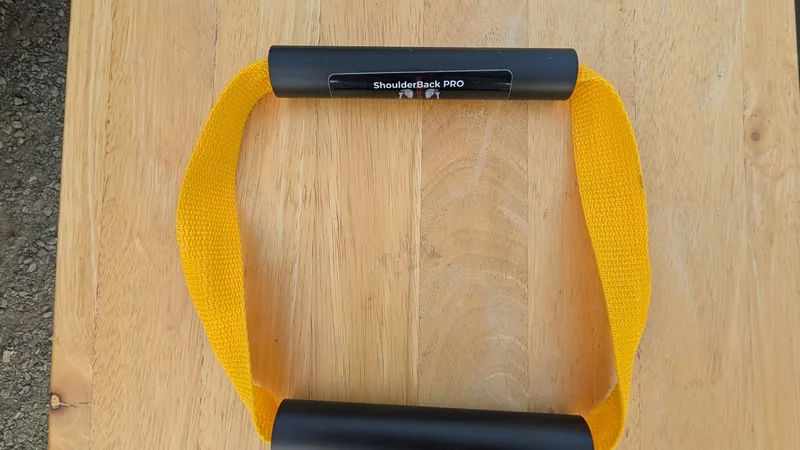 Essential guide: How ShoulderBack Pro Works: One Device, Two Connected Handles, Your Own Resistance
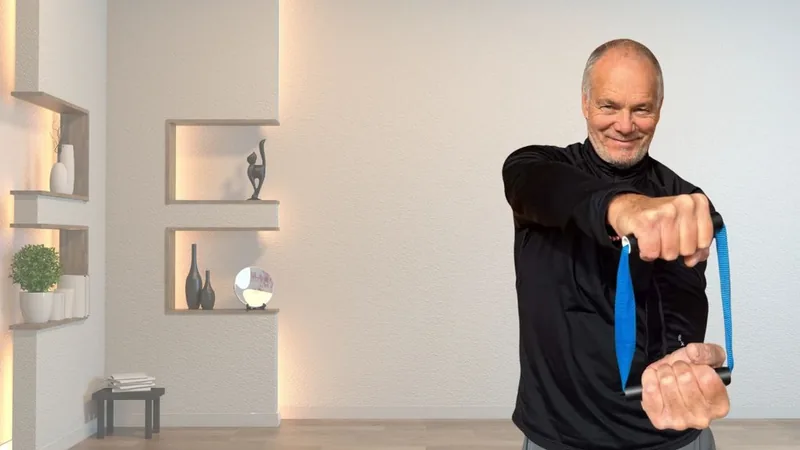 Pairing SBP With Walking: The Simplest Whole-Body Routine for Active Aging
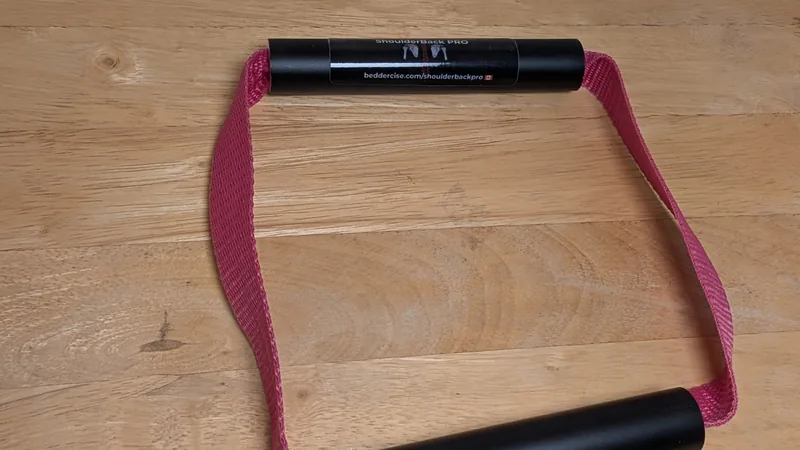 Locomotive: Rolling Circles for the Upper Back and Rear Cuff
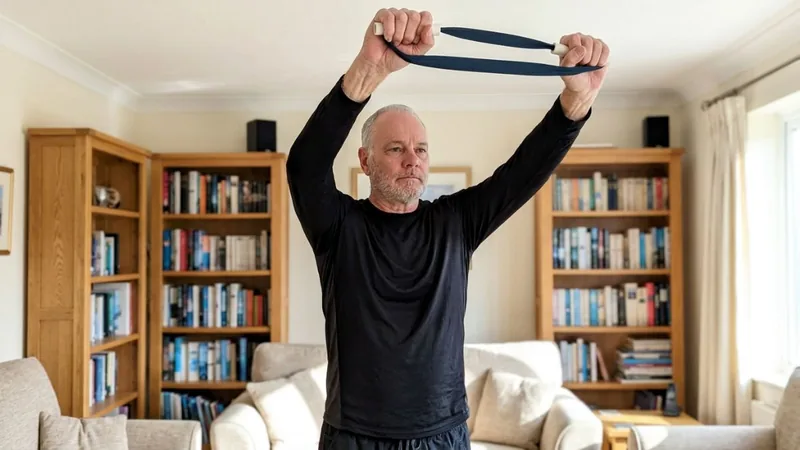 Overhead Press (High Shelf Reach): Trapezius and Deltoids Without a Weight