Shoulder anatomy & how it works
What Is the Subacromial Space and Why Does It Matter?
4-minute read · Published September 29, 2026 · Updated September 29, 2026
What this is
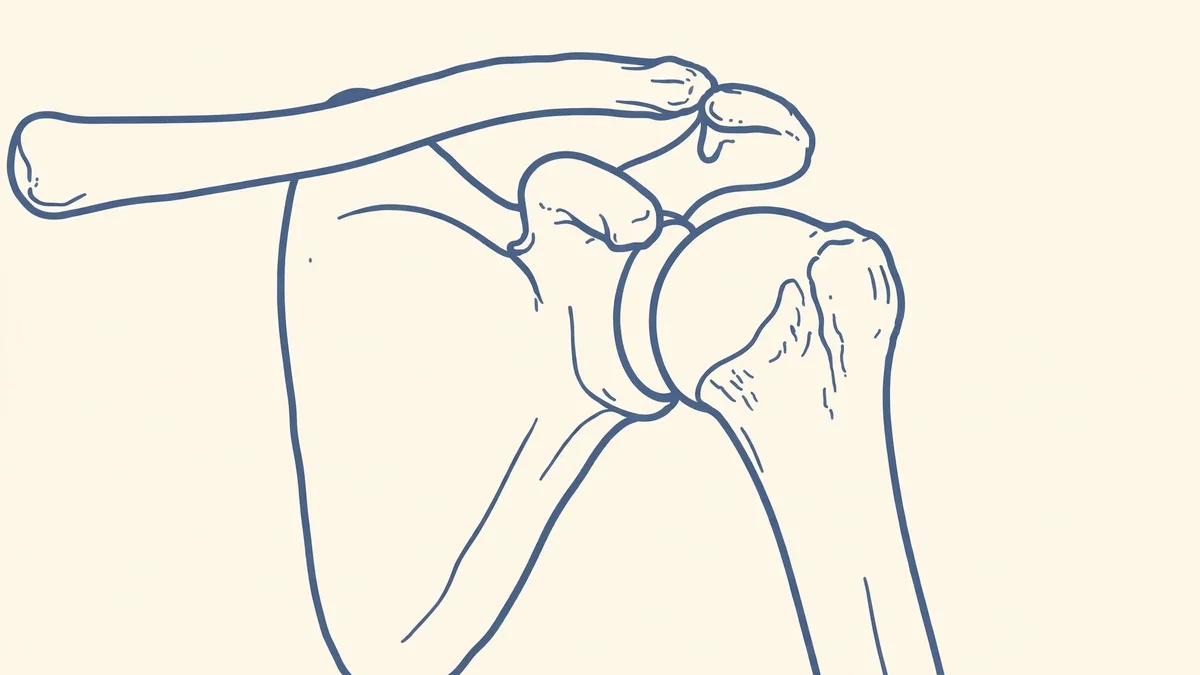
Think of the shoulder as a ball in a shallow socket. The top of the arm bone, the humeral head, sits under a bony arch formed by the acromion, which is the tip of your shoulder blade. The gap between the arch and the rotator cuff tendons is the subacromial space.
The space is small, and it changes slightly as the arm moves. Overhead reaching is thought to narrow it, which is normal. Problems start when the tendons or the bursa become irritated and the space feels crowded.
Why it matters
Tendons and the bursa are the structures that pass through this gap. If they become irritated, lifting the arm, especially overhead, can become uncomfortable. People often call this shoulder impingement, though the term can mean different things to different clinicians.
The muscles that steady the shoulder blade affect how the arch moves. A common explanation is that changing that movement changes how much room the tendons have, which is one reason exercise is often used.
What the research says
- Rotator cuff-related shoulder pain is the most common cause of shoulder pain. It includes subacromial pain, tendon problems and symptomatic tears [R03].
- Scapular stabilization exercise, which trains the muscles that steady the shoulder blade, improved pain and function in these conditions [R03].
- Shoulder rehabilitation usually moves through range of motion, then strength, then control and coordination [R16].
- Scan findings do not always match symptoms. The sources here do not show that a narrow space causes pain on its own (evidence varies, ask your clinician).
What you can do
- Learn your arm's safe range. Lift the arm only as far as it moves without sharp pain.
- Keep the shoulder blade moving. Sit tall and draw the shoulder blades gently back and down, then release slowly. Repeat a few times.
- Avoid sudden overhead loads while settling. Lower the weight, or use a shorter range, until the shoulder feels calm.
- Try seated arm reaches. Sit in a chair, let one hand guide the other arm forward and slightly up, then lower slowly.
- Notice when pain happens. Pain only at the top of a lift is worth noting. Pain at night, or pain that grows, is worth a clinician's check.
- Get a proper assessment. A clinician can decide what your symptoms mean and whether imaging is needed.
Where ShoulderBack Pro fits — and where it doesn't
ShoulderBack Pro can help with one part of this picture, the shoulder blade muscles. SeeSaw uses gentle alternating reaches, and the site lists it as working the shoulder-blade stabilizers. Open The Door, which the site lists as working infraspinatus and rhomboid major, is a second option. Both can be done seated.
It does not change the anatomy of the space or diagnose impingement or a tear, and there are no clinical trials of it yet. If a clinician has cleared gentle movement for you, the trainer is there to look at.
Related reading: the scapulohumeral rhythm: how shoulder blade and arm move together and what does the rotator cuff actually do.
When to see a professional
See a doctor or physiotherapist promptly if you have: pain after a fall or injury with sudden weakness or loss of movement; a shoulder that looks deformed, very swollen or bruised; fever or feeling unwell alongside the pain; chest pain or breathlessness (call emergency services); constant pain that doesn't change with rest or activity; pain that wakes you most nights; numbness, tingling or weakness into the arm or hand; pain in several joints at once; or pain that hasn't improved after a couple of weeks of sensible self-care [R30].
A doctor or physiotherapist diagnoses what is causing shoulder pain, including any problem in the subacromial space. A scan is only one part of that judgement.
Try this movement
SeeSaw (the muscles around the shoulder blade) →Frequently asked questions
Does a narrow subacromial space mean I have a problem?
Not on its own. Space measurements on scans do not always match pain. Only a clinician can judge what a scan means for you [R30].
Can exercise change the subacromial space?
The sources here do not show that exercise makes the space bigger. They do show that exercise can improve pain and function in rotator cuff-related pain [R03].
Why does this space matter?
It is where the rotator cuff tendons and the bursa sit. When they get irritated, arm movement overhead can become uncomfortable.
Sources
- Frontiers in Bioengineering & Biotechnology (2025). Specific modes of exercise to improve rotator cuff-related shoulder pain: systematic review and meta-analysis. https://pmc.ncbi.nlm.nih.gov/articles/PMC12011739/
- Mureşan et al. (2022). Effects of a novel proprioceptive rehabilitation device on shoulder joint position sense, pain and function. Medicina. https://www.ncbi.nlm.nih.gov/pmc/articles/PMC9505091/
- NHS Greater Glasgow & Clyde, Shoulder red flags; NHS MPFT self-help, Shoulder pain; BESS/BOA pathway summary (2021). https://www.nhsggc.scot/page_category/services/page/33