Shoulder anatomy & how it works
The AC Joint: The Small Joint on Top of Your Shoulder
4-minute read · Published September 8, 2026 · Updated September 8, 2026

What this joint is
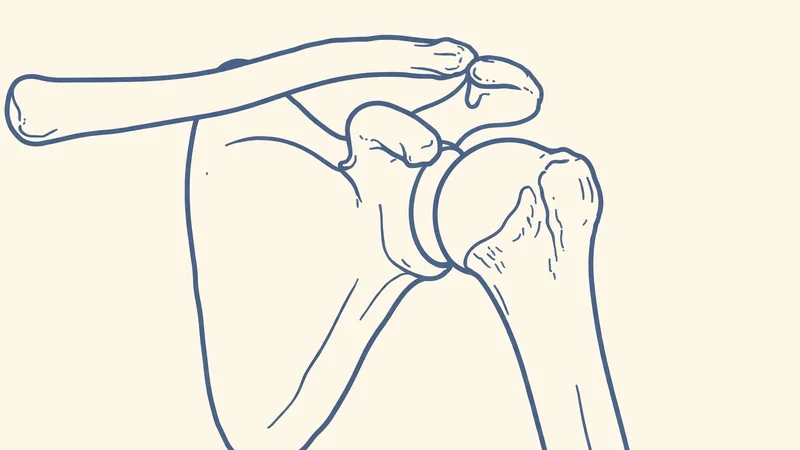
The AC joint stands for acromioclavicular. It joins the acromion, a bony point on top of the shoulder blade (scapula), to the collarbone (clavicle). It is small, but it sits right where the shoulder's load passes through, so it can be sore.
The joint is held together by ligaments. Those ligaments can be stretched or torn, most often after a fall onto the point of the shoulder.
Why it can hurt
Common triggers include a direct fall or bump, lifting or reaching with heavy effort, and gradual wear over the years. Pain is often felt on the top of the shoulder, and it can hurt when you reach across your body or lie on that side.
These patterns overlap with other shoulder problems. Only an examination can tell them apart.
What the research says
- AC joint specifics. There isn't strong research on AC joint treatments that we can cite here, so the closest evidence is about shoulder pain in general.
- Most shoulder pain is managed in primary care. Advice and exercise are the usual first steps, but acute, severe pain after an injury needs proper diagnosis [R30].
- Exercise helps shoulder pain in general. A 2025 review found that scapular stabilisation exercise improved pain and function in rotator cuff related pain. That review did not study the AC joint [R03].
- Shoulder problems often come with reduced joint position sense. Training that restores control tends to follow a sequence: range of motion, then strength, then control and coordination [R16]. A clinician decides where you are in that sequence.
What you can do
- Get assessed, especially after a fall. A bump with visible change, sudden weakness or a shoulder that looks out of shape needs prompt care [R30].
- Rest the activity that sets it off. Pause heavy lifting or reaching across the body until you have been assessed.
- Seated option: shoulder blade setting. Sit tall and gently draw your shoulder blades down and back. Hold briefly, then release. Stay in a comfortable range.
- Seated option: easy overhead reach. Only once a clinician has cleared it, slowly raise your arm within a pain-free range.
- Ask about the next step. Ask your clinician how to progress from gentle range to strength, and when to stop.
Where ShoulderBack Pro fits — and where it doesn't
The better first step here is an assessment and a clinician-guided plan, not a device. If a clinician later clears gentle, controlled movement, SeeSaw is the kind of general warm-up some people add, described on the routines page, and the trainer is on the shop page. It is a wellness tool, not a treatment for a joint injury.
When to see a professional
See a doctor or physiotherapist promptly if you have: pain after a fall or injury with sudden weakness or loss of movement; a shoulder that looks deformed, very swollen or bruised; fever or feeling unwell alongside the pain; chest pain or breathlessness (call emergency services); constant pain that doesn't change with rest or activity; pain that wakes you most nights; numbness, tingling or weakness into the arm or hand; pain in several joints at once; or pain that hasn't improved after a couple of weeks of sensible self-care.
A doctor, physiotherapist or sports clinician diagnoses AC joint problems, often with an examination and sometimes imaging.
Try this movement
SeeSaw (all scapular stabilizers) →Frequently asked questions
Can I exercise with AC joint pain?
Ask a clinician first. Gentle seated movement is often discussed, but only after an assessment confirms what is going on.
Is AC joint pain the same as a rotator cuff tear?
No. They are different structures. Only a clinician can tell which one, or both, is involved.
Will AC joint pain settle on its own?
Mild cases may ease, but no one can say how long without an assessment. Do not rely on time alone.
Sources
- Frontiers in Bioengineering & Biotechnology (2025). Specific modes of exercise to improve rotator cuff-related shoulder pain: systematic review and meta-analysis. https://pmc.ncbi.nlm.nih.gov/articles/PMC12011739/
- Mureşan et al. (2022). Effects of a novel proprioceptive rehabilitation device on shoulder joint position sense, pain and function. Medicina. https://www.ncbi.nlm.nih.gov/pmc/articles/PMC9505091/
- NHS Greater Glasgow & Clyde, Shoulder red flags; NHS MPFT self-help, Shoulder pain; BESS/BOA pathway summary (2021). https://pmc.ncbi.nlm.nih.gov/articles/PMC7905504