Shoulder anatomy & how it works
The Scapulohumeral Rhythm: How Shoulder Blade and Arm Move Together
6-minute read · Published December 22, 2025 · Updated December 22, 2025
Why this happens / What this is
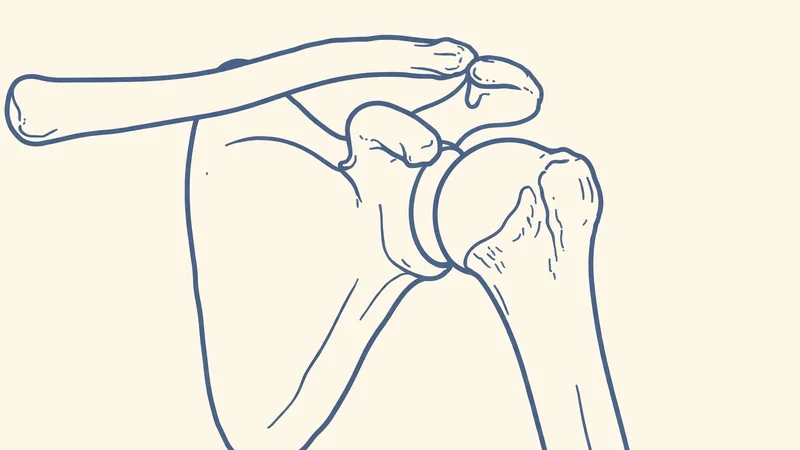
The shoulder is the most mobile joint in the body. The round head of the upper arm bone sits in a shallow socket on the shoulder blade. The socket is called the glenoid. Because the socket is shallow, the joint depends on muscles and tendons to keep it stable while it moves.
When you lift your arm, two things happen together. The arm bone rotates in its socket. The shoulder blade also tilts and rotates on the back of the ribcage, so the socket points upward. This teamwork is the scapulohumeral rhythm.
Several muscles do this work. The serratus anterior, the upper and lower trapezius, and the rhomboids all help guide the shoulder blade. If one group is weak, tight or slow to switch on, the rhythm may change. Textbooks describe this teamwork in simple terms, and people move in slightly different ways.
To learn the muscles in more detail, see 17 muscles of the shoulder blade.
What the research says
- In a 2025 review of exercise types, scapular stabilization exercise, which trains the muscles around the shoulder blade, improved pain and function in rotator cuff-related shoulder pain [R03].
- Shoulder problems are often linked with reduced proprioception, which is your sense of joint position. Reduced proprioception can affect movement accuracy [R16].
- Rehab usually moves through stages: range of motion, then strength, then control and proprioception, then coordination [R16].
What you can do
- Feel the rhythm. Sit tall. Slowly lift one arm forward and up, and notice your shoulder blade shifting on your back. Keep the movement small and slow.
- Practise a seated table slide. Rest your forearm on a table and slide it forward and back. Watch how the blade moves with the arm. Keep the movement smooth.
- Activate the blade gently. Squeeze your shoulder blades together, hold briefly, then release slowly. This is already a seated movement, so sit with your back supported.
- Use a two-arm drill. Let one arm guide the other with slow, shared movement. The other arm supplies the resistance, so you can progress by resisting a little harder or moving through a bit more range.
- Build in stages. Start with range and control before adding effort [R16]. Increase only when the movement is smooth and pain-free.
- Learn the muscles. Pair these drills with 17 muscles of the shoulder blade so you know what you are working.
Where ShoulderBack Pro fits — and where it doesn't
Two of the 16 lessons map neatly onto this topic. SeeSaw has one arm guide the other through alternating reaches, designed to work the shoulder-blade stabilizers, and the self-set pace lets you slow down and watch the blade move. Around the World, one large unhurried circle, is designed to work the serratus anterior and lower trapezius, two key blade-rotating muscles. It's a wellness tool, not a treatment, and there are no clinical trials of it yet. Start with SeeSaw, or see the trainer in the shop.
When to see a professional
See a doctor or physiotherapist promptly if you have: pain after a fall or injury with sudden weakness or loss of movement; a shoulder that looks deformed, very swollen or bruised; fever or feeling unwell alongside the pain; chest pain or breathlessness (call emergency services); constant pain that doesn't change with rest or activity; pain that wakes you most nights; numbness, tingling or weakness into the arm or hand; pain in several joints at once; or pain that hasn't improved after a couple of weeks of sensible self-care.
Try this movement
SeeSaw (the muscles around the shoulder blade) →Frequently asked questions
Is the scapulohumeral rhythm a real thing?
Yes. It is a helpful way to describe how the shoulder blade and arm work together. Textbooks simplify it, and people move in slightly different ways.
Does a clicking shoulder mean something is wrong?
Clicks are common and often painless. If clicks come with pain, swelling or weakness, see a clinician.
Can I train this rhythm at home?
Yes. Slow, seated drills are a sensible start. Ask a physiotherapist first if you have pain or a past injury.
Who can check how my shoulder blade and arm move?
A physiotherapist or doctor can assess how your shoulder blade and arm move together and tell you what is limiting you.
Sources
- Frontiers in Bioengineering & Biotechnology (2025). Specific modes of exercise to improve rotator cuff-related shoulder pain: systematic review and meta-analysis. https://pmc.ncbi.nlm.nih.gov/articles/PMC12011739/
- Mureşan et al. (2022). Effects of a novel proprioceptive rehabilitation device on shoulder joint position sense, pain and function. Medicina. https://www.ncbi.nlm.nih.gov/pmc/articles/PMC9505091/