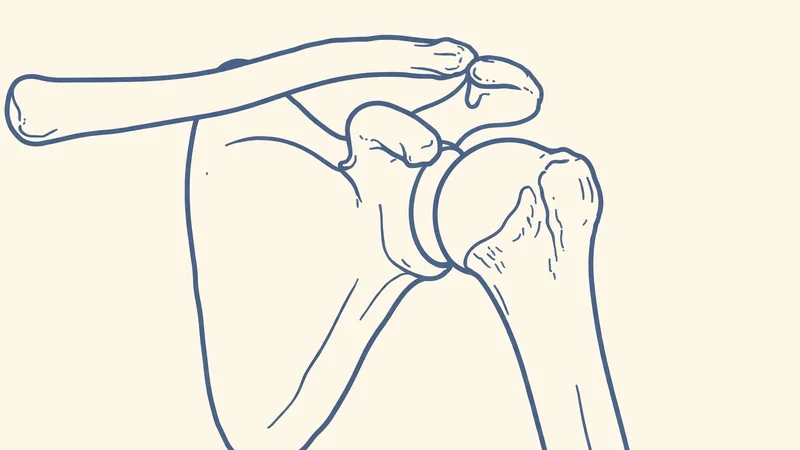
Shoulder anatomy & how it works
What Does the Rotator Cuff Actually Do? A Simple Guide
6-minute read · Published February 4, 2026 · Updated February 4, 2026

Why this happens / What this is
Your shoulder is a ball and socket joint. The ball is the top of your upper arm bone, called the humerus. The socket is a shallow cup on your shoulder blade, called the scapula.
Because the socket is shallow, the joint depends on muscles to hold the ball in place. That is why the rotator cuff matters so much. Its key members include:
- Supraspinatus: helps start lifting your arm out to the side.
- Infraspinatus and teres minor: help turn your arm outward, as when you open a car door.
- Subscapularis: helps turn your arm inward, toward your body. It sits on the front of the shoulder blade.
Each muscle ends in a tendon. A tendon is a tough cord that joins muscle to bone. Together, these tendons form a cuff over the ball of the joint.
When the cuff gets irritated, clinicians often use the term rotator cuff-related shoulder pain. It is the most common cause of shoulder pain [R03]. It can include a few different problems:
- Irritation of the tendon, sometimes called tendinopathy.
- Pain when the tendon rubs or pinches under the bony top of the shoulder as you lift.
- A tear, which can be partial or full thickness.
Each problem can feel different. Some people notice pain when reaching overhead. Others notice it when they sleep on one side, or after a sudden lift. Patterns like these are useful clues. They are not a diagnosis.
What the research says
- Resisted exercise that gets harder over time probably helps. Gentle movement with no load probably does not change pain much [R01].
- Some specific exercise types look promising. A 2025 review found that mobilization and stretching, scapular stabilization work and grip exercise were each linked with better pain or function [R03].
- Control may matter. Programs that focus on motor control, meaning how well your brain and muscles coordinate movement, may reduce disability a little more than generic exercise. The effect on pain is uncertain [R02].
- Position sense may be part of the picture. Shoulder disorders are linked with reduced joint position sense, which is your body's sense of where a joint is in space [R16].
- Exercise helps many older adults. Exercise programs reduced pain and improved function and range of motion in middle-aged and older adults with this type of pain [R04].
These findings are about exercise in general. None of them is a study of a single device.
What you can do
- Track your pattern for a week. Note the movements that hurt, such as reaching overhead, sleeping on one side or lifting a bag. Seated option: keep the notes in your favourite armchair, with a notebook or phone.
- Keep the shoulder blade moving. Sit tall with your arms relaxed. Gently draw your shoulder blades back and down, hold for a few breaths, then let go. Stay well short of pain. Seated option: this move is already done sitting.
- Add gentle resistance as you improve. Resisted work that progresses over time has the better evidence [R01]. Options include a light resistance band, a full water bottle, or pressing one arm against the other. Start light, keep control, and progress by resisting a little harder or doing longer sets.
- Go slowly. Smooth, controlled movement is easier to repeat than fast, forceful movement. Seated option: most of these moves can be done sitting, with your back supported.
- Stop and get help if pain rises. If pain sharpens, wakes you at night, or your arm feels weak, stop and speak with a clinician.
Where ShoulderBack Pro fits — and where it doesn't
Two of the trainer's 16 exercises relate to the cuff. SeeSaw has one arm guide the other through gentle reaches, which practises shoulder blade control, and Windshield Wipers uses slow side-to-side arcs designed to work the cuff muscles that turn the arm (subscapularis, infraspinatus and teres minor). The other arm provides the resistance through a fixed strap, so you set the effort. Start with SeeSaw, seated or standing.
It is a wellness tool, not a treatment, and it has no clinical trials. It does not address a torn tendon or a stiff, painful shoulder, so see a clinician for those. The trainer is available in the shop.
When to see a professional
See a doctor or physiotherapist promptly if you have: pain after a fall or injury with sudden weakness or loss of movement; a shoulder that looks deformed, very swollen or bruised; fever or feeling unwell alongside the pain; chest pain or breathlessness (call emergency services); constant pain that doesn't change with rest or activity; pain that wakes you most nights; numbness, tingling or weakness into the arm or hand; pain in several joints at once; or pain that hasn't improved after a couple of weeks of sensible self-care.
Only a doctor, physiotherapist or other qualified clinician can diagnose which part of the rotator cuff is involved, if any. Book a visit if you have any item in the box above.
Try this movement
SeeSaw (the muscles around the shoulder blade) →Frequently asked questions
Is the rotator cuff a single muscle?
No. It is a group of muscles and their tendons that work together around the shoulder joint.
Can I strengthen the rotator cuff at home?
Often, yes, and gradually. Resisted exercise that progresses over time has the better evidence. A clinician can help you choose a safe starting point.
Does resting the shoulder solve the problem?
Rest can calm some irritation, but it is not a reliable plan on its own. If pain persists, get it checked rather than waiting it out.
Sources
- Frontiers in Bioengineering & Biotechnology (2025). Specific modes of exercise to improve rotator cuff-related shoulder pain: systematic review and meta-analysis. https://pmc.ncbi.nlm.nih.gov/articles/PMC12011739/
- Naunton J et al. (2020). Effectiveness of progressive and resisted and non-progressive or non-resisted exercise in rotator cuff related shoulder pain: systematic review and meta-analysis of RCTs. Clinical Rehabilitation. https://search.pedro.org.au/search-results/record-detail/61404
- Dubé M-O et al. (2024). The Efficacy of Exercise Therapy for Rotator Cuff-Related Shoulder Pain According to the FITT Principle: Systematic Review With Meta-analyses. JOSPT. https://pubmed.ncbi.nlm.nih.gov/38848304/
- BMC Musculoskeletal Disorders (2026). Exercise interventions for rotator cuff-related shoulder pain in middle-aged and older adults: systematic review and meta-analysis. https://link.springer.com/10.1186/s12891-026-10035-4
- Mureşan et al. (2022). Effects of a novel proprioceptive rehabilitation device on shoulder joint position sense, pain and function. Medicina. https://www.ncbi.nlm.nih.gov/pmc/articles/PMC9505091/