Shoulder anatomy & how it works
How the Shoulder Works: A Plain-Language Guide to the Most Mobile Joint in Your Body
11-minute read · Published June 1, 2026 · Updated June 1, 2026

Your shoulder is not one joint. It is a team of joints, muscles and soft tissues. Together they let you reach for a coffee cup, scratch your back and wave to a grandchild across the room.
This guide walks through the parts, how they work together, what the research says, and where a tool like ShoulderBack Pro may or may not fit. If you are looking for the shoulder blade muscles in detail, see the 17 muscles that attach to your shoulder blade.
Why this happens: a ball, a shallow socket and a team of helpers
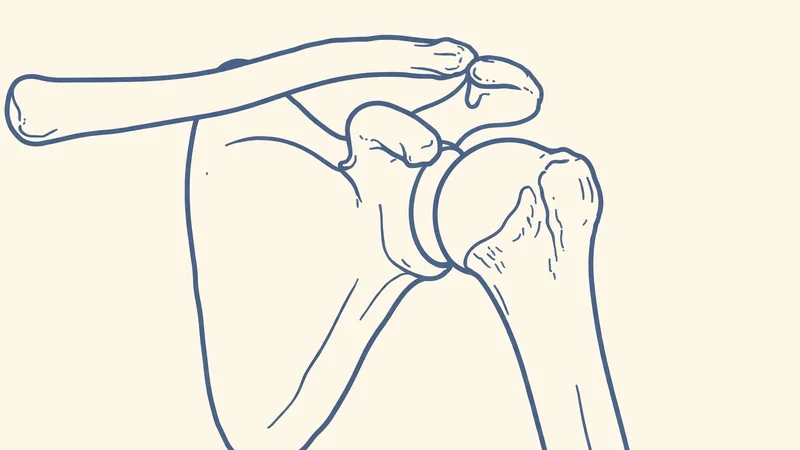
The main shoulder joint is where the upper arm bone meets the shoulder blade. The round top of the upper arm bone is called the humeral head. It sits in a shallow socket on the shoulder blade called the glenoid.
Picture a ball resting on a saucer rather than sitting deep in a cup. That shallow fit is what lets the arm swing in almost every direction.
The trade-off is simple. A shallow socket gives range but not much built-in stability. Something else has to keep the ball centred while the arm moves. That job falls to:
- The rotator cuff, a group of small muscles and their tendons that wrap around the front, top and back of the joint.
- The labrum, a rim of cartilage that deepens the socket a little.
- The joint capsule, a sleeve of tough connective tissue around the joint.
- Ligaments, which connect bone to bone and limit extreme movement.
When these parts work well together, the arm moves smoothly. When one part is weak, stiff or overloaded, the whole system can feel off.
The bones that make up the shoulder
Three bones meet at the shoulder:
- The humerus: the upper arm bone.
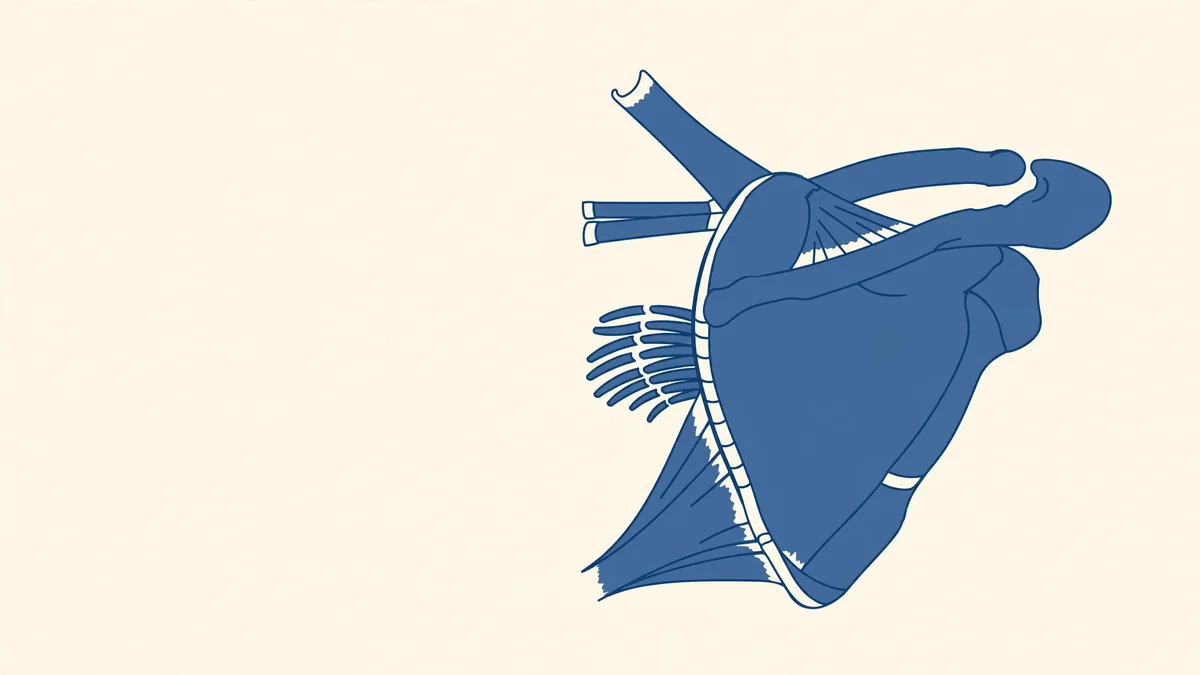
- The scapula: the shoulder blade, a flat, triangle-shaped bone on your upper back.
- The clavicle: the collarbone, which links the shoulder to the breastbone at the front of the chest.
The top of the shoulder blade has a bony point called the acromion. You can feel it at the very top of your shoulder. The collarbone meets the acromion at a small joint called the AC joint.
Unlike the hip, the shoulder blade is not locked into the ribcage. It glides across the back of the ribs and is held in place by muscles. Clinicians often describe the whole structure as the shoulder girdle.
The muscles that move and steady the arm
Several muscles do the work. Here are the main ones in plain terms:
- Deltoid: the rounded muscle over the top and outer shoulder. It lifts the arm out to the side and forward.
- Pectoralis major: the large chest muscle. It helps bring the arm across the body and toward the chest.
- Latissimus dorsi: the broad muscle of the mid and lower back. It helps pull the arm down and back.
- Trapezius: a large muscle across the upper back and neck. Its upper, middle and lower parts control the shoulder blade from different angles.
- Rhomboids: muscles between the shoulder blades that pull them toward the spine.
- Serratus anterior: a muscle along the side of the ribs that helps tilt the shoulder blade so the arm can reach overhead.
- Biceps and triceps: the front and back arm muscles that bend and straighten the elbow.
Muscles that position the shoulder blade are often called scapular stabilizers. Their job is to hold the shoulder blade in a good position so the arm has a steady base. Anatomy textbooks list many muscles that attach to the shoulder blade, and the exact count varies by source. What matters more is how they work together.
The shoulder blade is part of the joint
Many people think of the shoulder as the ball and socket alone. That leaves out the shoulder blade, which does a lot of the work.
When you lift your arm overhead, the shoulder blade also rotates and tilts upward. This movement turns the socket to face up, so the arm can go higher. Clinicians often describe this shared movement between the arm and the shoulder blade as the shoulder's coordinated rhythm.
If the shoulder blade does not move well, the arm can feel blocked, even when the joint itself is healthy. This is one reason shoulder exercise programs often include the shoulder blade, not just the arm.
Why the shoulder is so mobile, and what that costs
The shoulder is aimed at range. You can reach behind your back, up to a high shelf and out to the side in the same minute. Few other joints do this.
That freedom has a cost. Because the joint depends on muscles and soft tissue for stability, the shoulder is more vulnerable to overload, poor coordination and repeated strain than a joint like the hip. This does not mean the shoulder is fragile. It means that how you use it matters.
Common patterns include:
- Repeated overhead work, such as painting a ceiling, that tires the muscles over time.
- Long periods of sitting with the arms forward, which can change how the shoulder blade sits.
- A period of little use, after which the joint feels stiff and unfamiliar.
- A sudden fall or strain, which needs proper assessment.
Describing these patterns is not the same as diagnosing a problem. Only a clinician can do that.
Proprioception: the sense of where your arm is
Proprioception is your sense of where a joint is without looking at it. It is what lets you touch your nose with your eyes closed.
Research links shoulder problems with reduced joint position sense, and rehabilitation programs often include training for it [R16]. Rehab commonly moves from range of motion, to strength, and then to control and coordination [R16]. Think of it as learning to move well, not just moving more.
What the research says
Here is what the current evidence suggests, with the limits stated plainly.
- Resisted exercise that builds over time probably helps. A review of trials in rotator-cuff-related shoulder pain found that progressive, resisted exercise showed a benefit of uncertain clinical importance. Unloaded movement alone did not show a clear benefit on pain [R01].
- Control-focused programs may edge out generic exercise. Moderate-certainty evidence suggests motor-control programs reduce disability slightly more than non-specific exercise in the short and medium term. Effects on pain are uncertain, and we do not fully know why [R02].
- Shoulder blade exercise has some support. A 2025 review of specific exercise types found that scapular stabilization exercise improved pain and function [R03]. That review studied people with rotator-cuff-related pain, not healthy shoulders.
- Strength, mobility and posture are linked to shoulder pain in older adults. A 2026 narrative review found that these factors are each associated with shoulder pain and disability in adults 60 and over. The evidence on forward head posture in older adults is limited. These are associations, not proof that one causes the other [R28].
The main takeaway: the research supports exercise as part of care for many shoulder problems. It does not show that any single device or movement is a complete answer.
What you can do
These steps are safe starting points for most adults. Stop and talk to a clinician if pain is sharp, new, or wakes you at night.
- Learn your own range. Sit tall in a chair with your arms relaxed. Notice how far each arm moves forward, out to the side and up, without forcing. Move only as far as is comfortable.
- Practise moving both arms. Seated, let one arm guide the other through a slow, gentle reach. Two-arm movement can help with control and coordination.
- Add light resistance slowly. Resistance can come from a band, a movement trainer or your other arm pressing back. Increase it only when the movement feels controlled and steady.
- Wake up your shoulder blades. Seated, sit tall and let the shoulder blades draw gently down and back. Then let them relax. Small, slow movements are enough.
- Keep it short and regular. Many people find that a few minutes a day is easier to keep up than one long session. Choose movement you will actually repeat.
- Pay attention to pain. Mild effort is normal. Pain that rises sharply, lingers into the next day, or changes how you move is a signal to back off and get advice.

Where ShoulderBack Pro fits — and where it doesn't
SeeSaw is the closest match here. It is designed to work the shoulder-blade stabilizers by having one arm guide the other through slow reaches, and Open The Door is designed to work the small muscles at the back of the shoulder. Because the resistance comes from your other arm, you progress by resisting harder, moving through more range or doing longer sets. ShoulderBack Pro is a wellness tool with no clinical trials behind it, so it is not a treatment for any condition. If you have a diagnosis, follow your clinician's plan first. You can see ShoulderBack Pro here.
Frozen shoulder is a different matter. Research does not support simply waiting it out [R19], so a clinician should assess it before you try any new tool.
When to see a professional
See a doctor or physiotherapist promptly if you have: pain after a fall or injury with sudden weakness or loss of movement; a shoulder that looks deformed, very swollen or bruised; fever or feeling unwell alongside the pain; chest pain or breathlessness (call emergency services); constant pain that doesn't change with rest or activity; pain that wakes you most nights; numbness, tingling or weakness into the arm or hand; pain in several joints at once; or pain that hasn't improved after a couple of weeks of sensible self-care.
A doctor or physiotherapist is the person who diagnoses a shoulder condition. Most shoulder pain is first managed with advice and exercise [R30]. Sudden pain after trauma, nerve symptoms, or a shoulder that looks different needs proper assessment before you start anything new.
Try this movement
SeeSaw (the muscles around the shoulder blade) →Frequently asked questions
Why does my shoulder click?
Clicks without pain are common and are not usually a concern on their own. See a clinician if clicks come with pain, catching, swelling or weakness.
What is the difference between the rotator cuff and the shoulder blade?
The rotator cuff is a group of small muscles and tendons around the ball of the upper arm bone. The shoulder blade is a flat bone on your upper back that many of those muscles attach to. They work as one system.
Is the shoulder the most mobile joint in the body?
It is one of the most mobile. That range comes from a shallow socket, which means the shoulder depends on muscles and soft tissue for stability.
Can I exercise if my shoulder hurts?
Often yes, with a plan. Resisted exercise that progresses over time probably helps [R01], but the right starting load depends on your situation. Ask a clinician if you are unsure.
Does seated exercise count?
Yes. Seated movement can build control and range, and with resistance it can build strength too. A chair is a safe starting point for many people. The key is controlled effort that increases slowly over time.
Sources
- Naunton J et al. (2020). Effectiveness of progressive and resisted and non-progressive or non-resisted exercise in rotator cuff related shoulder pain: systematic review and meta-analysis of RCTs. Clinical Rehabilitation. https://search.pedro.org.au/search-results/record-detail/61404
- Dubé M-O et al. (2024). The Efficacy of Exercise Therapy for Rotator Cuff-Related Shoulder Pain According to the FITT Principle: Systematic Review With Meta-analyses. JOSPT. https://pubmed.ncbi.nlm.nih.gov/38848304/
- Frontiers in Bioengineering & Biotechnology (2025). Specific modes of exercise to improve rotator cuff-related shoulder pain: systematic review and meta-analysis. https://pmc.ncbi.nlm.nih.gov/articles/PMC12011739/
- Mureşan et al. (2022). Effects of a novel proprioceptive rehabilitation device on shoulder joint position sense, pain and function. Medicina. https://www.ncbi.nlm.nih.gov/pmc/articles/PMC9505091/
- Wong CK et al. (2017). Natural history of frozen shoulder: fact or fiction? A systematic review. Physiotherapy 103(1):40-47. https://pubmed.ncbi.nlm.nih.gov/27641499/
- PMC narrative review (2026). Body composition, strength, mobility and posture associated with shoulder pain and disability in community-dwelling older adults. https://www.ncbi.nlm.nih.gov/pmc/articles/PMC13513864/
- NHS Greater Glasgow & Clyde — Shoulder red flags; NHS MPFT self-help — Shoulder pain; BESS/BOA pathway summary (2021). https://pmc.ncbi.nlm.nih.gov/articles/PMC7905504