Coordination, control & how ShoulderBack Pro works
Assist and Resist: How One Arm Helps the Other Move
6-minute read · Published June 23, 2025 · Updated June 23, 2025
Why this happens
Think about how you lift a heavy bag with two hands. The stronger hand may take more of the load, but the weaker hand still helps steer and balance. Many clinicians think of the nervous system as good at sharing work between the two sides of the body.
That sharing is the idea behind assisted movement. One arm gives a little help, or a little resistance, while the other moves. The two arms coordinate, and the movement feels smoother and more deliberate.
This is called interlimb coordination, which simply means the two arms working together. It involves your brain, your nerves and your sense of joint position, which researchers call proprioception.
What the research says
- Bilateral, or two-arm, training produced greater shoulder-movement improvement than single-arm training in a study of chronic stroke patients. The authors describe this as interlimb coupling [R14]. This is evidence from stroke rehabilitation, not from healthy adults.
- Training that challenges joint position sense improved control in the trained wrist and in the untrained opposite wrist, a day later [R15]. The authors suggest the two sides of the body can learn from each other. That is a single study on wrists, so it should be read with care.
- Shoulder disorders often go with reduced proprioception, and rehabilitation usually moves from range of motion to strength, then to control and coordination [R16].
Taken together, these studies suggest that two-arm practice is worth exploring. They do not show that any particular device improves any particular shoulder.
What you can do
- Sit tall with support. Choose a chair with a back and place your feet flat. Relax your shoulders.
- Begin with the guiding arm. Use the arm that is more comfortable to gently guide the other through a small, slow movement.
- Let the working arm lead. Once it feels steady, let the working arm take the lead while the other follows lightly.
- Switch roles. Swap the arms so both sides practise each role.
- Keep effort mild. The goal is control, not strain. Stop before sharp pain.
- Keep sessions short. Two to five minutes is enough to start. Notice how the movement feels afterwards.
Where ShoulderBack Pro fits — and where it doesn't
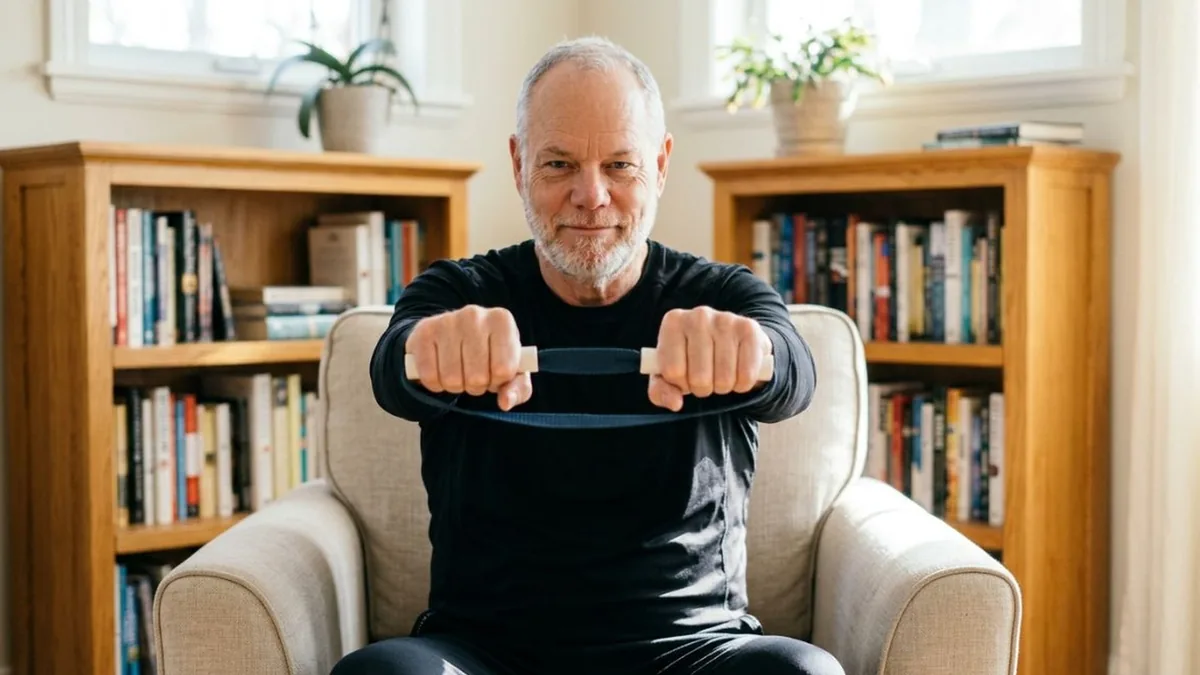
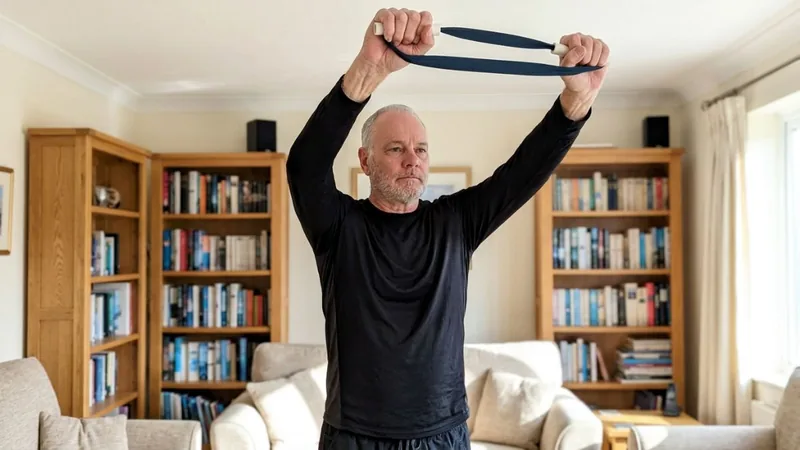
ShoulderBack Pro is built around this idea: a handle in each hand, joined by a fixed-length, non-elastic strap. One arm assists while the other resists, so the resistance comes from your own other arm and you set the effort, pace and range. To progress, resist harder, move through more range or do longer sets.
SeeSaw, where one arm guides the other through gentle alternating reaches, is a sensible first lesson, and Bicep Tricep (one arm curls while the other extends) shows the assist-and-resist idea most plainly. The stroke research above is not about ShoulderBack Pro. It is a wellness tool, not a treatment, and there are no clinical trials of it. ShoulderBack Pro is $29 CAD with a 30-day guarantee.
For a closer look at how the device's two handles work together, read how ShoulderBack Pro works.
When to see a professional
The red flags below follow standard shoulder-care guidance [R30]. If any of them apply, get assessed before you keep moving through the area.
See a doctor or physiotherapist promptly if you have: pain after a fall or injury with sudden weakness or loss of movement; a shoulder that looks deformed, very swollen or bruised; fever or feeling unwell alongside the pain; chest pain or breathlessness (call emergency services); constant pain that doesn't change with rest or activity; pain that wakes you most nights; numbness, tingling or weakness into the arm or hand; pain in several joints at once; or pain that hasn't improved after a couple of weeks of sensible self-care.
If you have had a stroke, a fracture or surgery, follow the protocol your surgeon or physiotherapist has given you, and use assisted movement only if they approve.
Try this movement
All 16 video lessons →Frequently asked questions
Is assisted exercise the same as resistance training?
Not quite. Assisted movement guides an arm through a motion, while resistance training adds load that the muscle works against. Both can be part of a plan, and a clinician can help you decide the balance.
Does training both arms help the untrained side?
Some research suggests the two sides of the body can share gains. One study of wrist training found changes in the untrained wrist [R15]. That is an interesting finding, not proof for shoulder training.
Is two-arm training only for stroke recovery?
The strongest evidence for two-arm training comes from stroke rehabilitation [R14]. Whether healthy adults benefit in similar ways is not yet known.
Can I try this seated?
Yes. Sitting tall with back support is a good place to start, and it keeps the movement easy to control.
Sources
- Journal of Physical Therapy Science (2016). The effects of bilateral movement training on upper limb function in chronic stroke patients. https://pmc.ncbi.nlm.nih.gov/articles/PMC5011582
- Scientific Reports (2021). Proprioceptive-focused training transfers gains to the opposite, untrained limb. https://pmc.ncbi.nlm.nih.gov/articles/PMC7935923
- Mureşan et al. (2022). Effects of a novel proprioceptive rehabilitation device on shoulder joint position sense, pain and function. Medicina. https://www.ncbi.nlm.nih.gov/pmc/articles/PMC9505091/
- NHS Greater Glasgow & Clyde, Shoulder red flags; NHS MPFT self-help, Shoulder pain; BESS/BOA pathway summary (2021). https://www.nhsggc.scot/page_category/services/page/33
More in this topic
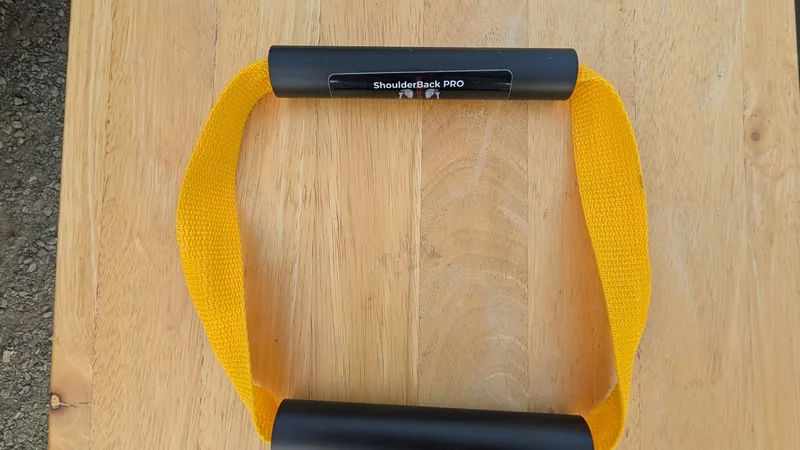 Essential guide: How ShoulderBack Pro Works: One Device, Two Connected Handles, Your Own Resistance
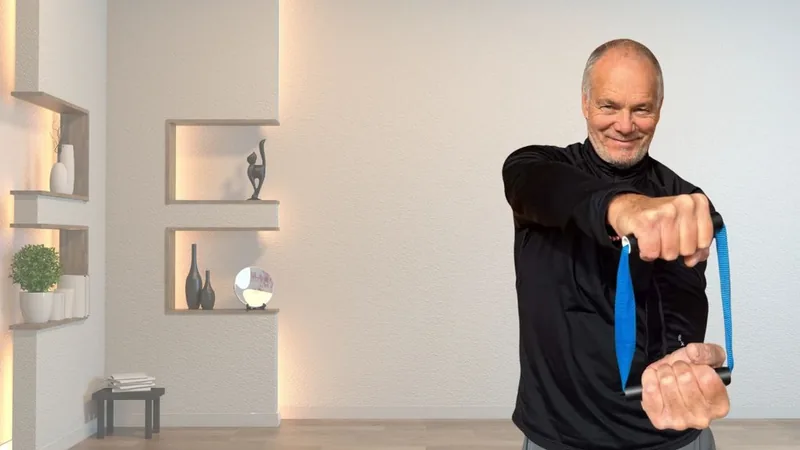 Pairing SBP With Walking: The Simplest Whole-Body Routine for Active Aging
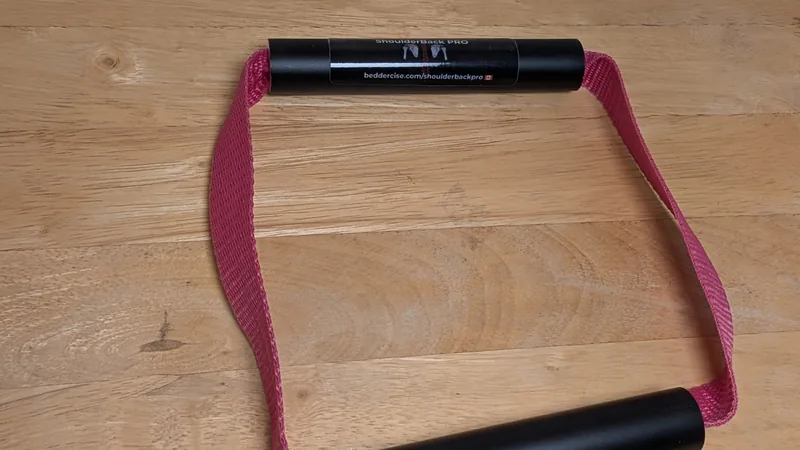 Locomotive: Rolling Circles for the Upper Back and Rear Cuff
 Overhead Press (High Shelf Reach): Trapezius and Deltoids Without a Weight