Shoulder anatomy & how it works
The 17 Muscles That Attach to Your Shoulder Blade (and What Each One Does)
10-minute read · Published June 2, 2026 · Updated June 2, 2026

If you want the wider picture first, start with our pillar guide, How the Shoulder Works. For the rotator cuff alone, read What Does the Rotator Cuff Actually Do?, and for the blade's movement, see Scapula 101.
Why this happens: the shoulder blade is a moving base
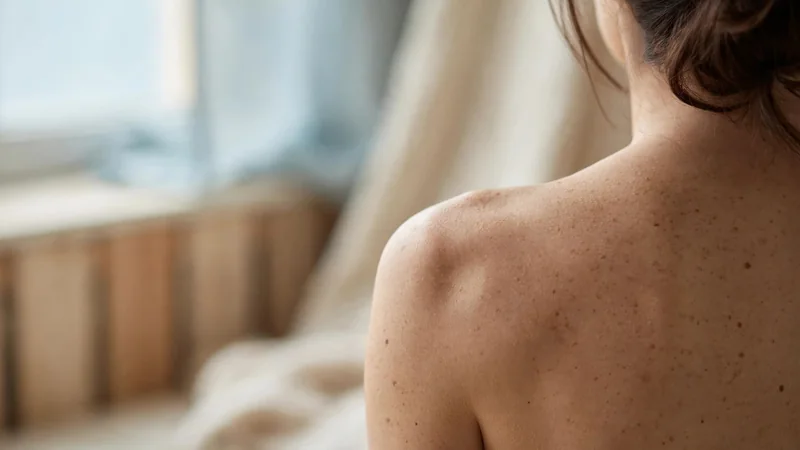
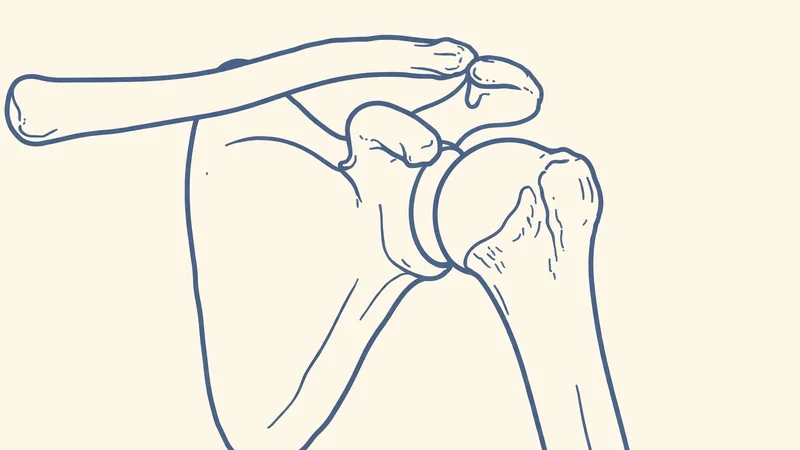
Your shoulder blade is a flat, triangle-shaped bone on the upper back. It is not fixed to your ribs the way a skull sits on the spine. It floats on the back of the rib cage, held in place by muscle.
That design is useful. It lets your arm reach far in many directions. The socket where the arm bone (the humerus) meets the blade is shallow. So the blade has to tilt, slide and rotate to keep the ball of the joint in a good position as you move.
Physiotherapists often describe the blade as the base the arm works from. When the base moves well, the arm has a stable platform. This is a helpful way to think about it. It is still a model, and we do not know for certain how each person's pain connects to how their blade moves.
The main muscle groups
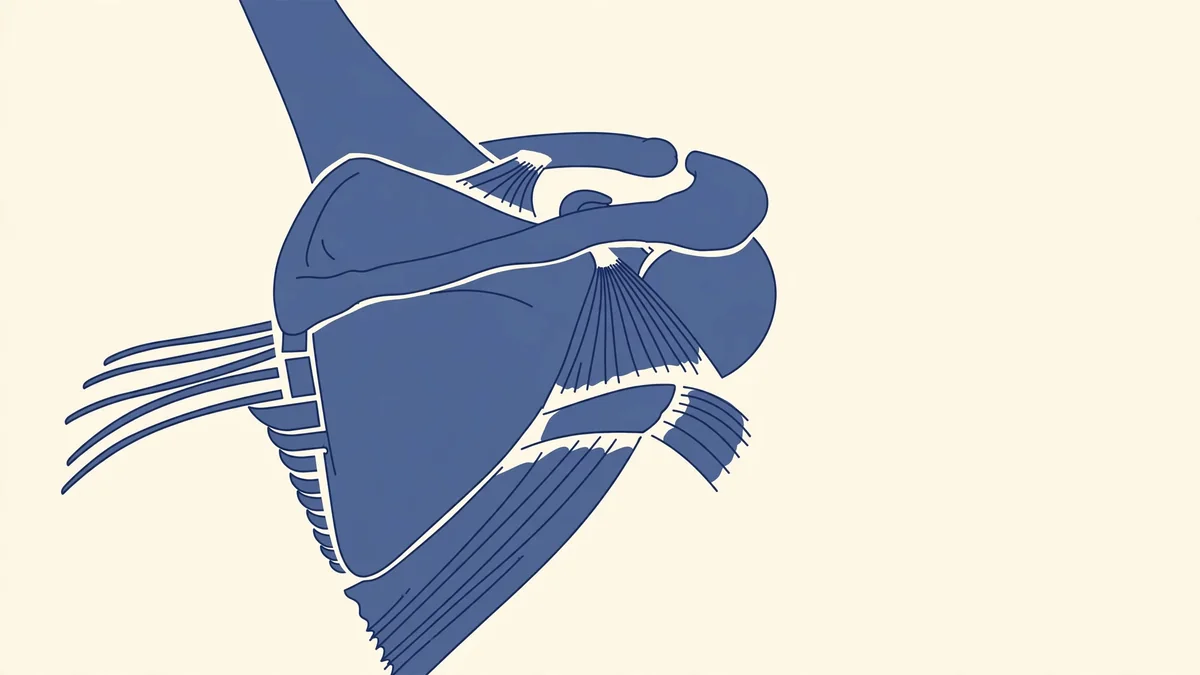
Muscles are easier to remember by their job than by their Latin names. The list below covers the major muscles that attach to the blade. Some textbooks include a few more, and the total of seventeen depends on how you count. Do not worry about memorizing every name.
Muscles on the back of the blade
- Trapezius (upper, middle and lower): a large, flat muscle across the upper back and neck. The upper part lifts the blade. The middle part pulls it toward the spine. The lower part pulls it down and helps the arm rise overhead.
- Rhomboids (major and minor): sit between the blade and the spine. They pull the blade back and toward the midline.
- Levator scapulae: runs from the side of the neck to the top inner corner of the blade. It lifts the blade and helps tilt the neck. Many people feel it after long hours at a screen.
- Supraspinatus: sits in the hollow above the spine of the blade. It helps start lifting the arm out to the side.
- Infraspinatus and teres minor: sit behind the blade. They turn the arm outward.
- Teres major: a small muscle on the lower outer edge of the blade. Sometimes called the "little lat," it helps bring the arm down and in.
- Deltoid (back fibres): the back part of the shoulder cap. It attaches to the spine and top of the blade, and helps move the arm backward.
Muscles on the front of the blade
- Subscapularis: the largest rotator cuff muscle, lying on the front surface of the blade. It turns the arm inward and helps keep the ball of the joint centred in its socket.
- Serratus anterior: a fan-shaped muscle that wraps around the side of the ribs. It pulls the blade forward around the rib cage and lifts it so the arm can reach overhead. Boxers use it when they punch forward, which is why it is nicknamed the "boxer's muscle."
- Pectoralis minor: a small chest muscle that attaches to a bony hook at the front of the blade. It pulls the blade forward and down.
- Coracobrachialis and the long heads of the biceps and triceps: arm muscles that start at the blade. They help move the arm forward, bend the elbow and steady the joint.
The rotator cuff: four muscles that steady the ball
The rotator cuff is a group of four muscles: the supraspinatus, infraspinatus, teres minor and subscapularis. Their job is to keep the ball of the arm joint steady while the larger muscles move the arm. They sit on the top, back and front of the blade, so they overlap with the list above.
When people talk about "rotator cuff exercises," they usually mean exercises for these four muscles. Much of the blade work in this article is about the muscles that position the blade, which is a related but different job.
What the research says
Most research looks at groups of muscles and whole movement programs, not at single muscles on their own. These points are the most useful:
- A 2025 review of specific exercise types found that scapular stabilization exercise, which trains the muscles that control the blade, was linked to better pain and function [R03].
- Shoulder problems often come with reduced joint position sense, which is the body's sense of where the joint is in space. Many rehab programs move in steps: range of motion first, then strength, then control and coordination [R16].
- In adults aged 60 and older, strength, mobility, body composition and posture are each linked to shoulder pain and disability. The evidence on forward head posture in older adults is limited and indirect [R28].
- Programs that focus on motor control may edge out generic exercise for disability in the short and medium term. The reason is not fully clear [R02].
None of these studies is about ShoulderBack Pro specifically. They describe exercise in general.
What you can do
Start slowly. Stop if a movement causes sharp pain, and ask a clinician if pain lingers after you finish. Each of these steps has a seated option.
- Find your blade. Sit tall in a chair with back support. Place your left hand on the top of your right shoulder blade. Slowly reach your right arm across your chest and feel the blade slide around the rib cage. Repeat three times, then switch sides. Standing works too.
- Try a seated blade slide. Sit with your arms relaxed. Draw both shoulder blades gently down and back, as if sliding them into your back pockets. Hold for three seconds and release. Repeat eight times.
- Notice the lift. Many people hold tension in the upper trapezius all day. Shrug your shoulders up only a little, then let them drop slowly. Do this five times, paying attention to how the release feels.
- Draw your elbows back. Sit with elbows bent at your sides. Gently pull your elbows back, as if closing a drawer behind you. Keep your neck long. Hold briefly and return.
- Build slowly. Use these movements on most days. If you feel fine the next day, add a repetition or two each week. If the next day is worse, go back to the last comfortable level.

Where ShoulderBack Pro fits, and where it doesn't
SeeSaw is the movement that fits this topic. It is designed to work the shoulder-blade stabilizers together, with one arm guiding the other through slow reaches while the blade moves with each one. Around the World is a good second choice for the serratus anterior and lower trapezius. The resistance comes from your other arm, so you progress by resisting harder, moving through more range or doing longer sets. Both can be done seated or standing.
It cannot tell you which muscle is weak or irritated, and it is a wellness tool with no clinical trials, not a treatment for a tear or diagnosed condition. A clinician can assess that. If you are curious, ShoulderBack Pro is here.
When to see a professional
See a doctor or physiotherapist promptly if you have: pain after a fall or injury with sudden weakness or loss of movement; a shoulder that looks deformed, very swollen or bruised; fever or feeling unwell alongside the pain; chest pain or breathlessness (call emergency services); constant pain that doesn't change with rest or activity; pain that wakes you most nights; numbness, tingling or weakness into the arm or hand; pain in several joints at once; or pain that hasn't improved after a couple of weeks of sensible self-care.
A doctor or physiotherapist is the person who can diagnose what is behind shoulder pain. Reading about muscles cannot do that for you.
Try this movement
SeeSaw (the muscles around the shoulder blade) →Frequently asked questions
Are the shoulder blade muscles the same as the rotator cuff?
No. The rotator cuff is four muscles that wrap around the ball of the arm joint. Most of the other muscles on the shoulder blade move the blade itself, though a few do both jobs.
Can I feel these muscles myself?
Some, yes. The upper trapezius sits close to the surface and is easy to find. The serratus anterior and subscapularis are deeper, so a clinician can show you what you are feeling.
Do I need to know all of them to exercise?
No. Most people do well with a few simple movements that use several of these muscles together. Naming them is optional.
Is a tight shoulder blade always a problem?
Not necessarily. Feeling tight is common and does not always mean something is damaged. The research on posture and pain is mixed.
Where should I start if my shoulder hurts?
See a doctor or physiotherapist for a proper look, especially if the pain is new, severe, or wakes you at night.
Sources
- Dubé M-O et al. (2024). The Efficacy of Exercise Therapy for Rotator Cuff-Related Shoulder Pain According to the FITT Principle: Systematic Review With Meta-analyses. JOSPT. https://pubmed.ncbi.nlm.nih.gov/38848304/
- Frontiers in Bioengineering & Biotechnology (2025). Specific modes of exercise to improve rotator cuff-related shoulder pain: systematic review and meta-analysis. https://pmc.ncbi.nlm.nih.gov/articles/PMC12011739/
- Mureşan et al. (2022). Effects of a novel proprioceptive rehabilitation device on shoulder joint position sense, pain and function. Medicina. https://www.ncbi.nlm.nih.gov/pmc/articles/PMC9505091/
- PMC narrative review (2026). Body composition, strength, mobility and posture associated with shoulder pain and disability in community-dwelling older adults. https://www.ncbi.nlm.nih.gov/pmc/articles/PMC13513864/