Shoulder anatomy & how it works
Middle Trapezius: The Muscle That Pulls Your Shoulder Blades Together
4-minute read · Published July 17, 2026 · Updated July 17, 2026
Why this happens / What this is
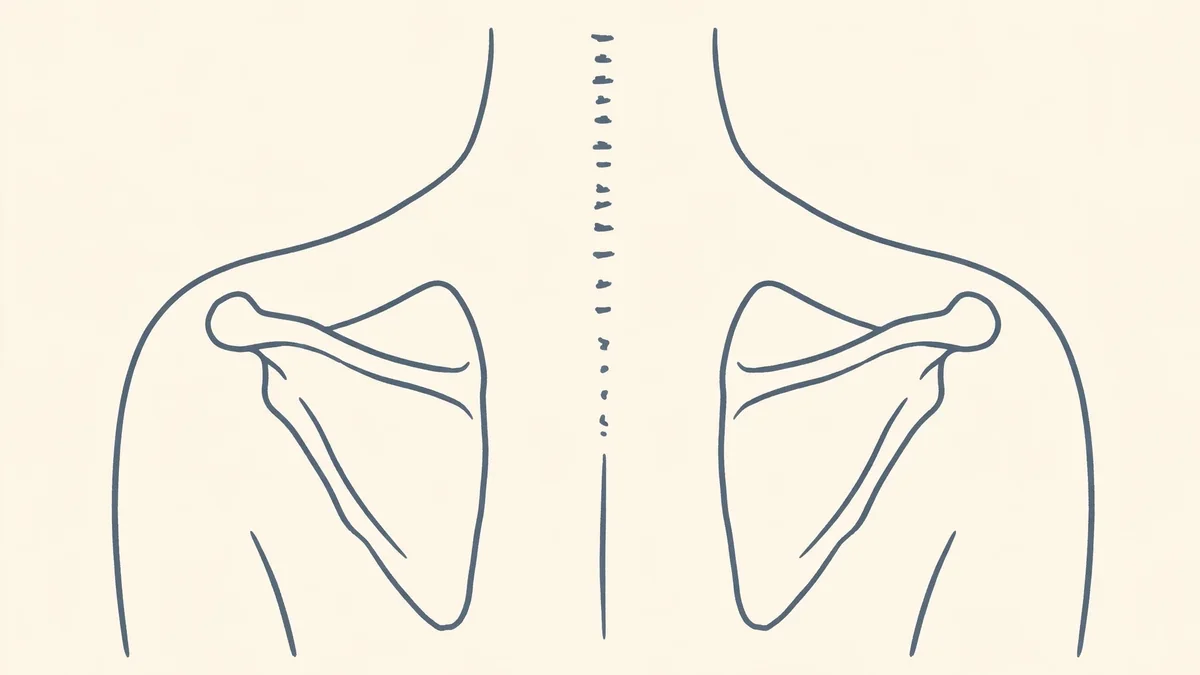
The trapezius is a large, flat muscle that covers the back of the neck and upper back. It has three main parts. The middle part sits between the shoulder blades.
Its job is to draw the shoulder blades together and help keep them steady. That steadiness supports the shoulder joint when you reach, lift or hold something.
Long sitting, with the shoulders rounded forward, can leave these muscles under-used. That is a pattern, not a diagnosis. A clinician can tell you whether your muscles are the issue.
What the research says
Scapular stabilization exercise, which trains the muscles that hold the shoulder blade in place, improved pain and function in a 2025 review of exercise types for rotator-cuff-related shoulder pain [R03]. The review looked at many muscles together, not the middle trapezius alone.
Strength, mobility, body composition and posture are each associated with shoulder pain and disability in adults 60 and older [R28]. These are targets you can work on, but the review also says the evidence for posture specifically in older adults is limited and indirect.
So the middle trapezius is worth training as part of a balanced routine. It is not a single magic muscle.
What you can do
- Sit tall with back support. Keep your feet flat and your ribs stacked over your hips.
- Draw the shoulder blades gently together. Imagine sliding them toward your back pockets, without shrugging.
- Practise a rowing-style pull. Use light resistance (a band, or your other arm pushing back), pull toward your chest, and pause briefly.
- Open out slowly. Let your arms return with control, breathing as you go.
- Stop before sharp pain. Mild muscle effort is normal. Sharp pain or numbness is a reason to get checked.
Where ShoulderBack Pro fits, and where it doesn't
Bear Hugs Me is the closest match. You draw the trainer toward your chest, and the site lists the middle trapezius and rhomboids as its targets. The resistance comes from your other arm, so you can make it harder by resisting more, moving through more range, or doing longer sets.
SeeSaw is a gentler second option that works the wider group of shoulder blade stabilizers. Both can be done in a chair. The trainer is a wellness tool, not a treatment, and it has no clinical trials yet.
When to see a professional
See a doctor or physiotherapist promptly if you have: pain after a fall or injury with sudden weakness or loss of movement; a shoulder that looks deformed, very swollen or bruised; fever or feeling unwell alongside the pain; chest pain or breathlessness (call emergency services); constant pain that doesn't change with rest or activity; pain that wakes you most nights; numbness, tingling or weakness into the arm or hand; pain in several joints at once; or pain that hasn't improved after a couple of weeks of sensible self-care.
Ongoing upper-back or shoulder pain belongs with a doctor or physiotherapist, who can assess the cause [R30].
Keep reading: Cluster guide · Lower trapezius · Rhomboids
Try this movement
SeeSaw (the muscles around the shoulder blade) →Frequently asked questions
Where is the middle trapezius?
It sits across the middle of your upper back, between your shoulder blades. It helps draw the shoulder blades together and keeps them steady.
Why do people say it is weak?
Long sitting and rounded positions can make these muscles less used. Many clinicians suggest training them, though the link between weakness and pain is still being studied.
What is a good seated exercise?
Try Bear Hugs Me: draw the trainer toward your chest, then open out slowly, breathing wide. Stop before any sharp pain.
Sources
- Frontiers in Bioengineering & Biotechnology (2025). Specific modes of exercise to improve rotator cuff-related shoulder pain: systematic review and meta-analysis. https://pmc.ncbi.nlm.nih.gov/articles/PMC12011739/
- PMC narrative review (2026). Body composition, strength, mobility and posture associated with shoulder pain and disability in community-dwelling older adults. https://www.ncbi.nlm.nih.gov/pmc/articles/PMC13513864/
- NHS Greater Glasgow & Clyde — Shoulder red flags; NHS MPFT self-help — Shoulder pain; BESS/BOA pathway summary (2021). https://www.nhsggc.scot/page_category/services/page/33