Coordination, control & how ShoulderBack Pro works
Can You Use ShoulderBack Pro Seated? Every Movement, From an Armchair
5-minute read · Published November 24, 2025 · Updated November 24, 2025
Why this happens / What this is
Many people want to train from a chair, for comfort, balance or because standing is hard. That is a sensible choice. Resistance training guidance for older adults says barriers and fears should be addressed, and a seated option is one practical way to do that [R06].
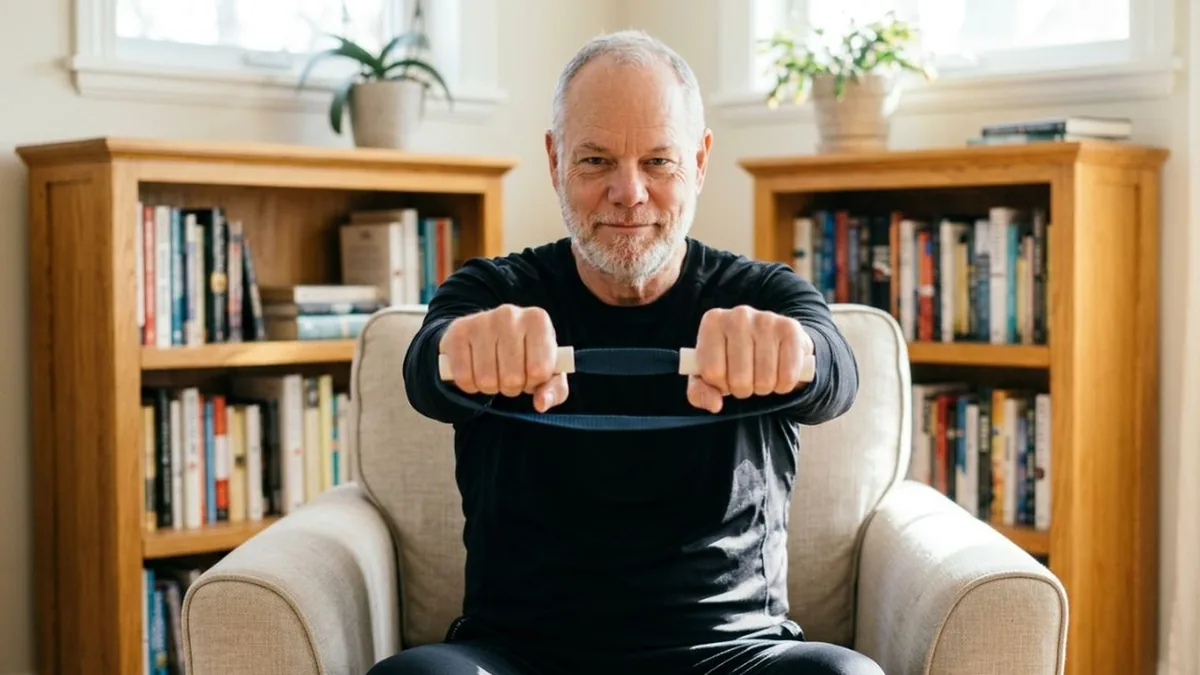
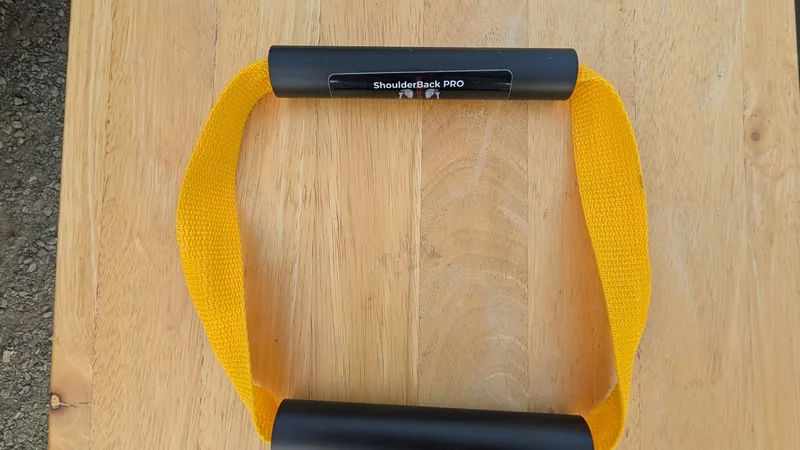
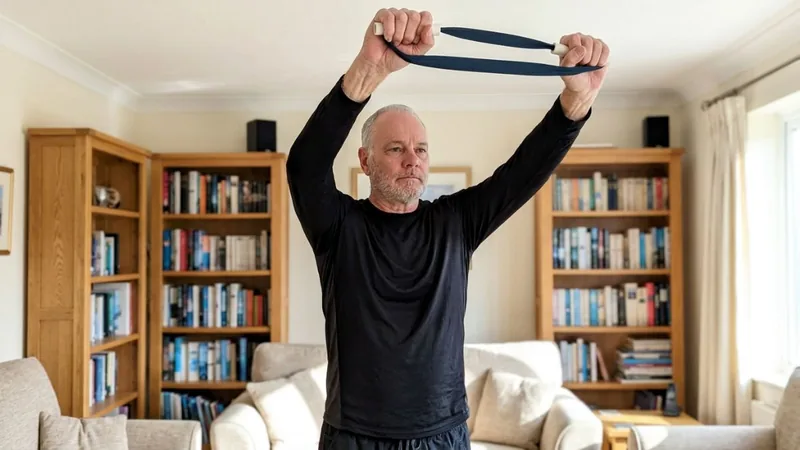
ShoulderBack Pro is aimed at this. The two handles are joined by a fixed-length, non-elastic strap. One arm assists while the other resists. Nothing stretches, snaps or drops, and no door anchor or weight is needed.
That makes it easy to set up in a chair. You sit, hold the handles, and control the movement with your own effort.
What the research says
Resisted exercise that progresses over time probably helps rotator-cuff-related shoulder pain, while gentle unloaded movement alone probably does not [R01]. Seated, controlled work can still be resisted, because you choose how hard the other arm works.
The WHO recommends that adults do muscle-strengthening activity at least two days a week. Adults 65 and older should also do balance and strength work at least three days a week [R07].
These findings are about exercise in general. They are not studies of ShoulderBack Pro specifically, and there are no clinical trials of the device.
What you can do
- Set up in a stable chair. Choose one with a back. Sit tall with your feet flat on the floor.
- Start with the easiest effort. Set the resistance low and find a range that feels comfortable.
- Choose seated-friendly movements. Steering and Around the World work well in a chair, with the back supported.
- Keep the chest open. Avoid leaning forward to reach. Let the arms do the work, within a comfortable range.
- Build up slowly. Resist a little harder, or move through a bit more range, each week and stop before sharp pain or numbness.
Where ShoulderBack Pro fits, and where it doesn't
Seated use is what the trainer is designed for. It weighs 160 grams, is made in Canada, and comes with 16 free video lessons from its inventor, Van Hill, that you can follow from your armchair.
Arm Wrestler is a good chair movement: you pivot the forearms inward with the elbow as a hinge, and the site lists the pectoralis major and subscapularis as its targets.
It is a wellness product, not a medical device, and no clinical trial has studied it. It costs $29 CAD with a 30-day money-back guarantee, and the shop page has the rest.
When to see a professional
See a doctor or physiotherapist promptly if you have: pain after a fall or injury with sudden weakness or loss of movement; a shoulder that looks deformed, very swollen or bruised; fever or feeling unwell alongside the pain; chest pain or breathlessness (call emergency services); constant pain that doesn't change with rest or activity; pain that wakes you most nights; numbness, tingling or weakness into the arm or hand; pain in several joints at once; or pain that hasn't improved after a couple of weeks of sensible self-care.
Ask your doctor or physiotherapist before starting if you have had shoulder surgery, a recent fracture, or a condition they are managing. They decide what is safe for you.
Keep reading: Cluster guide · Seated strengthening for seniors · ShoulderBack Pro for beginners
Try this movement
All 16 video lessons →Frequently asked questions
Can every ShoulderBack Pro movement be done seated?
Many of them can be adapted to a chair with back support. Sit tall, keep your feet flat, and skip any movement that causes sharp pain or needs you to lean.
Do I need a door or anchor?
No. The trainer does not need door anchors, weights or a wall. One arm assists while the other resists, so it can be used in an armchair.
What chair should I use?
Use a stable chair with a back, feet flat on the floor, and armrests you can ignore. Avoid chairs that rock or roll.
Is seated use right for everyone?
Seated use is a sensible starting point for many people, but it is not a medical treatment. Check with your doctor or physiotherapist if you have a shoulder condition or have had surgery.
Sources
- Naunton J et al. (2020). Effectiveness of progressive and resisted and non-progressive or non-resisted exercise in rotator cuff related shoulder pain: systematic review and meta-analysis of RCTs. Clinical Rehabilitation. https://search.pedro.org.au/search-results/record-detail/61404
- Fragala MS, Cadore EL, Dorgo S et al. (2019). Resistance Training for Older Adults: Position Statement From the National Strength and Conditioning Association. J Strength Cond Res. https://pubmed.ncbi.nlm.nih.gov/31343601/
- WHO (2020). Guidelines on physical activity and sedentary behaviour. https://www.sydney.edu.au/news-opinion/news/2020/11/26/new-global-guidelines-on-physical-activity-and-sedentary-behavio.html
More in this topic
 Essential guide: How ShoulderBack Pro Works: One Device, Two Connected Handles, Your Own Resistance
 Pairing SBP With Walking: The Simplest Whole-Body Routine for Active Aging
 Locomotive: Rolling Circles for the Upper Back and Rear Cuff
 Overhead Press (High Shelf Reach): Trapezius and Deltoids Without a Weight