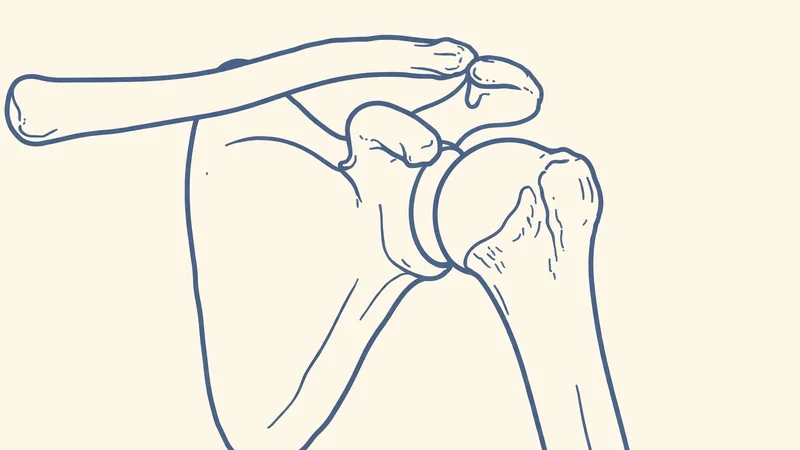
Shoulder anatomy & how it works
Tendons vs Ligaments vs Muscles: What Hurts in a Shoulder and Why It Matters
4-minute read · Published November 16, 2026 · Updated November 16, 2026

What this is
- Muscle: tissue that contracts to move a joint.
- Tendon: a tough cord that connects a muscle to bone.
- Ligament: a tough band that connects bone to bone and helps keep a joint stable.
- Joint capsule: a sleeve of tissue around the shoulder joint.
- Bursa: a small fluid-filled cushion that reduces friction.
For how the parts fit together, see the pillar How the Shoulder Works and the post on subscapularis.
Why the names matter
The right approach depends on which structure is involved, and only a clinician can work that out.
What the research says
- Rotator-cuff-related shoulder pain is common. It includes subacromial pain, tendinopathy (tendon irritation) and symptomatic tears [R03].
- Frozen shoulder involves excess scar tissue in the joint capsule, causing pain and loss of movement [R18]. That is a capsule problem, not a tendon problem. Research does not support simply waiting it out, so have a clinician assess it [R19].
- Most shoulder pain in primary care is managed with advice and exercise. Severe pain after an injury needs a proper diagnosis first [R30].
What you can do
- Get assessed if pain is new, severe or follows an injury. A clinician can check which structures are involved.
- Note what hurts and what is stiff. Pain on one reach and stiffness in every direction point in different directions.
- Ask directly: "Is this the tendon, the capsule, the joint or a nerve?"
- Start gently if cleared. Seated shoulder-blade squeezes are a low-load option.
- Build strength with a plan. Resisted, progressive exercise has the most support for rotator-cuff pain [R01]. Set it up with a clinician.
Where ShoulderBack Pro fits, and where it doesn't
The better first step is an assessment, because a movement trainer can't tell a tendon from a ligament or treat either one. If a clinician later clears gentle, controlled movement, the SeeSaw lesson is one optional general-conditioning exercise, and the trainer is in the shop.
When to see a professional
See a doctor or physiotherapist promptly if you have: pain after a fall or injury with sudden weakness or loss of movement; a shoulder that looks deformed, very swollen or bruised; fever or feeling unwell alongside the pain; chest pain or breathlessness (call emergency services); constant pain that doesn't change with rest or activity; pain that wakes you most nights; numbness, tingling or weakness into the arm or hand; pain in several joints at once; or pain that hasn't improved after a couple of weeks of sensible self-care.
If a structure is suspected to be torn, or movement has suddenly been lost, get seen promptly.
Try this movement
SeeSaw (the muscles around the shoulder blade) →Frequently asked questions
Can I tell which structure hurts by pressing on it?
Some clinicians use hands-on tests, but a guess at home is not reliable. Get it checked so the right structure is identified.
Is a tendon the same as a muscle?
No. A muscle creates movement. A tendon is the tough cord that connects that muscle to bone.
Does a ligament heal on its own?
It depends on what is injured and how badly. Ask your clinician, who can assess the structure and explain the options.
Sources
- Naunton J et al. (2020). Effectiveness of progressive and resisted and non-progressive or non-resisted exercise in rotator cuff related shoulder pain: systematic review and meta-analysis of RCTs. Clinical Rehabilitation. https://search.pedro.org.au/search-results/record-detail/61404
- Frontiers in Bioengineering & Biotechnology (2025). Specific modes of exercise to improve rotator cuff-related shoulder pain: systematic review and meta-analysis. https://pmc.ncbi.nlm.nih.gov/articles/PMC12011739/
- Le HV, Lee SJ, Nazarian A, Rodriguez EK (2017). Adhesive capsulitis of the shoulder: review of pathophysiology and current clinical treatments. Shoulder & Elbow 9(2):75-84. https://pubmed.ncbi.nlm.nih.gov/28405218/
- Wong CK et al. (2017). Natural history of frozen shoulder: fact or fiction? A systematic review. Physiotherapy 103(1):40-47. https://pubmed.ncbi.nlm.nih.gov/27641499/
- NHS Greater Glasgow & Clyde, shoulder red flags; NHS MPFT self-help, shoulder pain; BESS/BOA pathway summary (2021). https://pmc.ncbi.nlm.nih.gov/articles/PMC7905504