Coordination, control & how ShoulderBack Pro works
ShoulderBack Pro FAQ: 25 Questions Answered Honestly
9-minute read · Published October 8, 2025 · Updated October 8, 2025
What ShoulderBack Pro is
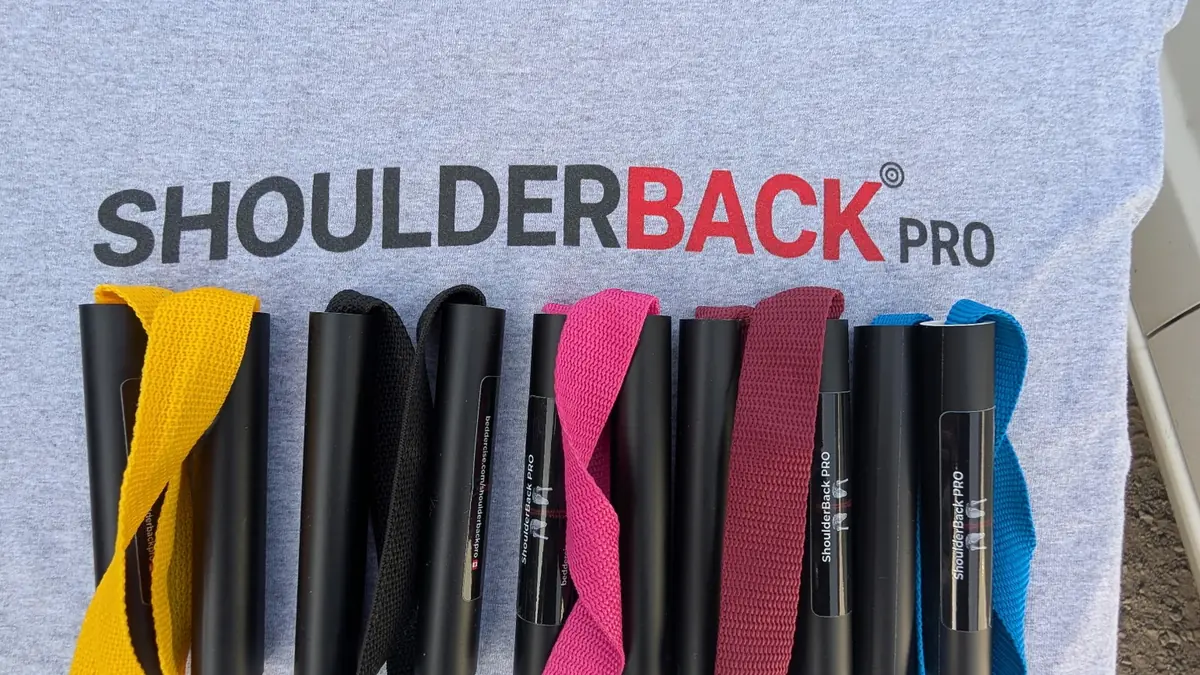
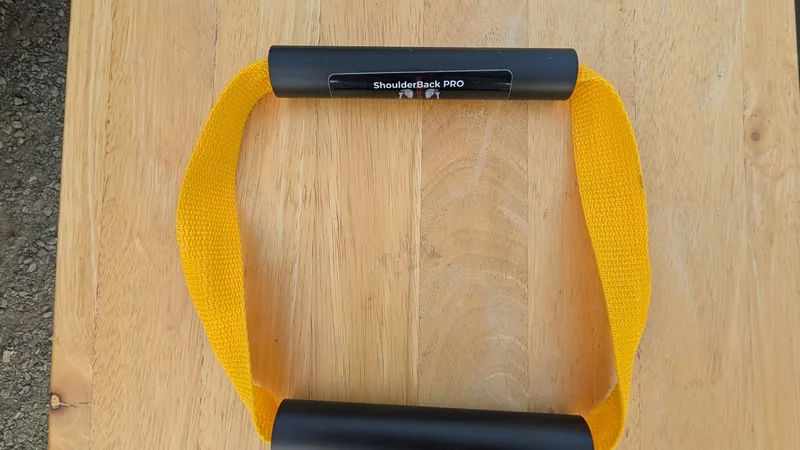
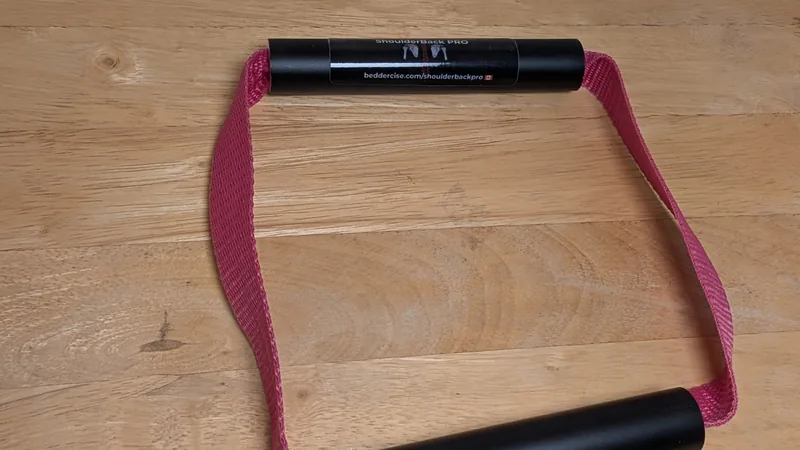
ShoulderBack Pro, which this article calls SBP, is a small trainer you hold in both hands. The two handles are joined by a strap that does not stretch. You control how much effort goes into each move, how fast you go, and how far you reach.
The idea is simple. One arm assists while the other resists. Your assisting arm guides the movement, and your working arm does the work at a level you set. The device is designed and assembled in Canada, and it weighs about 160 grams, so it fits in a pocket or a handbag.
Because you set the effort, pace and range, the same device can feel gentle on one day and more demanding on another. Bands often need a sturdy door, an anchor and a clear space to work in. SBP needs none of that. You can use it in an armchair, in a hotel room or on a balcony.
If you have used resistance bands before, you may wonder how the two compare. Read why resistance bands can irritate aging shoulders for one view. For the bigger picture of how the device works, read how ShoulderBack Pro works: one device, two connected handles.
The rotator cuff is a group of four small muscles that help hold the ball of the shoulder in its socket. Many of the questions people ask about SBP are really questions about that group of muscles, so the research below focuses on them.
Who it is for
Two groups tend to ask about SBP. The first is adults 55 and older who want gentle, seated movement they can keep doing for years. The second is adults aged 28 to 50 who sit at a desk, lift things, play sports, or care for someone else, and who want a short routine that needs no equipment.
Both groups share one need: controlled movement that is simple to repeat. Public health guidance recommends muscle-strengthening activity on at least two days a week for adults. Adults 65 and older should also do activity that builds balance and strength on at least three days a week [R07]. SBP is one tool for that kind of practice. It is not the only tool, and it may not be the right one for you.
What the research says
The research below is about exercise for shoulder pain in general. It is not about ShoulderBack Pro, and SBP has no clinical trials of its own. Keep that difference in mind as you read.
- Resisted exercise that progresses over time probably helps rotator-cuff-related shoulder pain. Gentle movement with no load probably does not do much for pain [R01].
- A 2025 review of exercise types found that scapular stabilization exercise, which trains the muscles that steady the shoulder blade, improved pain and function [R03].
- Programs that teach control and coordination may improve function a little more than generic exercise in the short and medium term. We do not fully know why [R02].
- Resistance training helps older adults keep muscle strength and supports daily function, mobility and independence [R06].
Van Hill, the inventor, says he "nursed back 2 rotator cuff issues on my own with persistence and patience." That is his personal experience. It is not study data. He also says, "I won't make medical promises; everyone's situation is different." That is the right way to read his story.
What you can do
Shoulder pain has many possible causes, so the steps below are general. They are not a diagnosis.
- Start seated. Sit in a sturdy chair with your back supported and your feet flat. Hold the trainer and move slowly. Seated practice keeps the focus on the shoulder.
- Keep the range small. Begin with a movement that feels easy. Stop before any sharp pain.
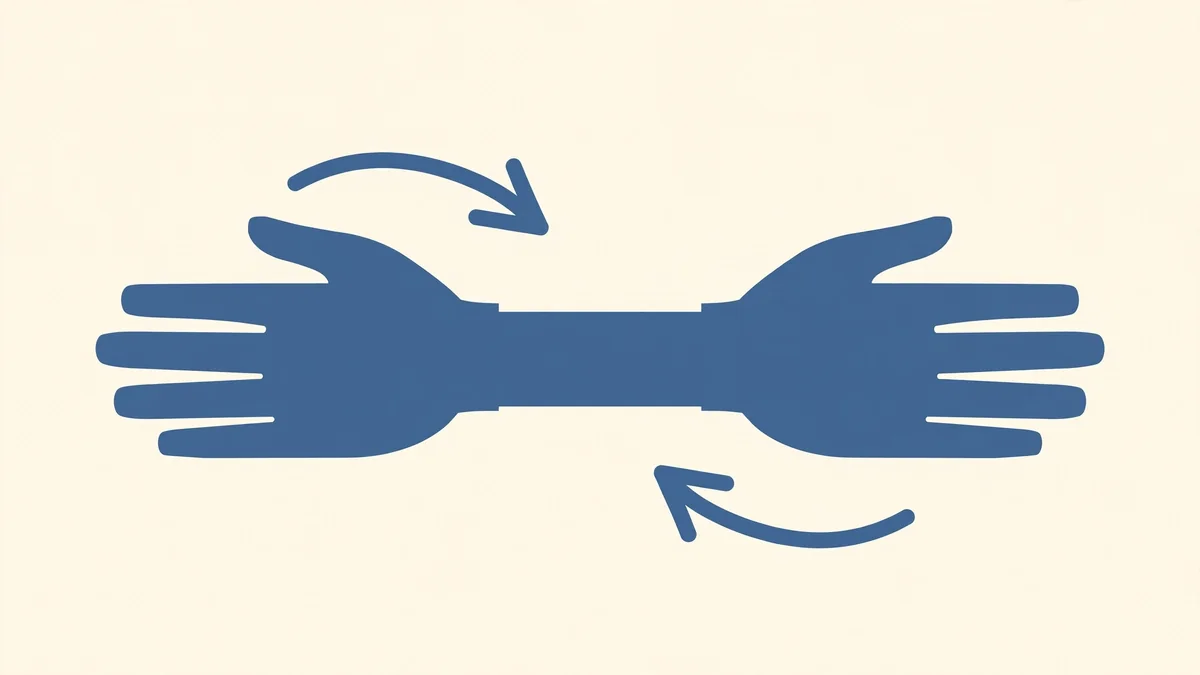
- Let the assisting arm guide. Use the assisting arm to set the path. The working arm should do a comfortable amount of work that you can control.
- Keep sessions short. Three minutes is enough to begin. Try the 3-minute morning armchair routine at the same time each day so it becomes a habit.
- Note how you feel the next morning. If pain rises from week to week, change the routine or see a clinician.
- Stand only when you are comfortable. Standing adds balance demands. Use a wall or counter for support if you need it.

Common mistakes at home
Most problems with a new routine come from doing too much, too soon. A few habits are worth watching for.
- Rushing the reps. Speed is not the goal. Slow movement lets you feel where the effort sits.
- Holding your breath. Breathe steadily through each move.- Forcing the range. A comfortable range is the target. Pain that sharpens is a signal to stop, not a challenge to push through.
- Turning every session into a test. One hard day does not mean progress. Short, steady sessions tend to serve people better than occasional long ones.
Safety checks before you start
Before your first session, check these points. Do not skip them just because the routine looks gentle.
- You have no recent fall or injury that still hurts or leaves you weak. If you do, see a clinician first.
- You have no new numbness, tingling or weakness in the arm or hand.
- If you have a diagnosed condition, recent surgery or a fracture history, a clinician has cleared gentle shoulder movement.
- A sturdy chair is within reach, so you can sit down at any point.
- You know which warning signs in the box below would mean stopping and calling a clinician.
Where ShoulderBack Pro fits, and where it doesn't
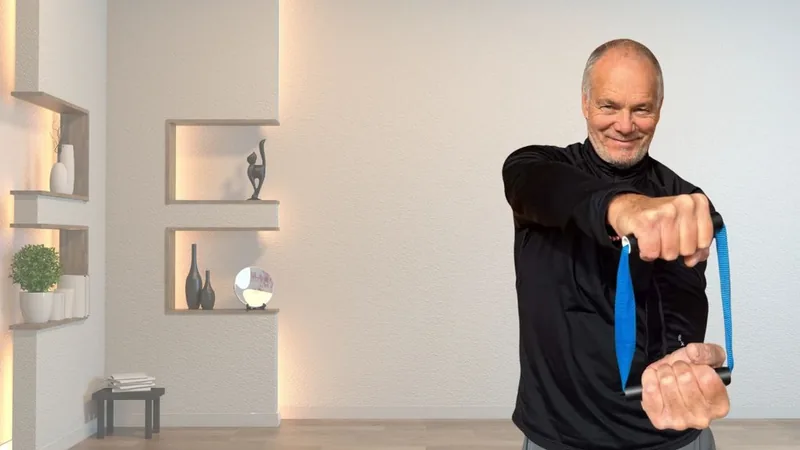
If you want a simple home routine that moves both arms with control, begin with SeeSaw, where alternating reaches let one arm guide the other, and Crosscuts, a diagonal glide the site lists as working the lats and the muscles that draw the shoulder blades together. The other arm supplies the resistance, so you make it harder by resisting more, moving through more range, or doing longer sets. All 16 movements are in the free video lessons.
It is a wellness tool, not a treatment for a rotator cuff tear, tendinopathy or any other diagnosed condition. That includes frozen shoulder, where research does not support waiting it out [R19], so have a clinician assess stiffness that is not improving. If you are cleared for gentle shoulder movement, you can order online for $29 CAD or call 1-800-555-0199; a 30-day guarantee gives a full refund.
When to see a professional
See a doctor or physiotherapist promptly if you have: pain after a fall or injury with sudden weakness or loss of movement; a shoulder that looks deformed, very swollen or bruised; fever or feeling unwell alongside the pain; chest pain or breathlessness (call emergency services); constant pain that doesn't change with rest or activity; pain that wakes you most nights; numbness, tingling or weakness into the arm or hand; pain in several joints at once; or pain that hasn't improved after a couple of weeks of sensible self-care.
These warning signs come from shoulder red-flag guidance [R30]. A doctor, physiotherapist or other licensed clinician is the person who diagnoses a shoulder problem. SBP is not a way to work out what is wrong.
Try this movement
All 16 video lessons →Frequently asked questions
Is ShoulderBack Pro a medical device?
No. SBP is a wellness product. It has no clinical trials of its own, and it is not intended to diagnose or treat any condition.
Can I use it sitting down?
Yes. You can use SBP seated in an armchair or standing. Seated practice is a good start if standing feels unsteady, or if you want to keep weight off your legs.
Will the strap stretch, snap or drop?
No. The strap is fixed-length and non-elastic, so nothing stretches, snaps or drops. You do not need door anchors, weights or bands.
How much does it cost?
A single unit is $29 CAD. The 4-pack is $87 CAD and follows a buy 3, get 1 free offer, with free shipping. The 30-day Living Room Guarantee offers a full refund.
Does it treat my shoulder pain?
No. It is not a treatment for diagnosed shoulder conditions. Research suggests that resisted, progressive exercise can help some people with rotator cuff pain [R01]. SBP itself has not been tested in clinical trials, so we cannot say how well it works. Some people use it to move with more control, and that is a personal report, not proof.
Sources
- Naunton J et al. (2020). Effectiveness of progressive and resisted and non-progressive or non-resisted exercise in rotator cuff related shoulder pain: systematic review and meta-analysis of RCTs. Clinical Rehabilitation. https://search.pedro.org.au/search-results/record-detail/61404
- Dube M-O et al. (2024). The Efficacy of Exercise Therapy for Rotator Cuff-Related Shoulder Pain According to the FITT Principle: Systematic Review With Meta-analyses. JOSPT. https://pubmed.ncbi.nlm.nih.gov/38848304/
- Frontiers in Bioengineering & Biotechnology (2025). Specific modes of exercise to improve rotator cuff-related shoulder pain: systematic review and meta-analysis. https://pmc.ncbi.nlm.nih.gov/articles/PMC12011739/
- Fragala MS, Cadore EL, Dorgo S et al. (2019). Resistance Training for Older Adults: Position Statement From the National Strength and Conditioning Association. J Strength Cond Res. https://pubmed.ncbi.nlm.nih.gov/31343601/
- World Health Organization (2020). Guidelines on physical activity and sedentary behaviour. https://www.sydney.edu.au/news-opinion/news/2020/11/26/new-global-guidelines-on-physical-activity-and-sedentary-behavio.html
- Wong CK et al. (2017). Natural history of frozen shoulder: fact or fiction? A systematic review. Physiotherapy 103(1):40-47. https://pubmed.ncbi.nlm.nih.gov/27641499/
- NHS shoulder red-flag and self-help guidance; BESS/BOA shoulder pathway summary (2021). https://pmc.ncbi.nlm.nih.gov/articles/PMC7905504
More in this topic
 Essential guide: How ShoulderBack Pro Works: One Device, Two Connected Handles, Your Own Resistance
 Pairing SBP With Walking: The Simplest Whole-Body Routine for Active Aging
 Locomotive: Rolling Circles for the Upper Back and Rear Cuff
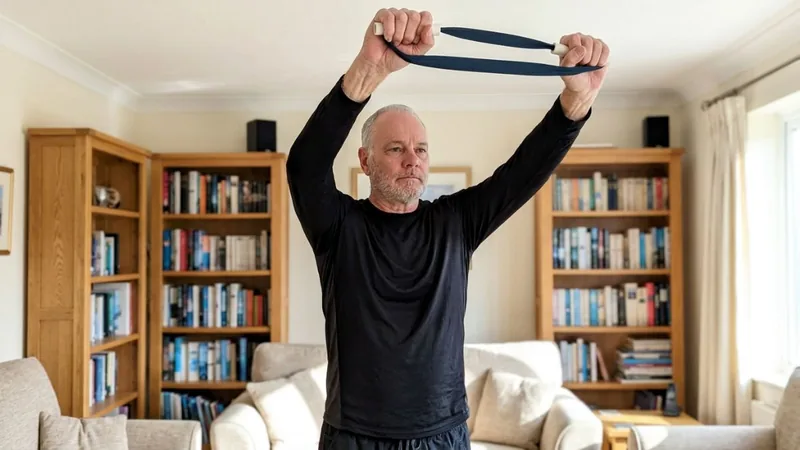 Overhead Press (High Shelf Reach): Trapezius and Deltoids Without a Weight