Ancient wisdom & traditional movement practices
Martial Arts After 50: Tai Chi, Aikido and Shoulder-Friendly Styles
6-minute read · Published November 10, 2026 · Updated November 10, 2026
What this is
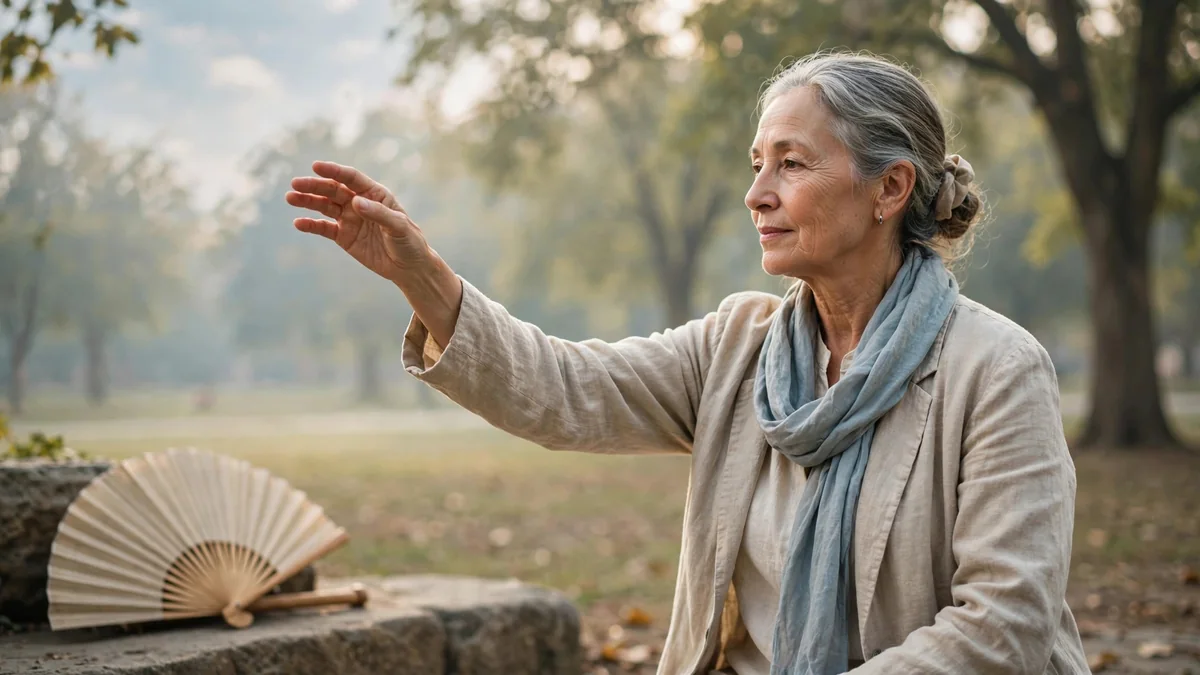
"Martial arts" covers a wide range of practices. Some are slow and flowing, like tai chi and qigong. Others, like many grappling and throwing styles, involve falls, quick movement and loaded joints. Aikido sits in between. It uses throws and joint control, and it teaches how to fall safely.
For a reader over 50, the style matters more than the label. A slow, adapted class is a very different experience from a fast sparring class.
Why the shoulder is at risk in some styles
The shoulder is a ball in a shallow socket. It moves in many directions, which is part of its strength and also its weakness. Shoulder stress in martial arts usually comes from falls, blocks, throws and fast loaded movement, rather than from slow, controlled work.
This is a general pattern, not a rule. Some people train for years without shoulder trouble. Others find that one hard fall changes things. Evidence on injury rates across martial arts is less clear than for some other sports, so evidence varies.
What the research says
- Tai chi and qigong may help adults aged 55 and over improve physical function. They may also reduce blood pressure, fall risk, depression and anxiety. This comes from a review of 36 reports and 3,799 participants [R10].
- A seven-week tai chi softball program improved upper-limb function in older adults, including shoulder mobility, arm strength and grip. The quality of that trial was modest [R13].
- Tai chi is not usually enough to build significant muscle on its own. Resistance training is what counters loss of muscle strength and mass in older adults [R06].
- For shoulder pain in general, resisted exercise that progresses over time probably helps, while gentle movement alone probably does not change pain much [R01].
What you can do
- Start with slow styles. Tai chi and qigong are good first choices. Many classes offer a seated version, which is a useful option for shoulders.
- Tell the teacher about your shoulder. Ask for modifications: no rolls, no overhead strikes and no falls until you are comfortable.
- Practice the arm movements seated. Sit tall in a sturdy chair and practice the slow arm sequences for a few minutes. Stop anything that causes sharp pain.
- Learn falls only with supervision. If you train in aikido or a similar style, learn breakfalls slowly with a coach who watches your shoulders closely.
- Build strength between classes. A progressive, resisted plan, ideally set up with a clinician, is the piece classes often miss [R01][R06].
- Set a clear stop rule. Sharp pain, numbness or weakness means stop, rest and get assessed.
Where ShoulderBack Pro fits, and where it doesn't
The slow circle in Around the World is designed to work the serratus anterior and lower trapezius, and it suits the unhurried feel of tai chi. One arm guides while the other resists, and you can do it seated. It teaches no footwork, balance or partner practice, so it supports a class rather than replacing one. It is a wellness tool with no clinical trials behind it, so it is not a treatment for any condition (the trainer is here).
When to see a professional
See a doctor or physiotherapist promptly if you have: pain after a fall or injury with sudden weakness or loss of movement; a shoulder that looks deformed, very swollen or bruised; fever or feeling unwell alongside the pain; chest pain or breathlessness (call emergency services); constant pain that doesn't change with rest or activity; pain that wakes you most nights; numbness, tingling or weakness into the arm or hand; pain in several joints at once; or pain that hasn't improved after a couple of weeks of sensible self-care.
If you had a fall in a class and your shoulder is painful or weak afterward, get it checked before training again.
Try this movement
Around the World (circles, both arms) →Frequently asked questions
Is tai chi enough strength training after 50?
Tai chi builds some strength and balance, but it is usually not enough on its own. Resistance training is what counters muscle loss, so many people add it, ideally with a clinician's guidance.
Is aikido safe for shoulders after 50?
It can be, with an adapted approach and a teacher who coaches falls carefully. Evidence for aikido specifically is limited, so ask your clinician.
Can tai chi help shoulder pain?
Tai chi has been studied for upper-limb function in older adults, with modest quality evidence. It is not a treatment for diagnosed shoulder conditions.
Which style should I choose?
Pick one you will keep doing, with a patient teacher who knows about your shoulder. Slow styles such as tai chi are the usual starting point.
Sources
- Naunton J et al. (2020). Effectiveness of progressive and resisted and non-progressive or non-resisted exercise in rotator cuff related shoulder pain: systematic review and meta-analysis of RCTs. Clinical Rehabilitation. https://search.pedro.org.au/search-results/record-detail/61404
- Fragala MS, Cadore EL, Dorgo S et al. (2019). Resistance Training for Older Adults: Position Statement From the National Strength and Conditioning Association. J Strength Cond Res. https://pubmed.ncbi.nlm.nih.gov/31343601/
- Rogers CE, Larkey LK, Keller C (2009). A review of clinical trials of tai chi and qigong in older adults. West J Nurs Res 31(2):245-79. https://qigonginstitute.org/abstract-print/4690
- Lou L et al. (2017). Effect of Tai Chi softball on function-related outcomes in older adults: RCT. Evid Based Complement Alternat Med. https://search.pedro.org.au/search-results/record-detail/49889
More in this topic
 Essential guide: Ancient Wisdom for Strong Shoulders: What Traditional Movement Got Right (and What Science Adds)
 The Chinese Medicine Clock and Morning Movement: Fun Framing, Real Habit
 Cold Water and Shoulders: From Nordic Plunges to Modern Ice Baths
 Ancient Massage Traditions: Thai, Tui Na, Lomi Lomi — Comfort vs Proof