Ancient wisdom & traditional movement practices
Ancient Wisdom for Strong Shoulders: What Traditional Movement Got Right (and What Science Adds)
9-minute read · Published March 31, 2025 · Updated March 31, 2025
Why the shoulder needs this kind of attention
The shoulder is the most mobile joint in the body. The arm sits in a shallow socket, and the shoulder blade (scapula) glides over the back of the rib cage. That freedom lets you reach overhead, throw a ball and hug a grandchild.
The price of that freedom is that the shoulder relies on muscles to steady it. The rotator cuff is a group of four muscles and their tendons that hold the head of the upper arm in the socket. The muscles around the shoulder blade position the joint. When those muscles are weak, poorly coordinated or tired, the shoulder can feel unstable or sore.
That is why traditional practices so often move the whole arm and the upper back together. They train mobility and control at the same time, not one muscle in isolation.
Where traditional movement came from
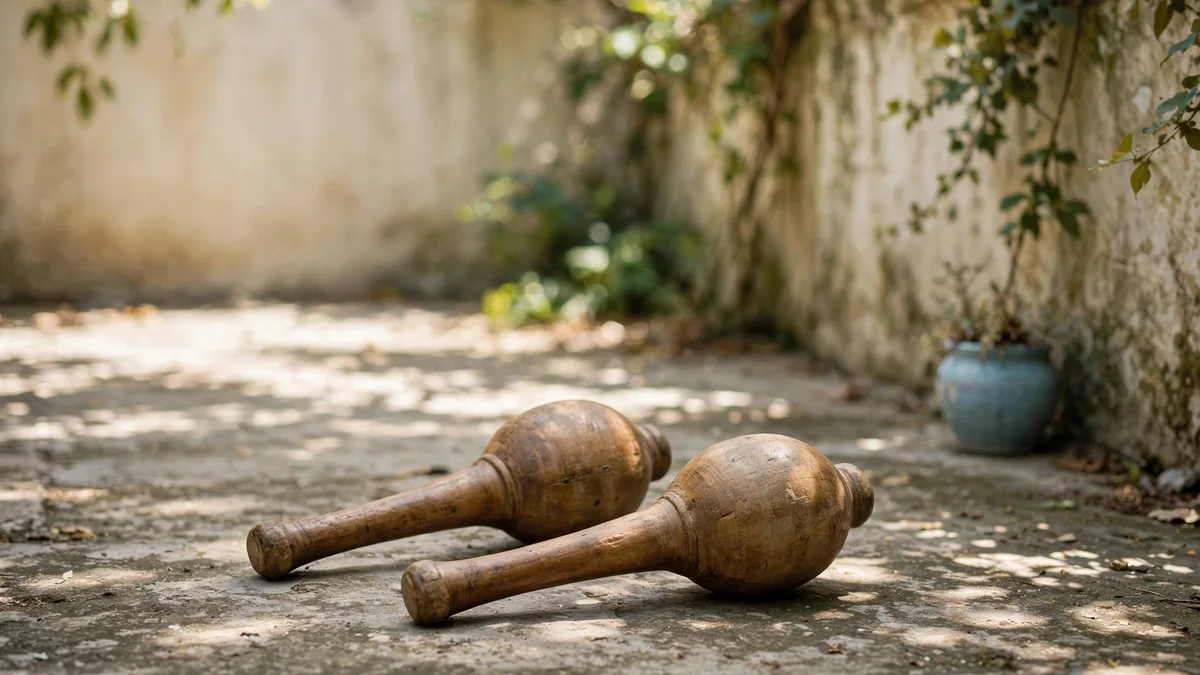
Indian clubs. Club swinging is a very old form of arm training. The 12th-century Manasollasa and the 13th-century Malla Purana describe it. In Persia, wrestlers used a heavy wooden tool called the meel. The British adopted lighter clubs in the 19th century, and club swinging was an Olympic event in 1904 and 1932 [R35]. Read more in Indian clubs and the Persian meel.
Tai chi and qigong. These slow, flowing practices use circles, weight shifts and breath. Qigong is often taught as a set of short movements. Many people find them calm and steady. Their history is rich, and their modern study is more recent. The guides on tai chi for shoulders and qigong shoulder movements show how these ideas look in practice.
Yoga. Yoga traditions include many arm and shoulder postures, and some are now tested in older adults. Thai Yoga and Iyengar yoga are two examples that have been studied in trials [R11, R12].
The historical record tells us that people trained their shoulders on purpose for centuries. It does not tell us which exercises produced which results. That is the job of modern research.
What the research says
Here is what the trials say for the practices above. Most trials looked at whole-body function in older adults, not shoulder pain.
Tai chi and qigong. A review of clinical trials found that tai chi and qigong may help adults aged 55 and over with physical function. The same review reported possible benefits for fall risk, blood pressure, depression and anxiety [R10].
Tai Chi softball. A 7-week tai chi program that used arm movements improved upper-limb function in older adults, including shoulder mobility, arm strength, grip and fine motor control. The study was small and of modest quality [R13].
Thai Yoga. A randomised trial in sedentary adults over 60 found that 12 weeks of low-intensity Thai Yoga improved chair stands, arm curls, reach tests and walking tests, compared with a control group [R11].
Iyengar yoga. A pilot trial found that twice-weekly yoga for 12 weeks improved standing balance and mobility in older community members [R12].
Two cautions are needed. These studies are small to medium in size, and most of them did not test shoulder pain. They show that these practices are worth trying for function, not that they resolve a shoulder problem.
For rotator cuff-related shoulder pain, the newer work is more specific. Programs that teach control and coordination may work a little better than generic exercise for disability in the short and medium term. It is still unclear whether that comes from motor control itself or from progression and tailoring [R02].
What traditional practices seem to get right
Across these traditions, a few features keep showing up. They are not proven rules, but they match what modern research values.
- Both arms work together. Club swinging, tai chi and many yoga sequences move both sides of the body. Research on bilateral movement in stroke rehab suggests that moving both arms can produce more shoulder movement than moving one alone. That evidence comes from stroke patients, not healthy adults [R14]. It is a reason to be curious, not a proof.
- Circles and smooth arcs. Many practices move the arm in circles. This keeps the joint moving through a range, at a pace the body can follow.
- Slow pace and breath. Slow movement lets you notice pain, effort and balance. Breath gives the movement a rhythm.
- Short, regular practice. Many traditions are taught as brief, frequent sessions rather than one long, rare workout.
- Start light. Teachers commonly matched the club or the movement to the student. Modern rehab also starts with range of motion before adding load [R16].
What science adds
Modern research adds three things. It measures outcomes, it compares practices, and it asks which parts of a practice matter. For shoulders, the key idea is progression. Rehab usually moves from range of motion, to strength, to control and coordination [R16]. A traditional practice can fit that path, but it works best when the load and difficulty go up gradually.
Science also reminds us that a long history does not guarantee benefit. A practice that is old and popular may still be unhelpful for a specific shoulder. Trials are how we tell the difference.
What you can do
- Choose one tradition to try. Pick tai chi, qigong, yoga or club-style arm work. Stick with it for a few weeks before you judge it.
- Start seated. Sit in a sturdy chair with your back supported. Most practices can be adapted this way.
- Use a light object. If you want a club-like feel, use a light bottle or a small cushion instead of a heavy club.
- Make circles small. Start with small arm circles in front of the chest and grow them gently.
- Breathe steadily. Let the breath set the pace. Pause if you need to.
- Ask a teacher or clinician. A qualified teacher can guide your form. If you have a shoulder problem, ask your clinician first.
- Stop at sharp pain. Discomfort that eases as you move is different from sharp pain, numbness or tingling. Stop for the latter.

Where ShoulderBack Pro fits — and where it doesn't
ShoulderBack Pro covers one idea from this list: both arms working together in a slow circle. Its Around the World lesson is designed to work the serratus anterior and lower trapezius through one large, unhurried circle, with one arm resisting the other so you set the effort, pace and range. It can be done seated.
It does not replace a teacher or a full practice, and it is a wellness tool with no clinical trials, not a treatment for a diagnosed condition. Watch the Around the World lesson, or order online if you want your own.
When to see a professional
See a doctor or physiotherapist promptly if you have: pain after a fall or injury with sudden weakness or loss of movement; a shoulder that looks deformed, very swollen or bruised; fever or feeling unwell alongside the pain; chest pain or breathlessness (call emergency services); constant pain that doesn't change with rest or activity; pain that wakes you most nights; numbness, tingling or weakness into the arm or hand; pain in several joints at once; or pain that hasn't improved after a couple of weeks of sensible self-care.
A few situations need a clinician before you start any traditional practice:
- Frozen shoulder: research does not support simply waiting it out, as untreated cases improved only partly after one to four years [R19]. A clinician should assess it before you start.
- Acute injury: a fall, sudden weakness or a deformed shoulder needs a medical assessment first.
- Nerve symptoms: numbness, tingling or weakness in the hand needs assessment first.
- After surgery: follow your surgeon's or physiotherapist's plan.
- Severe osteoporosis, a recent fracture or an inflammatory arthritis flare: ask a clinician before any new routine.
Only a doctor or physiotherapist can diagnose the cause of shoulder pain. This article does not diagnose anything.
Try this movement
Around the World (circles, both arms) →Frequently asked questions
Are ancient shoulder exercises proven to work?
Not in general. Some traditional practices, such as tai chi and qigong, have been tested in older adults and show benefits for physical function. Long history alone does not prove that a practice helps a shoulder.
Which traditional practice is best for shoulders?
There is no single best practice. Choose one you enjoy and will keep doing. Practices that use both arms in slow, controlled circles are a sensible place to start.
Can I try Indian clubs or tai chi seated?
Yes, with changes. Use a light object instead of a heavy club, and sit in a sturdy chair. Ask a qualified teacher for guidance, especially if you have a shoulder problem.
Does yoga help shoulder mobility in older adults?
Some trials of yoga in older adults show gains in function and balance. The trials do not test shoulder pain specifically, so ask your clinician before a new yoga routine.
Can ShoulderBack Pro replace these traditions?
No. ShoulderBack Pro is a modern, guided trainer. It can sit alongside a practice you enjoy, but it does not replace one or treat a diagnosed condition.
Sources
- Dubé M-O et al. (2024). The Efficacy of Exercise Therapy for Rotator Cuff-Related Shoulder Pain According to the FITT Principle: Systematic Review With Meta-analyses. JOSPT. https://pubmed.ncbi.nlm.nih.gov/38848304/
- Rogers CE, Larkey LK, Keller C (2009). A review of clinical trials of tai chi and qigong in older adults. West J Nurs Res 31(2):245-79. https://qigonginstitute.org/abstract-print/4690
- Noradechanunt C, Worsley A, Groeller H (2017). Thai Yoga improves physical function and well-being in older adults: a randomised controlled trial. J Sci Med Sport. https://ro.uow.edu.au/smhpapers/4599
- Tiedemann A et al. (2013). A 12-week Iyengar yoga program improved balance and mobility in older community-dwelling people: pilot RCT. J Gerontol A. https://www.qigonginstitute.org/abstract-print/9524
- Lou L et al. (2017). Effect of Tai Chi softball on function-related outcomes in older adults: RCT. Evidence-Based Complementary and Alternative Medicine. https://search.pedro.org.au/search-results/record-detail/49889
- Journal of Physical Therapy Science (2016). The effects of bilateral movement training on upper limb function in chronic stroke patients. https://pmc.ncbi.nlm.nih.gov/articles/PMC5011582
- Mureşan et al. (2022). Effects of a novel proprioceptive rehabilitation device on shoulder joint position sense, pain and function. Medicina. https://www.ncbi.nlm.nih.gov/pmc/articles/PMC9505091/
- Wong CK et al. (2017). Natural history of frozen shoulder: fact or fiction? A systematic review. Physiotherapy 103(1):40-47. https://pubmed.ncbi.nlm.nih.gov/27641499/
- Wikipedia, Indian club (history only; secondary source). https://en.wikipedia.org/wiki/Indian_club