Ancient wisdom & traditional movement practices
Qigong Shoulder Movements: 'Cloud Hands' and Why Circles Work
5-minute read · Published June 4, 2025 · Updated June 4, 2025
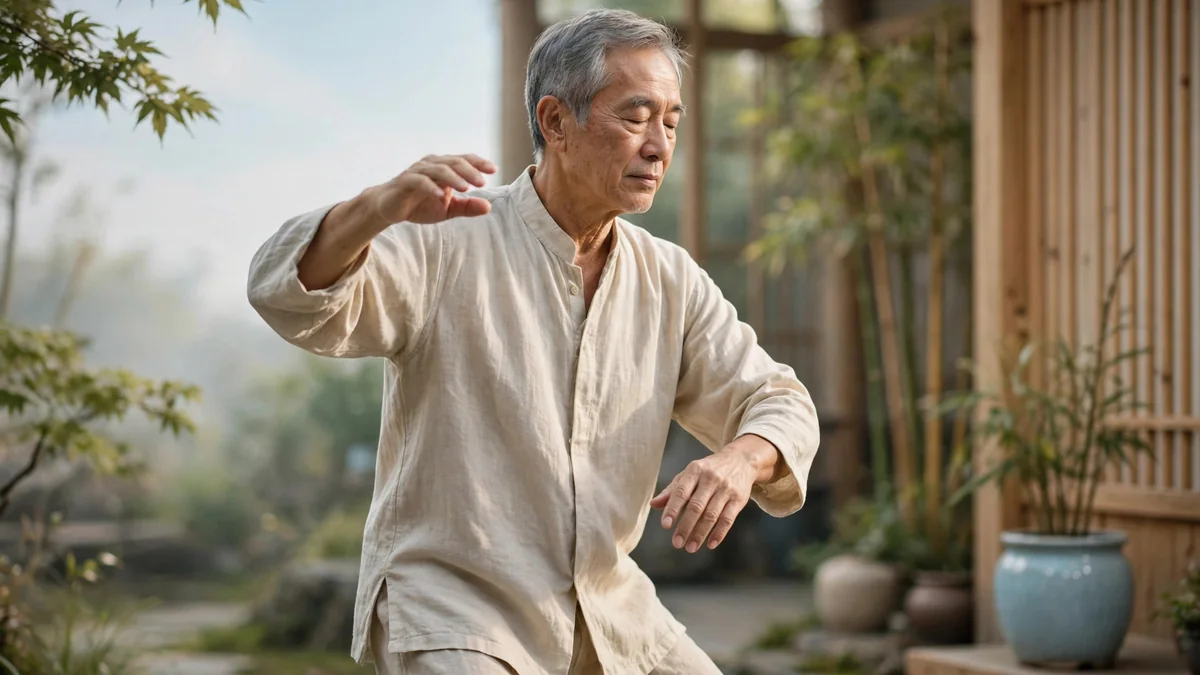
What Cloud Hands is
Cloud Hands is a common movement in tai chi and qigong practice. The arms sweep slowly in front of the body, the palms turn over, and the weight shifts gently from one leg to the other. The hands seem to float, like clouds.
The movement is slow on purpose. It asks you to move with attention, breathing and balance, not with speed or force. For many people it feels more like a moving meditation than a workout.
Why circles seem to help
A circle moves the shoulder joint through many directions in one smooth line. That matters because rehab often starts with range of motion, then builds to strength, then to control and coordination [R16]. Gentle circles sit at the start of that path.
Circles are also easy to repeat. They keep the arms moving at a steady pace, and they can be made bigger or smaller depending on comfort.
What the research says
Tai chi and qigong have been tested in many older-adult trials. A review of those trials found they may help adults aged 55 and over improve physical function. The same review reported possible benefits for fall risk, blood pressure, depression and anxiety [R10].
A 7-week tai chi program that used arm movements, called Tai Chi softball, improved upper-limb function in older adults. That included shoulder mobility, arm strength, grip and fine motor control. The trial was small and of modest quality [R13].
These findings are about the whole body in older adults. They are not trials of Cloud Hands for shoulder pain. The research is encouraging, but not conclusive for the shoulder specifically.
Activity guidelines also matter. The WHO says every move counts, and advises adults 65 and over to include balance and strength activity at least three days a week [R07].
What you can do
- Sit tall for a seated Cloud Hands. Use a sturdy chair with your back supported and your feet flat on the floor.
- Start with small circles. Let the hands float in front of the chest, at a height that feels easy.
- Shift your weight gently. In a seated version, lean slightly from one side to the other as the arms move.
- Breathe with the movement. Breathe in as the hands open, and out as they close. Keep the breath slow and comfortable.
- Keep the pace slow. Speed adds force, and force is not the goal. Pause if you need to.
- Stand when you are ready. Once the seated version feels steady, try the standing version with feet hip-width apart.
- Stop at sharp pain. Discomfort that eases as you continue is different from sharp pain, numbness or tingling. Stop for the latter and get it checked.
Where ShoulderBack Pro fits — and where it doesn't
If you like the idea of slow two-arm circles with some resistance, Around the World is the closest match among the 16 guided movements: one large, unhurried circle in front of you, with the other arm supplying the resistance. To progress, resist harder or draw a bigger circle. Locomotive adds rolling forward circles aimed at the upper back. Both work seated.
It is not qigong and does not replace Cloud Hands. It is a wellness tool with no clinical trials, so with a shoulder problem a clinician comes first.
Watch the Around the World lesson, or order a trainer ($29 CAD, 30-day guarantee).
When to see a professional
See a doctor or physiotherapist promptly if you have: pain after a fall or injury with sudden weakness or loss of movement; a shoulder that looks deformed, very swollen or bruised; fever or feeling unwell alongside the pain; chest pain or breathlessness (call emergency services); constant pain that doesn't change with rest or activity; pain that wakes you most nights; numbness, tingling or weakness into the arm or hand; pain in several joints at once; or pain that hasn't improved after a couple of weeks of sensible self-care.
Only a doctor or physiotherapist can diagnose the cause of shoulder pain. If you have a stiff, hard-to-move shoulder that might be frozen shoulder, research does not support waiting it out [R19], so have a clinician assess it. This article does not diagnose anything.
Try this movement
Around the World (circles, both arms) →Frequently asked questions
What is Cloud Hands?
Cloud Hands is a slow, flowing qigong and tai chi movement. The arms sweep in front of the body in circles while the weight shifts gently from side to side.
Can I do qigong seated?
Yes. Sit tall in a sturdy chair, keep your feet flat, and let your arms move in smaller circles. Stop if you feel pain.
Do qigong shoulder movements fix shoulder pain?
No promises. The trials are about physical function in older adults, not shoulder pain specifically. Ask a clinician about shoulder pain.
Why do circles seem to help a stiff shoulder?
Circles move the shoulder through a range of directions, and range of motion is usually the first stage of rehab. Keep circles smooth and comfortable, not forced.
Sources
- WHO (2020). Guidelines on physical activity and sedentary behaviour (University of Sydney summary of WHO 2020). https://www.sydney.edu.au/news-opinion/news/2020/11/26/new-global-guidelines-on-physical-activity-and-sedentary-behavio.html
- Rogers CE, Larkey LK, Keller C (2009). A review of clinical trials of tai chi and qigong in older adults. West J Nurs Res 31(2):245-79. https://qigonginstitute.org/abstract-print/4690
- Lou L et al. (2017). Effect of Tai Chi softball on function-related outcomes in older adults: RCT. Evidence-Based Complementary and Alternative Medicine. https://search.pedro.org.au/search-results/record-detail/49889
- Mureşan et al. (2022). Effects of a novel proprioceptive rehabilitation device on shoulder joint position sense, pain and function. Medicina. https://www.ncbi.nlm.nih.gov/pmc/articles/PMC9505091/
- Wong CK et al. (2017). Natural history of frozen shoulder: fact or fiction? A systematic review. Physiotherapy 103(1):40-47. https://pubmed.ncbi.nlm.nih.gov/27641499/
More in this topic
 Essential guide: Ancient Wisdom for Strong Shoulders: What Traditional Movement Got Right (and What Science Adds)
 The Chinese Medicine Clock and Morning Movement: Fun Framing, Real Habit
 Cold Water and Shoulders: From Nordic Plunges to Modern Ice Baths
 Ancient Massage Traditions: Thai, Tui Na, Lomi Lomi — Comfort vs Proof