Ancient wisdom & traditional movement practices
Kettlebell and Club Swinging: Modern Takes on Old Tools
4-minute read · Published August 1, 2025 · Updated August 1, 2025
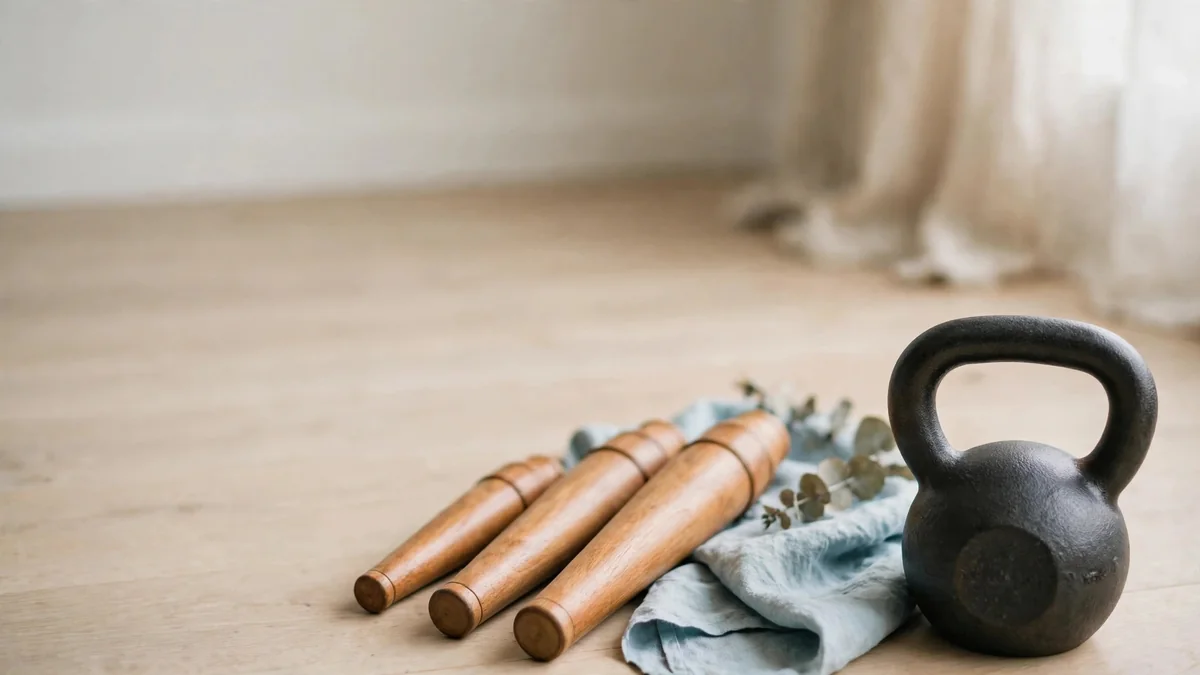
What these tools are
A kettlebell is a weight with a handle. Swinging and lifting it asks the shoulder to control a load through a whole movement. Indian clubs are swung in arcs around the head and body, relying on rhythm and control rather than heavy load.
Both have history. [R35] describes club swinging in the 12th-century Manasollasa and the 13th-century Malla Purana. British users adopted lighter clubs in the 19th century, and club swinging was an Olympic event in 1904 and 1932. That history says nothing about health benefit.
What the research says
There isn't strong research on kettlebells or club swinging for shoulder health specifically. Claims about either should be treated as unconfirmed, so ask your clinician.
What we can say comes from resistance training research. [R01] found that resisted exercise which progresses over time probably helps rotator cuff-related shoulder pain, while unloaded movement alone probably does not. That suggests a tool which adds progressive resistance may have a role. It does not tell us which tool, or which swing, is best.
What you can do
- Start light, or start empty-handed. Learn the movement before adding a heavier tool.
- Learn with a qualified coach or clinician. Good form matters more with loaded tools.
- Try a seated version. Seated circles with a light club, elbow controlled and shoulder relaxed, are a gentle start.
- Keep the range small at first. Widen it only if it feels comfortable.
- Stop if pain is sharp or lingers. Ease off and check with a clinician before continuing.
Where ShoulderBack Pro fits, and where it doesn't
If the appeal of clubs is smooth, circular shoulder control, Around the World is the closest match. You draw one large, unhurried circle in front of you while the other arm resists, and the site lists it as working the serratus anterior and lower trapezius. It can be done seated. To make it harder, resist more firmly or work for longer sets.
It adds no weight, so it will not replace the heavier lifting a kettlebell asks for, and it is a wellness tool, not a treatment. You can see the Around the World lesson or look at the shop.
See a doctor or physiotherapist promptly if you have: pain after a fall or injury with sudden weakness or loss of movement; a shoulder that looks deformed, very swollen or bruised; fever or feeling unwell alongside the pain; chest pain or breathlessness (call emergency services); constant pain that doesn't change with rest or activity; pain that wakes you most nights; numbness, tingling or weakness into the arm or hand; pain in several joints at once; or pain that hasn't improved after a couple of weeks of sensible self-care.
When to see a professional
If you have a diagnosed shoulder condition, your doctor or physiotherapist decides whether loaded swings are safe. Get assessed before starting if you have had a recent injury, sudden weakness, or pain that wakes you at night.
Learn more
Try this movement
Around the World (circles, both arms) →Frequently asked questions
Is club swinging good for shoulders?
Evidence for health benefits is limited. A long history is not proof of benefit, so ask your clinician before starting.
Are kettlebells better than Indian clubs?
Neither is shown to be better. They suit different goals and experience levels.
Can I start if my shoulder is sore?
Get assessed first, especially after an injury or if pain wakes you at night. Then start with the lightest option your clinician approves.
Sources
- Naunton J et al. (2020). Effectiveness of progressive and resisted and non-progressive or non-resisted exercise in rotator cuff related shoulder pain: systematic review and meta-analysis of RCTs. Clinical Rehabilitation. https://search.pedro.org.au/search-results/record-detail/61404
- Wikipedia, Indian club (history; secondary source, used for history only, not health claims). https://en.wikipedia.org/wiki/Indian_club
More in this topic
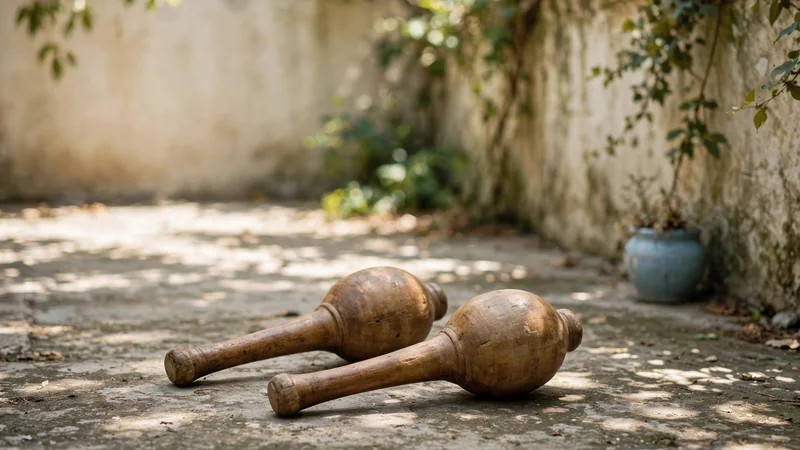 Essential guide: Ancient Wisdom for Strong Shoulders: What Traditional Movement Got Right (and What Science Adds)
 The Chinese Medicine Clock and Morning Movement: Fun Framing, Real Habit
 Cold Water and Shoulders: From Nordic Plunges to Modern Ice Baths
 Ancient Massage Traditions: Thai, Tui Na, Lomi Lomi — Comfort vs Proof