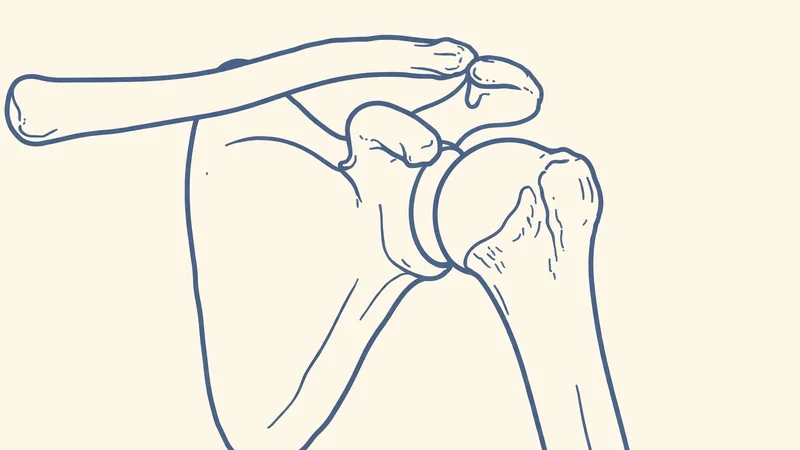
Shoulder anatomy & how it works
Deltoid Muscle Guide: Front, Side and Rear, in Plain English
4-minute read · Published December 15, 2025 · Updated December 15, 2025
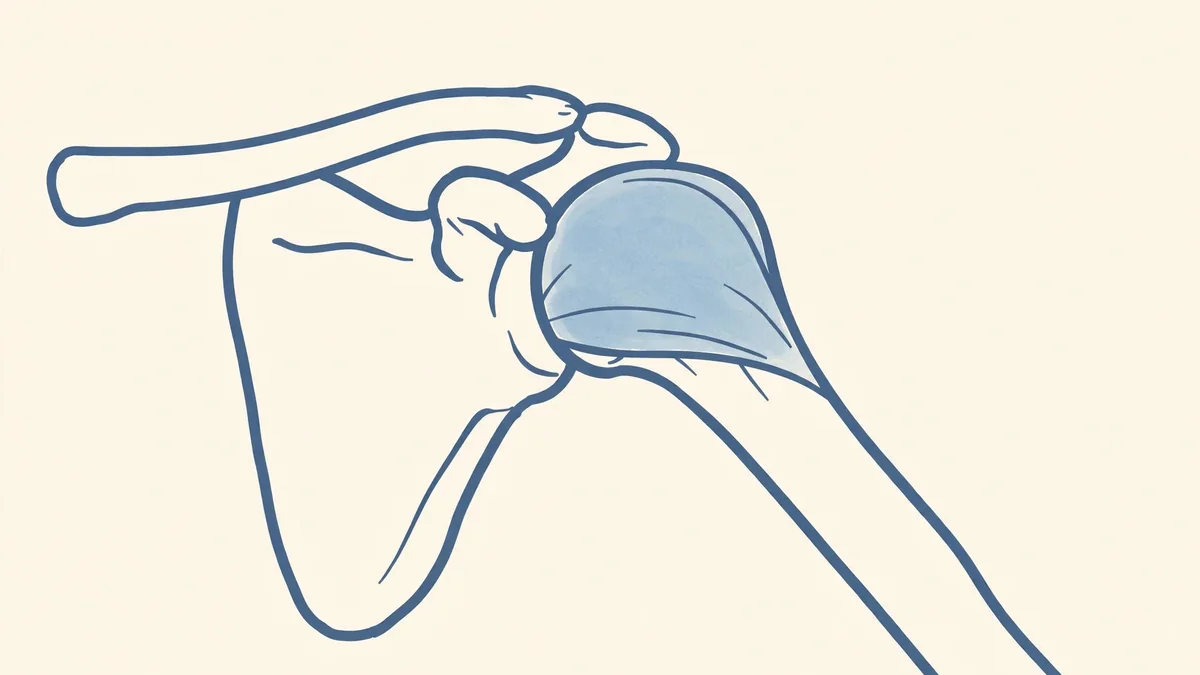
What this is
The deltoid (DEL-toid) is the big, rounded muscle you can feel over the top of your shoulder. It attaches to the collarbone and shoulder blade at the top and to the upper arm bone below. Its job is to lift and move the arm away from the body.
Think of it as three bands that work together:
- Front (anterior): helps lift your arm forward and bring it in toward your chest.
- Side (middle or lateral): lifts your arm out to the side, as in a slow sideways raise.
- Rear (posterior): helps extend the arm backward and rotate it outward.
Each part works best when the shoulder blade moves smoothly beneath it. That is why the deltoid is rarely a lone actor.
What the research says
Most research on shoulder pain looks at the rotator cuff and the shoulder as a whole, rather than the deltoid alone. Progressive, resisted exercise probably makes a modest difference rotator cuff-related shoulder pain, though the size of the benefit is uncertain [R01]. A 2025 review also found that specific exercise types, including scapular stabilization, improved pain and function [R03].
The takeaway is that the muscles around the shoulder blade and the rotator cuff matter as much as the deltoid. Training the deltoid in isolation is not the whole story.
What you can do
- Find your three parts. Place a hand on the front, side and back of the top of your shoulder. Gently lift your arm a little and feel which part works.
- Try a seated side raise. Sit tall with arms relaxed. Lift one arm slowly to the side only as far as is comfortable, then lower it with control. Repeat on the other side.
- Try a seated forward reach. Lift your arm forward in front of you, slowly, then return it with control.
- Keep the range comfortable. A mild effort is enough. Stop before sharp pain or a catch.
- Add a slow glide. Use the SeeSaw idea: one arm guides the other in gentle reaches, which keeps the shoulder blades involved.
- Keep a routine you enjoy. Short sessions, a few days a week, are easier to keep up than long ones.
Where ShoulderBack Pro fits — and where it doesn't
The trainer can help with the "works together" part of this picture. SeeSaw has one arm guide the other through gentle reaches, so the shoulder blades join in. Steering (the ten-and-two wheel turn) is listed by the site as working the front and rear deltoid, and Dumbbell Raise (a weightless sideways lift) targets the side deltoid and supraspinatus. Both can be done seated, and the other arm provides the resistance.
It will not isolate one part of the deltoid, and it is a wellness tool with no clinical trials behind it. Start with the SeeSaw movement if you have been cleared to move your shoulder, or see ShoulderBack Pro here. For the deeper muscle picture, read the 17 muscles that attach to your shoulder blade.
When to see a professional
The red-flag list below follows NHS shoulder guidance [R30].
See a doctor or physiotherapist promptly if you have: pain after a fall or injury with sudden weakness or loss of movement; a shoulder that looks deformed, very swollen or bruised; fever or feeling unwell alongside the pain; chest pain or breathlessness (call emergency services); constant pain that doesn't change with rest or activity; pain that wakes you most nights; numbness, tingling or weakness into the arm or hand; pain in several joints at once; or pain that hasn't improved after a couple of weeks of sensible self-care.
Only a clinician can diagnose which part of the shoulder is involved.
Try this movement
SeeSaw (the muscles around the shoulder blade) →Frequently asked questions
Which deltoid part is most likely to ache?
No single part is to blame in most cases. Pain is better explained by the whole shoulder, so a clinician should assess it.
Do I need weights to train the deltoids?
No. Controlled movement, bands or a body-controlled trainer can all work the muscle, and you can do it seated.
Is the deltoid the same as the rotator cuff?
No. The deltoid is the large outer muscle. The rotator cuff is a group of smaller muscles underneath it that steer the joint.
Sources
- Frontiers in Bioengineering & Biotechnology (2025). Specific modes of exercise to improve rotator cuff-related shoulder pain: systematic review and meta-analysis. PROSPERO CRD42024550602. https://pmc.ncbi.nlm.nih.gov/articles/PMC12011739/
- Naunton J et al. (2020). Effectiveness of progressive and resisted and non-progressive or non-resisted exercise in rotator cuff related shoulder pain: systematic review and meta-analysis of RCTs. Clinical Rehabilitation. https://search.pedro.org.au/search-results/record-detail/61404
- NHS Greater Glasgow & Clyde, Shoulder red flags; NHS MPFT, Shoulder pain self-help; BESS/BOA pathway summary (2021). https://www.nhsggc.scot/page_category/services/page/33