Ancient wisdom & traditional movement practices
Ba Duan Jin (Eight Brocades): The Qigong Set Older Adults Love
6-minute read · Published December 16, 2024 · Updated December 16, 2024
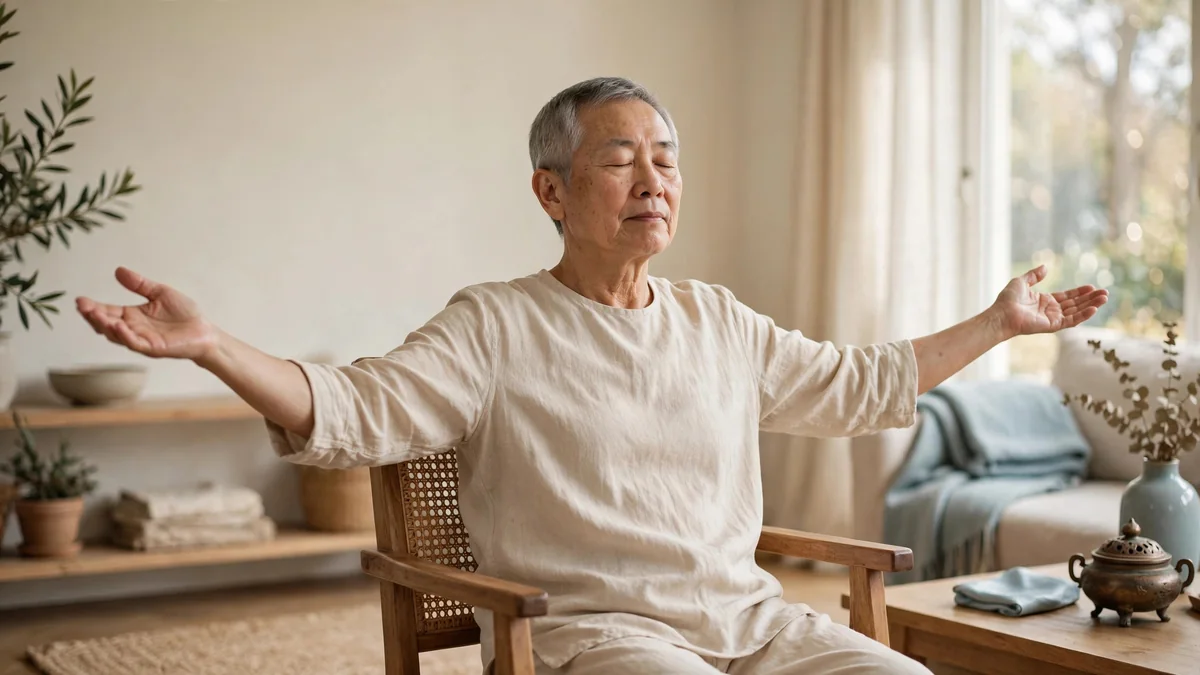
What Ba Duan Jin is
Qigong (pronounced "chee-gung") is a traditional Chinese practice that pairs slow movement with calm breathing and focus. Ba Duan Jin is one well-known qigong set. Its name means "eight pieces of brocade," an image of fine cloth woven from many threads.
The history of the set is hard to pin down. Treat any exact date you read with care.
Several of the eight movements use the arms. Some lift them overhead. Some draw them out to the sides. Some turn the upper body gently. Each move is slow, and the breath follows the motion.
Many people like it for three reasons. It is gentle. It can be learned in a few sessions. And it fits in a living room.
Why it may help shoulders
Your shoulder works best when the shoulder blade and the rotator cuff move together. The rotator cuff is the group of small muscles that keeps the ball of the upper arm bone seated in its socket. Slow lifts and circles ask those muscles to coordinate.
Traditional explanations of qigong talk about energy flow. The research cited here does not use that idea. This article focuses on movement, breath and control, which you can observe for yourself.
What the research says
- Reviews of tai chi and qigong trials in adults 55 and over suggest these practices may help physical function. They may also help fall risk, blood pressure, depression and anxiety [R10]. Results vary from trial to trial.
- In one seven-week program that used tai chi in a softball format, older adults improved shoulder mobility, arm strength and grip. The study was rated as modest in quality [R13].
- Gentle movement without added load probably does not change shoulder pain much on its own. Resisted exercise that progresses over time probably does [R01]. So Ba Duan Jin is best seen as a daily mobility and calm habit, not a strength program.
- The World Health Organization advises that every move counts. Adults should also do muscle-strengthening activity at least two days a week [R07].
What you can do
Try this sequence seated first. Use a sturdy chair with no wheels.
- Settle. Sit tall, feet flat, hands on your thighs. Take three slow breaths. Let your jaw and shoulders soften.
- Arm lifts. Raise both arms out to the sides, then up overhead as far as feels comfortable. Lower them slowly. Rest, then repeat a few times.
- Gentle side reach. Lift one arm up and over toward the other side, like a slow bend through the ribs. Hold briefly, breathe, and come back. Switch sides.
- Arm circles. Make small, slow circles with both arms, first forward and then back. Keep the range easy. Stop before you feel strain.
- Close. Rest your hands in your lap and breathe for a moment. Notice how your shoulders feel now compared with before.
When the seated version feels easy, try it standing with feet hip-width apart. Hold the back of a chair if you need balance help.
Stop any movement that brings sharp pain, numbness or tingling. Those signs mean you should check with a clinician.
For the bigger picture, read the pillar on ancient movement for strong shoulders. You may also like tai chi for shoulders and qigong shoulder movements.
Where ShoulderBack Pro fits and where it doesn't
The nearest match is Around the World, one large unhurried circle in front of you, which the site lists as working the serratus anterior and lower trapezius. It feels much like the circles above, with the other arm adding gentle resistance that you can raise by pressing harder or circling through more range. It is a wellness tool, not a qigong program or a treatment, and there are no clinical trials of it yet. If you already enjoy Ba Duan Jin, keep it. The trainer is on the shop page, $29 CAD with a 30-day guarantee.
When to see a professional
See a doctor or physiotherapist promptly if you have: pain after a fall or injury with sudden weakness or loss of movement; a shoulder that looks deformed, very swollen or bruised; fever or feeling unwell alongside the pain; chest pain or breathlessness (call emergency services); constant pain that doesn't change with rest or activity; pain that wakes you most nights; numbness, tingling or weakness into the arm or hand; pain in several joints at once; or pain that hasn't improved after a couple of weeks of sensible self-care.
A doctor or physiotherapist is the right person to diagnose the cause of shoulder pain. Ask one before starting any new routine if you have a recent injury, surgery or nerve symptoms.
Try this movement
Around the World (circles, both arms) →Frequently asked questions
Is Ba Duan Jin the same as tai chi?
No. Both come from traditional Chinese practice and use slow movement with breath. Ba Duan Jin is a shorter set of eight movements, and many people learn it seated or standing.
Can adults over 55 do Ba Duan Jin safely?
Many do. Start with small ranges and stop at any sharp pain, numbness or tingling. If you have a recent shoulder injury or surgery, check with your clinician first.
How often should I practise?
The sources here do not name one best schedule. Short sessions on most days are a common way to start. Build up only as it feels comfortable.
Does it replace strength training?
Not by itself. Qigong gives gentle movement, balance practice and calm. For strength, resisted exercise that progresses over time has the stronger support [R01].
Sources
- Naunton J et al. (2020). Effectiveness of progressive and resisted and non-progressive or non-resisted exercise in rotator cuff related shoulder pain: systematic review and meta-analysis of RCTs. Clinical Rehabilitation. https://search.pedro.org.au/search-results/record-detail/61404
- WHO (2020). Guidelines on physical activity and sedentary behaviour. https://www.sydney.edu.au/news-opinion/news/2020/11/26/new-global-guidelines-on-physical-activity-and-sedentary-behavio.html
- Rogers CE, Larkey LK, Keller C (2009). A review of clinical trials of tai chi and qigong in older adults. West J Nurs Res 31(2):245-79. https://qigonginstitute.org/abstract-print/4690
- Lou L et al. (2017). Effect of Tai Chi softball on function-related outcomes in older adults: RCT. Evid Based Complement Alternat Med. https://search.pedro.org.au/search-results/record-detail/49889
More in this topic
 Essential guide: Ancient Wisdom for Strong Shoulders: What Traditional Movement Got Right (and What Science Adds)
 The Chinese Medicine Clock and Morning Movement: Fun Framing, Real Habit
 Cold Water and Shoulders: From Nordic Plunges to Modern Ice Baths
 Ancient Massage Traditions: Thai, Tui Na, Lomi Lomi — Comfort vs Proof