Active aging & sports: keep playing
Why Falls, Not Serves, Cause Most Pickleball Injuries — and Shoulder Strength Still Matters
6-minute read · Published August 13, 2025 · Updated August 13, 2025
Why this happens
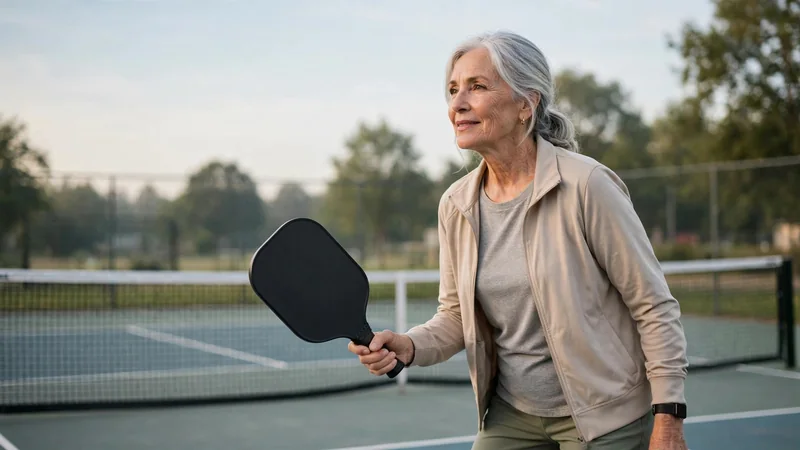
Pickleball looks gentle, but it asks for quick changes of direction, sudden stops and reaches across the court. A misstep on a damp surface, a lunge for a dink or a collision at the net can send you to the ground. The arm often goes out to break the fall, and that is where many shoulder and wrist injuries begin.
So the shoulder is not always the source of the problem. Footing, reaction time and the ability to recover balance matter a great deal. A strong, well-controlled shoulder may help you steady yourself, though the data above does not test that.
This is a pattern across the data, not a verdict on any one player. Your own risk depends on your health, your court and how you play.
What the research says
- Pickleball upper-extremity injuries rose significantly over a decade, and they were highest in older adults and women [R31].
- Emergency room visits for pickleball rose sharply after 2020. Adults aged 50 and older accounted for 91% of reported injuries, falls were the most common mechanism, and sprains, strains and fractures were the most common types [R32].
- An earlier analysis, published as a preprint, found that among players aged 60 and older, strains and sprains made up 33% of injuries and fractures made up 28% [R33].
- A South Korean study found self-reported injuries most often at the knee, elbow and shoulder, and age was a documented risk factor [R34].
- For adults 65 and older, the WHO recommends multicomponent activity that emphasizes functional balance and strength on at least three days a week [R07].
What you can do
- Warm up for five minutes courtside. Walk, swing your arms gently and take a few small side steps. Do not jump in cold.
- Practise balance on the court. Seated option: sit tall in a chair and lift one foot slightly, then the other, while you breathe steadily. Stand and do the same if you are steady.
- Keep your footwork low and wide. Bend your knees, keep your feet under you, and avoid reaching far beyond your base.
- Train the shoulder blade. Seated option: sit tall and draw your shoulder blades back and down, then let them release. Many coaches use this to build control for reaching.
- Protect the arm when you fall. Learn to fall onto a bent knee and roll rather than straight onto an outstretched hand.
- Rest when fatigue shows. Tired legs and shoulders are a common setting for mistakes. Stepping off the court is a smart choice.
For a fuller pre-play routine, read our pickleball warm-up for players over 50. You can also explore what the pickleball injury data says and pickleball shoulder pain from overheads and dinks.
Where ShoulderBack Pro fits — and where it doesn't
Crosscuts is the closest match to a paddle swing: a diagonal glide from one shoulder toward the opposite hip, with your other arm supplying the resistance. We think it is a reasonable way to practise controlled reaching and rotating off the court, and you set the effort and range, seated or standing.
It won't improve balance or stop a fall, and it's a wellness tool with no clinical trials yet. If you have fallen recently or feel unsteady, see a clinician first; otherwise you can order online.
When to see a professional
See a doctor or physiotherapist promptly if you have: pain after a fall or injury with sudden weakness or loss of movement; a shoulder that looks deformed, very swollen or bruised; fever or feeling unwell alongside the pain; chest pain or breathlessness (call emergency services); constant pain that doesn't change with rest or activity; pain that wakes you most nights; numbness, tingling or weakness into the arm or hand; pain in several joints at once; or pain that hasn't improved after a couple of weeks of sensible self-care.
A doctor or physiotherapist diagnoses any injury from a fall. If you have fallen and the shoulder is painful, weak or unstable, get it checked before you play again.
Try this movement
Crosscuts (lats, obliques, scapular retractors) →Frequently asked questions
Are serves really not a big cause of pickleball injuries?
Serves can contribute to shoulder strain, but the national data highlights falls as the most common way people get hurt. Shoulder overuse is a real issue too, so both matter.
Can shoulder exercise prevent falls?
Shoulder exercise does not prevent falls on its own. Balance, leg strength and footwork are the main targets for fall prevention, and multicomponent activity is recommended for older adults [R07].
Why does this matter for players over 50?
Adults over 50 account for most of the pickleball injuries reported, and falls are the most common cause. Planning for footing and control is a practical way to keep playing.
Sources
- WHO (2020). Guidelines on physical activity and sedentary behaviour. https://www.sydney.edu.au/news-opinion/news/2020/11/26/new-global-guidelines-on-physical-activity-and-sedentary-behavio.html
- Pickleball Pains: a 10-year epidemiologic analysis of rising upper-extremity injuries (2014–2023, NEISS). Journal of Orthopaedic Experience & Innovation. https://journaloei.scholasticahq.com/article/160819-pickleball-pains-a-10-year-epidemiologic-analysis-of-rising-upper-extremity-injuries
- ETSU / AOAO 10-year national study (2013–2022, NEISS). https://dc.etsu.edu/asrf/2024/schedule/149
- Weiss H et al. (2021). Pickleball-related injuries (NEISS 2010–2019). Injury Epidemiology (preprint). https://researchsquare.com/article/rs-180980/v1
- Frontiers in Public Health (2025). Injury epidemiology of recreational pickleball players in South Korea: cross-sectional study. https://www.frontiersin.org/journals/public-health/articles/10.3389/fpubh.2025.1617291/pdf