Active aging & sports: keep playing
Active Aging: What 'Functional Fitness' Really Means for Shoulders
5-minute read · Published October 8, 2026 · Updated October 8, 2026

Why this happens
Muscle strength and muscle mass tend to decline with age. Doctors call the more serious form sarcopenia. It is common. The Australian and New Zealand guidelines note that sarcopenia affects almost one in three older people [R08].
The good news is that losing muscle is not inevitable. The same guidelines describe resistance exercise as the first-line approach, and no drug is available to do the job [R08].
For shoulders, functional fitness means strength and control in the positions you use every day. Reaching up, pulling, carrying and turning all depend on the shoulder blade and rotator cuff working together.
For the bigger picture, read Shoulder Exercises for Pickleball Players: Strength, Control and Endurance. Related reading: Cross-Country Skiing and Shoulders: The Poling Motion and Pickleball Injuries Are Rising 88%: What the Data Says and How to Stay on the Court.
What the research says
- Resistance training supports function. A major position statement reports that resistance training in older adults counters strength and muscle loss, and supports function, mobility, independence and quality of life [R06].
- Multicomponent activity matters. The WHO advises adults 65 and over to add activity that builds balance and strength on at least three days a week [R07].
- Shoulder pain and disability are linked to strength and mobility. In adults over 60, strength, mobility, body composition and posture are each associated with shoulder pain and disability. These are targets that can change [R28].
- Exercise helps middle-aged and older shoulders. A 2026 review found exercise programs reduced pain and improved function and range of motion in middle-aged and older adults with rotator cuff-related pain [R04].
What you can do
Pick three tasks you want to do well for years. Common choices are reaching a high shelf, carrying a bag, and getting dressed. Then build strength in ways that match them.
- Overhead reach practice. Reach up as if placing a teacup on a high shelf. Go only as high as is comfortable. Seated option: reach forward and up from the chair, with the feet flat.
- Carry practice. Hold a light bag in one hand, stand tall, and walk a few steps. Switch hands. Seated option: lift a light bag from your lap to the table.
- Controlled pulls. Use a towel or light band to draw the arms back, keeping the shoulder blades steady. Seated or standing.
- Strength twice a week or more. The WHO advises muscle-strengthening work on at least two days a week for adults [R07].
- Add a little over time. Start light. When a movement feels easy and steady, progress by resisting a bit harder, moving through more range, or doing longer sets.
Where ShoulderBack Pro fits — and where it doesn't
For the reaching and carrying side of this, Crosscuts is the natural match. It is a diagonal glide from high shoulder to opposite hip, designed to work the lats, obliques and the muscles that pull the shoulder blades together. Your other arm provides the resistance, so you choose how hard to work, and it is easy to do from an armchair. Overhead Press, the teacup-on-a-high-shelf reach, pairs well with it.
It is not a medical device and not a treatment, and there is no trial evidence about it specifically. It will not replace walking or lifting, and anyone returning to a sport after an injury should check with a clinician first. At $29 CAD with a 30-day guarantee, the trainer is in the shop.
When to see a professional
If strength work causes sharp pain, or if you have pain after an injury, get it assessed before you push harder. A doctor or physiotherapist can help plan a safe return to activity. This article describes general patterns only.
See a doctor or physiotherapist promptly if you have: pain after a fall or injury with sudden weakness or loss of movement; a shoulder that looks deformed, very swollen or bruised; fever or feeling unwell alongside the pain; chest pain or breathlessness (call emergency services); constant pain that doesn't change with rest or activity; pain that wakes you most nights; numbness, tingling or weakness into the arm or hand; pain in several joints at once; or pain that hasn't improved after a couple of weeks of sensible self-care.
Try this movement
Crosscuts (lats, obliques, scapular retractors) →Frequently asked questions
Is it too late to start building shoulder strength?
Probably not. Resistance training in older adults is linked to better strength, function and independence. Start gently and build up with guidance if you need it.
Do I need heavy weights for functional fitness?
No. Controlled movement with light resistance can be a useful start. Progress gradually, and ask a clinician or qualified trainer if you have a condition.
Can I keep playing pickleball or golf?
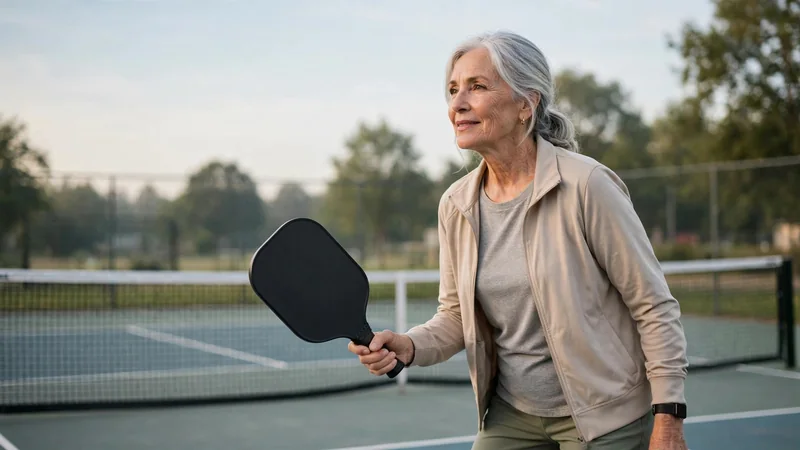
Many older adults keep playing. Strength and control work supports that goal. If you have pain or an injury, get it assessed before returning to full play.
Does SBP replace strength training?
No. SBP is one controlled-movement tool. It does not replace a full strength program that includes lifting or walking.
Sources
- Fragala MS, Cadore EL, Dorgo S et al. (2019). Resistance Training for Older Adults: Position Statement From the National Strength and Conditioning Association. J Strength Cond Res. https://pubmed.ncbi.nlm.nih.gov/31343601/
- WHO (2020). Guidelines on physical activity and sedentary behaviour. https://www.sydney.edu.au/news-opinion/news/2020/11/26/new-global-guidelines-on-physical-activity-and-sedentary-behavio.html
- Australian/NZ sarcopenia guidelines summary (2025). Journal of Cachexia, Sarcopenia and Muscle via Medical Republic. https://medicalrepublic.com.au/how-to-stop-muscle-loss-in-older-people/81501
- PMC narrative review (2026). Body composition, strength, mobility and posture associated with shoulder pain and disability in community-dwelling older adults. https://www.ncbi.nlm.nih.gov/pmc/articles/PMC13513864/
- BMC Musculoskeletal Disorders (2026). Exercise interventions for rotator cuff-related shoulder pain in middle-aged and older adults: systematic review and meta-analysis. https://link.springer.com/10.1186/s12891-026-10035-4