Active aging & sports: keep playing
Pickleball Shoulder Pain: Overheads, Dinks and the Overuse Trap
5-minute read · Published May 4, 2026 · Updated May 4, 2026

What this is
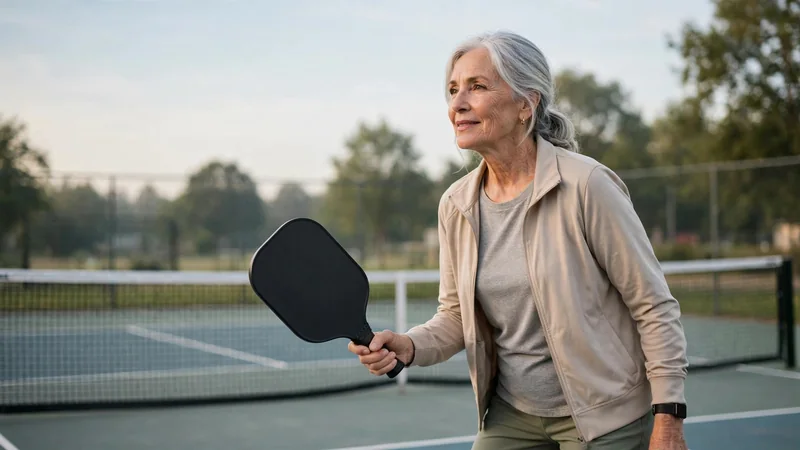
Pickleball asks the shoulder to do several things. Overhead serves and smashes take the arm above the shoulder. Dinks, the soft shots played near the net, involve many small, repeated arm movements. Quick side steps and reaching wide add sudden loads.
The overuse trap happens when players add more hours and more intensity while their strength and endurance lag behind. Rest days shrink, and the shoulder gets less time to adapt.
What the injury data shows
- Upper-body injuries are rising. A 10-year US analysis found upper-extremity injuries rose significantly from 2014 to 2023. They were highest in older adults and women [R31].
- Older players are most affected. Emergency visits for pickleball rose sharply after 2020. Adults 50 and older made up 91% of reported injuries, and falls were the most common cause [R32].
- Sprains and fractures are common. Among players 60 and older in an earlier US study, strains and sprains were about a third of injuries and fractures about a quarter [R33].
- The shoulder is not the only area. In a South Korean study of self-reported injuries, the knee was most common at 23%, followed by the elbow and forearm at 18%. The shoulder and upper arm came next at 17% [R34].
These studies count injuries. They do not show which exercises prevent them. Falls and knees matter as much as the shoulder in this data.
What the research says
- Progressive resistance probably helps shoulder pain. Exercise with resistance that builds gradually is the type most likely to help, while gentle movement alone probably does not move the needle much [R01].
- Warm-up and balance matter. Because falls cause many reported injuries [R32], practice in footwork and balance is worth including alongside shoulder work.
What you can do
- Plan rest days. Keep at least one lighter or rest day between long play sessions.
- Build up slowly. Add play time gradually, rather than doubling your weekly hours in one go.
- Build shoulder control seated first. A seated high-shelf reach, with the other arm gently resisting, loads the shoulder without a weight. Progress by resisting harder, reaching through more range, or doing longer sets.
- Shorten your swing for dinks. Keep the elbow close to your body and let the paddle do less of the work.
- Practise footwork and balance. Light side steps and split-step practice reduce the chance of a fall. Seated reaches while holding a sturdy chair are a good option if standing balance is a concern.
- Use strength work across the week. WHO guidance recommends muscle-strengthening activity on at least two days a week for adults [R07].
Where ShoulderBack Pro fits, and where it doesn't
ShoulderBack Pro covers one slice of this: controlled, self-resisted shoulder work between games. Crosscuts is designed to work the lats, obliques and scapular retractors through a diagonal glide, which suits the swing pattern. The High Shelf Reach (Overhead Press) is designed to work the trapezius and deltoids, a match for overhead shots. Both can be done seated or standing, and the shop page has the details.
It does nothing for falls, knees or elbows. It's a wellness tool rather than a treatment, and it has not been tested in clinical trials.
When to see a professional
See a doctor or physiotherapist promptly if you have: pain after a fall or injury with sudden weakness or loss of movement; a shoulder that looks deformed, very swollen or bruised; fever or feeling unwell alongside the pain; chest pain or breathlessness (call emergency services); constant pain that doesn't change with rest or activity; pain that wakes you most nights; numbness, tingling or weakness into the arm or hand; pain in several joints at once; or pain that hasn't improved after a couple of weeks of sensible self-care.
Any pain after a fall should be checked, even if it seems minor. A doctor or physiotherapist is the right person to assess a shoulder that keeps hurting on the court.
Try this movement
Crosscuts (lats, obliques, scapular retractors) →Frequently asked questions
Are pickleball shoulder injuries really increasing?
A national US dataset covering 2014 to 2023 found that upper-extremity injuries rose significantly over the decade. They were highest in older adults and women.
Are overhead shots the main cause?
Falls and sprains are common in the injury data. Overhead swings may add load, but these studies do not isolate them as the cause.
Can I keep playing with some pain?
Mild, short-lived discomfort that settles may be manageable. Sharp, worsening or night pain is a reason to rest and get checked.
Does strength training prevent pickleball injuries?
Strength work is recommended for adults, and for older adults in particular. Whether it prevents shoulder injury in players is not yet proven.
Sources
- Naunton J et al. (2020). Effectiveness of progressive and resisted and non-progressive or non-resisted exercise in rotator cuff related shoulder pain: systematic review and meta-analysis of RCTs. Clinical Rehabilitation. https://search.pedro.org.au/search-results/record-detail/61404
- WHO (2020). Guidelines on physical activity and sedentary behaviour. https://www.sydney.edu.au/news-opinion/news/2020/11/26/new-global-guidelines-on-physical-activity-and-sedentary-behavio.html
- Pickleball Pains: a 10-year epidemiologic analysis of rising upper-extremity injuries (2014–2023, NEISS). Journal of Orthopaedic Experience & Innovation. https://journaloei.scholasticahq.com/article/160819-pickleball-pains-a-10-year-epidemiologic-analysis-of-rising-upper-extremity-injuries
- ETSU / AOAO 10-year national study (2013–2022, NEISS). https://aoao.org/2025/03/21/rising-orthopedic-injuries-in-pickleball-insights-from-a-10-year-national-study/
- Weiss H et al. (2021). Pickleball-related injuries (NEISS 2010–2019). Injury Epidemiology (preprint). https://researchsquare.com/article/rs-180980/v1
- Frontiers in Public Health (2025). Injury epidemiology of recreational pickleball players in South Korea: cross-sectional study. https://www.frontiersin.org/journals/public-health/articles/10.3389/fpubh.2025.1617291/pdf