Active aging & sports: keep playing
Pickleball Injuries Are Rising 88%: What the Data Says and How to Stay on the Court
5-minute read · Published July 11, 2025 · Updated July 11, 2025
Why injuries happen
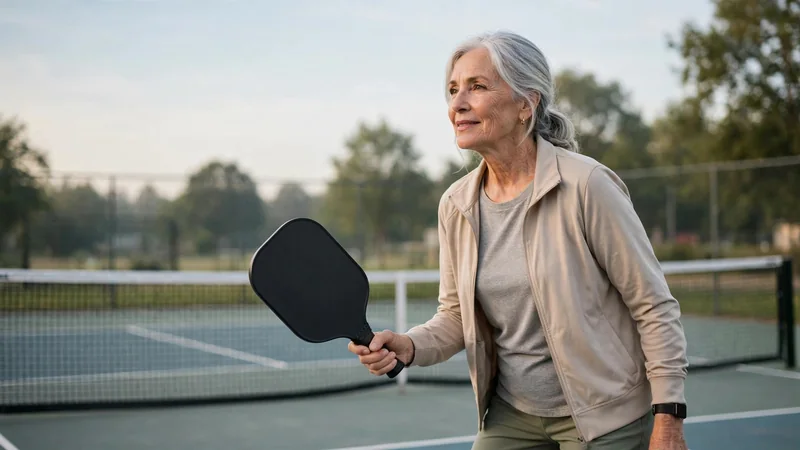
Pickleball packs a lot into a short point. Players make quick lunges, sudden stops, fast direction changes and reaches for wide shots. Overhead swings load the shoulder. The legs, wrists and elbows take their share too.
Quick, unplanned movements are a likely reason the data points to falls and sprains rather than slow, steady wear.
What the data says
- Emergency visits are up. A 10-year national study found ER visits for pickleball up 88% since 2020. Adults 50 and older accounted for 91% of reported injuries [R32].
- Falls lead the list. Falls were the most common cause of injury, and sprains, strains and fractures were the most common types [R32].
- Upper-body injuries are rising. A separate analysis found pickleball upper-extremity injuries rose significantly over the decade, highest in older adults and women [R31].
- Earlier data shows the same pattern. Among players 60 and older, one analysis of 2010 to 2019 data estimated 28,984 injuries. Strains and sprains made up 33% of them, and fractures 28% [R33].
- Shoulders are common, but not always the top spot. In one South Korean study of recreational players, the knee was the most common self-reported injury site at 23%. The shoulder or upper arm came in at 17% [R34].
The main lesson: the rise is concentrated in older players, and falls are a leading cause. Balance and footwork deserve as much attention as arm strength.
What you can do
- Warm up before you play. Start with easy movement: walking, arm swings, shoulder rolls and a few gentle reaches. Keep it comfortable. Seated option: Do seated arm circles and shoulder rolls in a sturdy chair.
- Build strength and balance off the court. The WHO suggests muscle-strengthening work at least two days a week. Adults 65 and older should add balance and functional strength work at least three days a week [R07]. Seated option: Seated rows with a light band, and seated leg lifts.
- Practise stopping and turning. Work on controlled stops and footwork in a safe space, such as near a wall or a chair you can hold. Seated option: Practise weight shifts while seated, reaching gently to each side.
- Keep your shoulders in shape. Many clinicians suggest controlled shoulder and shoulder-blade work to prepare for overhead and reaching motions, though no study in our set tests this for pickleball. Seated option: Sit tall and do slow, controlled movements with a trainer or a light band.
- Know when to stop. Sharp pain, a sudden loss of control, or pain that lingers into the next day means you stop and get it checked.
Where ShoulderBack Pro fits, and where it doesn't
ShoulderBack Pro covers one small part of this: controlled shoulder and upper-back work off the court. The Crosscuts lesson is designed to work the lats, obliques and scapular retractors with a diagonal glide, and the resistance comes from your other arm, so you decide how hard to push. Harder resistance, more range or longer sets are how you progress. It can be done seated or standing.
It does not address falls, footwork or the knee injuries the Korean study found most often, and it is a wellness tool with no clinical trials. See the Crosscuts routine, or look at the trainer if you are curious.
When to see a professional
See a doctor or physiotherapist promptly if you have: pain after a fall or injury with sudden weakness or loss of movement; a shoulder that looks deformed, very swollen or bruised; fever or feeling unwell alongside the pain; chest pain or breathlessness (call emergency services); constant pain that doesn't change with rest or activity; pain that wakes you most nights; numbness, tingling or weakness into the arm or hand; pain in several joints at once; or pain that hasn't improved after a couple of weeks of sensible self-care.
A fall on the court with sudden shoulder weakness needs prompt assessment, not a return to play.
Try this movement
Crosscuts (lats, obliques, scapular retractors) →Frequently asked questions
Are pickleball injuries really rising?
Yes, according to emergency-room data. One national study found emergency visits for pickleball up 88% since 2020, and a separate analysis found upper-body injuries rose significantly over the decade [R32][R31].
Is pickleball more dangerous for older players?
The data suggests injuries are concentrated in older adults. Adults 50 and older accounted for most reported injuries in one 10-year study, and falls were the most common cause [R32].
Do warm-ups and strength work prevent pickleball injuries?
Nothing in our reference list tests this directly. Warm-ups and strength and balance work are sensible habits for older adults in general [R07], but think of them as good practice, not a guarantee.
Can I keep playing with shoulder pain?
Ask a clinician first if the pain is new, severe, or does not settle. Mild, short-lived soreness may allow lighter play, but stop if pain sharpens or lasts into the next day.
Sources
- Pickleball Pains: a 10-year epidemiologic analysis of rising upper-extremity injuries (2014–2023, NEISS). Journal of Orthopaedic Experience & Innovation. https://journaloei.scholasticahq.com/article/160819-pickleball-pains-a-10-year-epidemiologic-analysis-of-rising-upper-extremity-injuries
- ETSU / AOAO 10-year national study of pickleball injuries (2013–2022, NEISS). https://dc.etsu.edu/asrf/2024/schedule/149
- Weiss H et al. (2021). Pickleball-related injuries (NEISS 2010–2019). Injury Epidemiology (preprint). https://researchsquare.com/article/rs-180980/v1
- Frontiers in Public Health (2025). Injury epidemiology of recreational pickleball players in South Korea: cross-sectional study. https://www.frontiersin.org/journals/public-health/articles/10.3389/fpubh.2025.1617291/pdf
- WHO (2020). Guidelines on physical activity and sedentary behaviour. https://www.sydney.edu.au/news-opinion/news/2020/11/26/new-global-guidelines-on-physical-activity-and-sedentary-behavio.html