Active aging & sports: keep playing
Shoulder Exercises for Pickleball Players: Strength, Control and Endurance
9-minute read · Published July 16, 2025 · Updated July 16, 2025
Why pickleball loads the shoulder
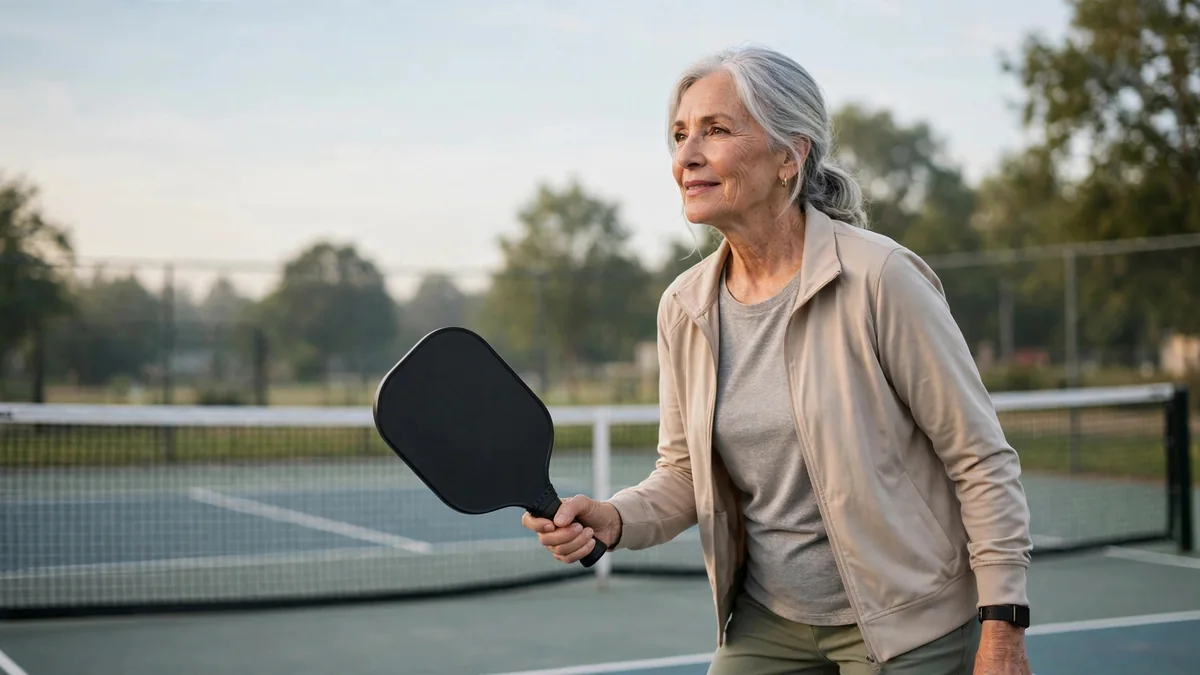
Pickleball looks gentle, but it asks a lot of the shoulder. A serve or overhead is a fast, repeated reach above the head. Quick volleys ask the shoulder blade and rotator cuff to stop and start many times a game. A lunge to a dink, a reach wide or a sudden stop can ask the whole arm to take load without warning.
Your shoulder is a ball-and-socket joint. It depends on the rotator cuff (a group of four muscles and their tendons) and on the muscles around the shoulder blade to stay steady. When those muscles are weak, tired or poorly coordinated, the joint has less support for fast, repeated movement.
What the injury data says
Pickleball has grown quickly, and so have its injuries. The evidence is strongest in its description of who gets hurt and how.
- Upper-extremity injuries from pickleball rose significantly across a 10-year period, and the highest rates were in older adults and women [R31].
- A 10-year national study found emergency room visits for pickleball up 88% since 2020. Adults 50 and over accounted for 91% of reported injuries. Falls were the most common mechanism, and sprains, strains and fractures were the most common types [R32].
- A 2010 to 2019 analysis estimated about 28,984 pickleball injuries among players aged 60 and over. Strains and sprains made up 33% of them and fractures 28% [R33].
- A 2025 study of recreational players in South Korea, based on self-reports, found knee injuries most common (23%), followed by elbow or forearm (18%) and shoulder or upper arm (17%). Age was a documented risk factor [R34].
Read these numbers with care. The emergency room data capture serious injuries, not every ache, and they come from different countries and time periods. The pattern is still clear: falls, sprains and fractures are the risks to plan for, and the shoulder is one of several joints at risk.
What the research says about strength
- Resistance training in older adults counters loss of strength and muscle, and supports function, mobility, independence and quality of life [R06]. Shoulder and upper-back strength are part of that picture.
- The WHO advises adults to do muscle-strengthening activity on at least two days a week. Adults 65 and over should also do multicomponent activity that emphasises functional balance and strength on at least three days a week [R07].
- Strength alone may not be enough to prevent falls or overuse. Balance, coordination and a gradual build in load matter too. This is why the plan below mixes strength, control and endurance.

The plan: strength, control and endurance
Warm-up (about five minutes, before you play)
- Arm circles, small then larger, in both directions.
- Gentle chest and upper-back opening, such as slow reaches with a relaxed neck.
- Two or three practice serves or volleys at half speed.
Strength (two or three days a week, not on consecutive match days)
- Seated rows with a light band or a steady trainer pull, keeping the shoulder blades settled.
- Overhead reaches from a chair or standing, with a small range that you can control.
- Slow, controlled arm movement in front of the body, keeping the elbows soft.
Control (on court or at home, a few minutes at a time)
- Practice split-step timing and quick, short reaches without swinging hard.
- Slow-motion overheads with a pause at the top, so you feel the shoulder blade move.
- Stop and reset your grip and footwork before each volley.
Endurance (build gradually)
- Add play time in steps, rather than doubling it in one week.
- Use a rest day between heavy sessions and a short cool-down afterwards.
- Notice fatigue. If your technique falls apart late in a game, rest.
Common mistakes on court
- Swinging from the shoulder alone. Much of the power can come from the legs, hips and trunk. Forcing the arm to do all the work raises the load on the shoulder.
- Reaching too far, too fast. Wide reaches and sudden lunges ask the shoulder to stop and start under load. Move your feet and get closer to the ball.
- Playing through sharp pain. Discomfort that gets worse during a game is a sign to stop, not to push harder.
- Skipping the warm-up on busy days. A few minutes of gentle movement before the first game is one of the simplest protections you have.
- Adding too much new load at once. This is one of the most common ways to overdo it. Build up gradually.
What you can do
Every step above has a seated option. Sit tall in an armchair for the warm-up and strength moves, keep the back supported, and use a shorter range. If standing feels unsteady, stay seated for the control drills and practise your footwork later with a clinician's or coach's guidance.
If you are returning after a break, start with the warm-up and the seated strength moves for two weeks before you play a full session. If a shoulder feels sharp, hot or swollen after play, rest it and get it checked.

A two-week starter plan
If you are returning to the sport, or are new to it, try this gentle progression. Adjust it to your clinician's advice if you have an injury.
Week one. Do the warm-up before every session. Add two seated strength sessions, using the rows and reaches in gentle ranges. Play short, relaxed games and stop before you feel tired.
Week two. Keep the warm-up. Add the control drills, and repeat one strength session if the shoulder feels settled the next day. Extend your game time only if you feel well afterwards.
After two weeks. If the shoulder has been comfortable during play and the next morning, you can build gradually. If it has been sore for more than a day, scale back, and see a clinician if it does not settle.
Where ShoulderBack Pro fits — and where it doesn't
For the off-court part of this plan, two of the trainer's 16 exercises match what a pickleball shoulder needs. Crosscuts is a diagonal glide from high shoulder to opposite hip that works the lats, side abdominals and shoulder-blade retractors, which are the muscles behind a controlled swing. Overhead Press (High Shelf Reach) practises reaching above the shoulder with control, much like a slow-motion overhead. The resistance comes from your other arm pushing back through a fixed, non-elastic strap, so you decide how hard to work, and you progress by resisting harder, moving through more range or doing longer sets. Both can be done seated or standing. See the routines page.
It is a wellness tool rather than a treatment, and it has not been tested in clinical trials. It does not replace a court warm-up, coaching or a clinician's assessment, and it does not train footwork or balance. It costs $29 CAD with a 30-day guarantee if you want to order ShoulderBack Pro.
For more on the sport, read pickleball warm-up for players over 50, pickleball shoulder pain, overheads and the overuse trap, and pickleball injuries are rising 88%.
When to see a professional
See a doctor or physiotherapist promptly if you have: pain after a fall or injury with sudden weakness or loss of movement; a shoulder that looks deformed, very swollen or bruised; fever or feeling unwell alongside the pain; chest pain or breathlessness (call emergency services); constant pain that doesn't change with rest or activity; pain that wakes you most nights; numbness, tingling or weakness into the arm or hand; pain in several joints at once; or pain that hasn't improved after a couple of weeks of sensible self-care.
A doctor or physiotherapist diagnoses a pickleball shoulder injury. If you fell on the court, have sudden weakness, or cannot lift the arm, get assessed before you play again.
Try this movement
Crosscuts (lats, obliques, scapular retractors) →Frequently asked questions
Why do pickleball players get shoulder injuries?
Pickleball involves repeated overhead reaches, quick changes of direction and falls. Emergency room data show that falls are the most common mechanism, and sprains, strains and fractures are the most common injury types [R32].
How often should I do shoulder strength work?
The WHO advises adults to do muscle-strengthening activity on at least two days a week, and adults 65 and over to add multicomponent balance and strength work on at least three days [R07].
Is the shoulder the most common pickleball injury?
Not always. In one South Korean study of recreational players, knee injuries were most common, followed by elbow or forearm and then shoulder or upper arm [R34]. Shoulder injuries are still a major concern.
Can I do these exercises seated?
Yes. Chair-based versions of the reaches, rows and controlled arm movements work well, and they are a good option if you are returning after a break or managing a sore shoulder with a clinician's advice.
When should I stop playing and see someone?
Stop and get checked after a fall or hard impact, if you have sudden weakness or loss of movement, if the shoulder looks deformed or very swollen, or if pain wakes you most nights.
Sources
- Fragala MS, Cadore EL, Dorgo S et al. (2019). Resistance Training for Older Adults: Position Statement From the National Strength and Conditioning Association. Journal of Strength and Conditioning Research. https://pubmed.ncbi.nlm.nih.gov/31343601/
- WHO (2020). Guidelines on physical activity and sedentary behaviour. Summary via University of Sydney news (2020). https://www.sydney.edu.au/news-opinion/news/2020/11/26/new-global-guidelines-on-physical-activity-and-sedentary-behavio.html
- Pickleball Pains: a 10-year epidemiologic analysis of rising upper-extremity injuries (2014–2023, NEISS). Journal of Orthopaedic Experience & Innovation. https://journaloei.scholasticahq.com/article/160819-pickleball-pains-a-10-year-epidemiologic-analysis-of-rising-upper-extremity-injuries
- ETSU / AOAO 10-year national study (2013–2022, NEISS). https://aoao.org/2025/03/21/rising-orthopedic-injuries-in-pickleball-insights-from-a-10-year-national-study/
- Weiss H et al. (2021). Pickleball-related injuries (NEISS 2010–2019). Injury Epidemiology (preprint). https://researchsquare.com/article/rs-180980/v1
- Frontiers in Public Health (2025). Injury epidemiology of recreational pickleball players in South Korea: cross-sectional study. https://www.frontiersin.org/journals/public-health/articles/10.3389/fpubh.2025.1617291/pdf