Active aging & sports: keep playing
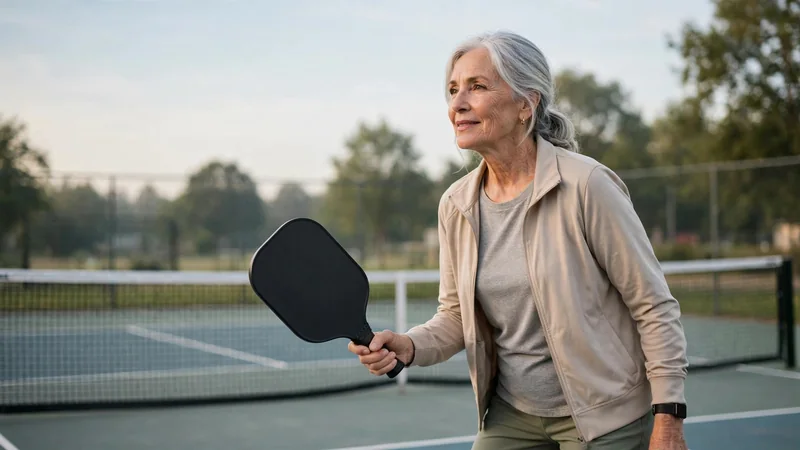
Pickleball Warm-Up for Players Over 50 (5 Minutes, Courtside)
5-minute read · Published May 5, 2025 · Updated May 5, 2025

Why warm up
Falls and sprains are among the most common pickleball injuries [R32]. A warm-up will not prevent all of them. What it can do is prepare your joints and muscles for quick changes of direction and for reaching.
Warm-up research in this age group is limited, so the advice here is based on general exercise principles. Many clinicians suggest starting with range of motion, then adding light control, before you play hard.
That order matches how shoulder rehab commonly progresses: range of motion, then strength, then control and coordination [R16].
What the research says
- Gentle range work has some support. In a 2025 review of rotator cuff-related shoulder pain, mobilization and stretching improved function and pain over about two months [R03]. That was a study of people with shoulder pain, not healthy players, so it is a reason to try gentle range work, not proof that it prevents injury.
- Balance and strength matter for older adults. WHO guidance for adults 65 and older emphasises multicomponent activity that builds functional balance and strength on at least three days a week [R07].
- Falls are a major concern. Falls were the most common mechanism in one large US injury study of pickleball [R32].
What you can do
- Shoulder rolls (1 minute). Stand or sit tall. Roll both shoulders forward in small circles, then back. Keep the neck relaxed.
- Arm swings (1 minute). Let both arms swing gently forward and back, like a pendulum. Seated option: do the same in a sturdy chair, with the body upright.
- Wall reach (1 minute). Face a wall with your hands on it. Walk your fingers up to a comfortable height, then return. Keep the motion smooth and small.
- Trunk turns (1 minute). Stand with feet hip-width apart. Hold your hands at chest height and turn your upper body gently from side to side. Keep the hips facing forward. Seated option: turn in the chair.
- Ready-position reach (1 minute). Bend the knees slightly, hold the paddle in front, and reach it gently out to each side. Seated option: sit forward in the chair and reach the arms out to the sides.
Where ShoulderBack Pro fits, and where it doesn't
Pocket-size and 160 grams, ShoulderBack Pro fits in a paddle bag. Its Crosscuts glide, from a high shoulder to the opposite hip, is designed to work the lats, external obliques and scapular retractors, which echoes the swing. Your other arm supplies the resistance, so keep it light and easy before play, and add more resistance only after the game.
It's a wellness product, not a medical device, and no clinical trial has studied it. Check with a clinician first if you have a shoulder problem. It's $29 CAD with a 30-day guarantee on the shop page.
When to see a professional
See a doctor or physiotherapist promptly if you have: pain after a fall or injury with sudden weakness or loss of movement; a shoulder that looks deformed, very swollen or bruised; fever or feeling unwell alongside the pain; chest pain or breathlessness (call emergency services); constant pain that doesn't change with rest or activity; pain that wakes you most nights; numbness, tingling or weakness into the arm or hand; pain in several joints at once; or pain that hasn't improved after a couple of weeks of sensible self-care.
If a warm-up move causes pain that lingers after you stop, a doctor or physiotherapist can assess the shoulder before you return to play.
Try this movement
Crosscuts (lats, obliques, scapular retractors) →Frequently asked questions
How long should a pickleball warm-up take?
Five minutes is a practical target. Many players add a few extra minutes on cold days or before a long session.
Can I warm up seated?
Yes. Seated versions of the moves are a good option, especially if standing balance is a concern.
Does warming up prevent falls?
Not on its own. Balance and footwork practice matter too, since falls account for many reported pickleball injuries.
What if one of the moves hurts?
Stop that move. A mild stretch is normal. Sharp pain, pain that lingers after you stop, or night pain is a reason to see a clinician.
Sources
- Frontiers in Bioengineering & Biotechnology (2025). Specific modes of exercise to improve rotator cuff-related shoulder pain: systematic review and meta-analysis. https://pmc.ncbi.nlm.nih.gov/articles/PMC12011739/
- WHO (2020). Guidelines on physical activity and sedentary behaviour. https://www.sydney.edu.au/news-opinion/news/2020/11/26/new-global-guidelines-on-physical-activity-and-sedentary-behavio.html
- Mureşan et al. (2022). Effects of a novel proprioceptive rehabilitation device on shoulder joint position sense, pain and function. Medicina. https://www.ncbi.nlm.nih.gov/pmc/articles/PMC9505091/
- ETSU / AOAO 10-year national study (2013–2022, NEISS). https://aoao.org/2025/03/21/rising-orthopedic-injuries-in-pickleball-insights-from-a-10-year-national-study/