Shoulder anatomy & how it works
What Is the Shoulder Girdle? Collarbone, Shoulder Blade and Four Joints
6-minute read · Published August 18, 2026 · Updated August 18, 2026

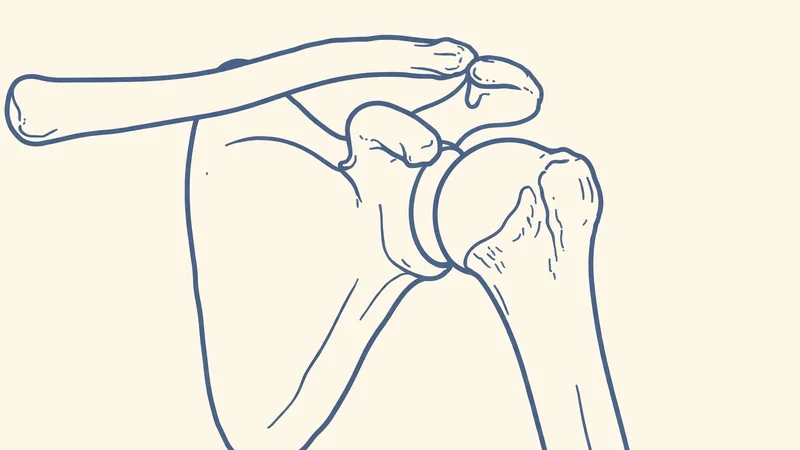
The main bones
The collarbone (clavicle) is a thin bone that runs from the breastbone to the top of the shoulder. It acts like a strut that keeps the arm away from the chest.
The shoulder blade (scapula) is a flat, triangular bone on the back of the ribs. It is not fixed in place. It glides and tilts as you move the arm, which is one reason the shoulder can move so widely.
The upper arm bone (humerus) fits into a shallow socket on the shoulder blade.
The joints
The shoulder girdle has four main joints, often called the four joints of the shoulder:
- Sternoclavicular joint: where the collarbone meets the breastbone.
- Acromioclavicular joint: where the collarbone meets the top of the shoulder blade.
- Glenohumeral joint: the main ball-and-socket joint, where the upper arm meets the shoulder blade.
- Scapulothoracic joint: where the shoulder blade glides over the back of the ribs. It is not a true joint, but it works as one.
These joints move together, so a change in one can affect the others.
Why the muscles matter
Many muscles attach to the shoulder blade. They position it, steer its movement and help the arm stay under control. The rotator cuff is a group of small muscles that hold the upper arm bone in its socket. Together, these muscles set the stage for everything the arm does.
A recent review of older adults found that strength, mobility, body composition and posture are each linked to shoulder pain and disability [R28]. The review also says the evidence on posture is limited and indirect [R28]. "Linked" is not the same as "causes."
What the research says
Research on the shoulder blade and rotator cuff is still developing. A 2025 review found that scapular stabilization exercise, which trains the muscles around the shoulder blade, improved pain and function in people with rotator-cuff-related pain [R03].
The proprioceptive system, which senses where a joint is in space, is also important. Shoulder disorders are linked to reduced joint position sense, and that sense affects how accurately you move [R16]. Rehabilitation generally moves from range of motion, to strength, to control and coordination [R16]. Those stages are a guide for clinicians, not a fixed formula.
What you can do
- Learn the parts. Locate your collarbone and the top point of your shoulder blade with your fingers. That helps you notice movement.
- Move through full range. Slow, pain-free range of motion keeps the girdle mobile.
- Train the shoulder blade gently. Let it glide and tilt with the arm rather than locking it in place.
- Keep both sides balanced. Use similar effort on each arm.
- Seek help for pain. Ask a clinician to explain what is happening in your own shoulder.
Seated option: sit tall in a chair and slide your shoulder blades down and back, slowly, several times.
Where ShoulderBack Pro fits — and where it doesn't
If you want to feel the shoulder blade move, SeeSaw is a good place to start. One arm guides the other through alternating reaches, and the site lists it as working the shoulder-blade stabilizers. It can be done seated or standing. It is a wellness tool, not a treatment, and it cannot tell you what is wrong with a painful shoulder.
The SeeSaw lesson is free, and the trainer is in the shop.
When to see a professional
Knowing the anatomy does not tell you what is wrong with your shoulder. A doctor or physiotherapist diagnoses shoulder conditions.
See a doctor or physiotherapist promptly if you have: pain after a fall or injury with sudden weakness or loss of movement; a shoulder that looks deformed, very swollen or bruised; fever or feeling unwell alongside the pain; chest pain or breathlessness (call emergency services); constant pain that doesn't change with rest or activity; pain that wakes you most nights; numbness, tingling or weakness into the arm or hand; pain in several joints at once; or pain that hasn't improved after a couple of weeks of sensible self-care.
Try this movement
SeeSaw (the muscles around the shoulder blade) →Frequently asked questions
Is the shoulder one joint?
No. The shoulder girdle includes several joints that move together. That teamwork is why the shoulder is so mobile and why it can be sensitive to strain.
Why do so many muscles attach to the shoulder blade?
The shoulder blade is a platform that positions the arm. Muscles attached to it steer the arm's range and control, so their balance matters.
Does knowing the anatomy tell me what is wrong?
No. Anatomy explains how the parts work, not what is causing your pain. A doctor or physiotherapist diagnoses shoulder conditions.
Sources
- Mureşan et al. (2022). Effects of a novel proprioceptive rehabilitation device on shoulder joint position sense, pain and function. Medicina. https://www.ncbi.nlm.nih.gov/pmc/articles/PMC9505091/
- Frontiers in Bioengineering & Biotechnology (2025). Specific modes of exercise to improve rotator cuff-related shoulder pain: systematic review and meta-analysis. https://pmc.ncbi.nlm.nih.gov/articles/PMC12011739/
- PMC narrative review (2026). Body composition, strength, mobility and posture associated with shoulder pain and disability in community-dwelling older adults. https://www.ncbi.nlm.nih.gov/pmc/articles/PMC13513864/