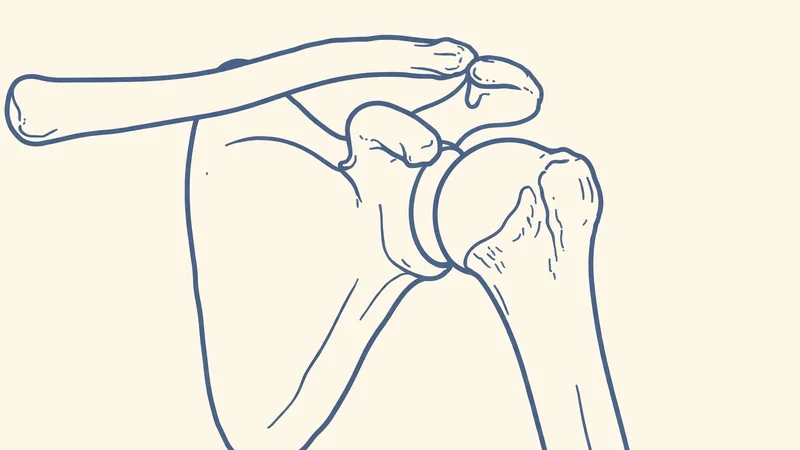
Shoulder anatomy & how it works
Supraspinatus: The Small Muscle Behind Big Shoulder Problems
4-minute read · Published June 16, 2025 · Updated June 16, 2025

Why this happens
The supraspinatus sits in the hollow above the spine of the shoulder blade (the scapula). Its tendon runs across the top of the shoulder joint and attaches to the upper arm bone. In simple terms, it helps start the lift of the arm to the side and keeps the ball of the joint centred in its socket.
Because the tendon passes under a bony arch at the top of the shoulder, it is one of the muscles people hear about most in discussions of shoulder pain. That attention is understandable. It does not mean the muscle is the sole source of a problem.
Think of the supraspinatus as one member of a team. The other rotator cuff muscles, the shoulder blade muscles and the nervous system's sense of joint position all share the work. When one member struggles, the whole team may change how it moves.
What the research says
- Rotator cuff-related shoulder pain is the most common cause of shoulder pain, and it includes subacromial pain, tendinopathy and symptomatic tears [R03]. The supraspinatus tendon is one of the rotator cuff tendons that can be involved in these problems.
- In the same 2025 review, scapular stabilization exercise improved pain and function [R03]. Movement that trains the shoulder blade is part of the picture.
- Shoulder disorders often go with reduced joint position sense, and rehabilitation usually moves from range of motion to strength, then to control and coordination [R16].
What you can do
- Learn the lift slowly. Sit tall with your arm at your side. Lift it out to the side only as high as is comfortable, then lower it with control.
- Slow the lowering. The lowering phase trains control, and many people find it more useful than a fast lift.
- Add shoulder-blade work. Gentle reaches and slow circles help the muscles that position the shoulder blade. Keep them small.
- Work seated first. A supportive chair takes the load off your legs and back and lets you focus on the shoulder.
- Keep a simple log. Note which movements feel comfortable and which bring on pain. A clinician will find this useful.
- Get a check when things change. Pain at night, growing weakness, or a shoulder that feels unstable needs a clinician, not more repetitions.
Where ShoulderBack Pro fits — and where it doesn't
The Dumbbell Raise lesson in ShoulderBack Pro is the closest match: the site lists the supraspinatus and lateral deltoid as its targets, and it is a slow sideways lift with no weight. The other arm supplies the resistance, so you can resist harder or lift through more range as it gets easier. SeeSaw is a gentler first step for the shoulder blade side.
It cannot tell you whether a tendon is torn, and it is no replacement for a clinician's plan. It is a wellness tool with no clinical trials. Start with the SeeSaw lesson, or look at the trainer.
When to see a professional
The red flags below follow standard shoulder-care guidance [R30]. If any of them apply, get assessed before you keep moving through the area.
See a doctor or physiotherapist promptly if you have: pain after a fall or injury with sudden weakness or loss of movement; a shoulder that looks deformed, very swollen or bruised; fever or feeling unwell alongside the pain; chest pain or breathlessness (call emergency services); constant pain that doesn't change with rest or activity; pain that wakes you most nights; numbness, tingling or weakness into the arm or hand; pain in several joints at once; or pain that hasn't improved after a couple of weeks of sensible self-care.
Only a doctor or physiotherapist can diagnose a problem in the supraspinatus or the tendons around it.
Try this movement
SeeSaw (the muscles around the shoulder blade) →Frequently asked questions
Is the supraspinatus the same as a rotator cuff tear?
No. The supraspinatus is a muscle. A tear is an injury to its tendon or nearby tissue, and only a clinician can tell whether one is present.
Can I exercise the supraspinatus at home?
Gentle, controlled movement is one option. Progressive, resisted exercise has the best support for rotator cuff-related pain [R01], so ask a clinician how to build up safely.
What should make me stop and see someone?
Sharp pain, night pain that wakes you, or new weakness are reasons to pause and see a clinician.
Sources
- Naunton J et al. (2020). Effectiveness of progressive and resisted and non-progressive or non-resisted exercise in rotator cuff related shoulder pain: systematic review and meta-analysis of RCTs. Clinical Rehabilitation. https://search.pedro.org.au/search-results/record-detail/61404
- Frontiers in Bioengineering & Biotechnology (2025). Specific modes of exercise to improve rotator cuff-related shoulder pain: systematic review and meta-analysis. https://pmc.ncbi.nlm.nih.gov/articles/PMC12011739/
- Mureşan et al. (2022). Effects of a novel proprioceptive rehabilitation device on shoulder joint position sense, pain and function. Medicina. https://www.ncbi.nlm.nih.gov/pmc/articles/PMC9505091/
- NHS Greater Glasgow & Clyde, Shoulder red flags; NHS MPFT self-help, Shoulder pain; BESS/BOA pathway summary (2021). https://www.nhsggc.scot/page_category/services/page/33