Coordination, control & how ShoulderBack Pro works
Steering: Gentle Rotation for Deltoids and Rhomboids
4-minute read · Published February 3, 2025 · Updated February 3, 2025
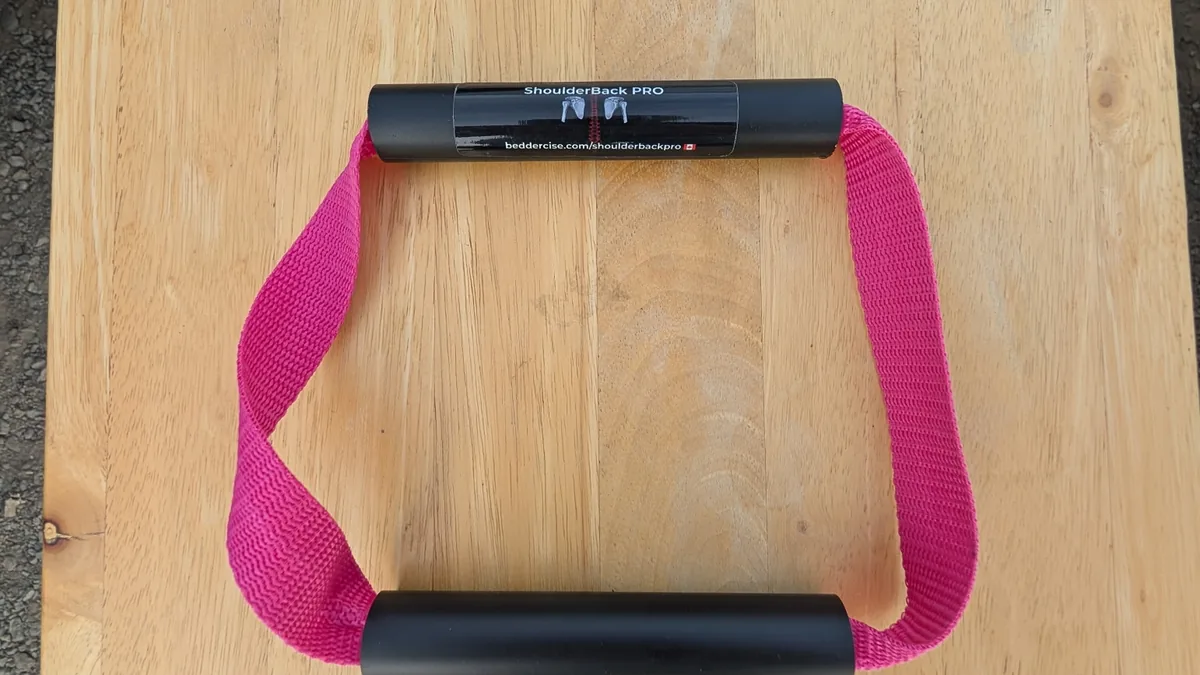
Steering is one of the simplest shoulder movements to learn. You hold two handles, picture a wheel and turn it slowly. The movement feels like driving through a gentle corner. Your shoulders do the work, and your arms move together.
This post explains what the movement is, why working both arms together is interesting and how to keep it gentle. For the wider design behind it, see our guide to how ShoulderBack Pro works.
What the Steering movement is
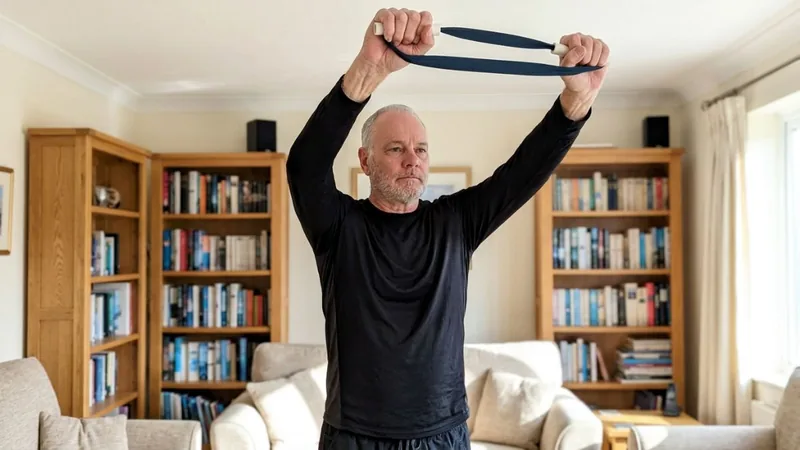
In ShoulderBack Pro, the two handles are joined by a fixed-length, non-elastic strap. Each hand holds one handle. Steering uses the classic ten-and-two hand position, as if you were on a steering wheel.
The movement works two groups of muscles. The deltoids are the rounded muscles on top of the shoulder. The rhomboids sit between the shoulder blades and help hold them in place.
In the trainer, one arm assists while the other resists. You set the effort, pace and range. Nothing stretches, snaps or drops, which makes the movement easy to control.
Why both arms together is interesting
Working both arms at the same time is not new. Researchers have studied it in rehabilitation for years.
- In chronic stroke patients, bilateral training, which moves both arms together, produced greater shoulder improvement than single-arm training [R14]. That work is in stroke rehabilitation, not in healthy adults. It is a reason the idea is interesting, not proof that any tool works.
- Training that challenges joint position sense improved the untrained opposite wrist as well as the trained one, 24 hours later [R15]. In plain words, the two sides of the body can learn from each other.
- Programs that teach control and coordination may edge out generic exercise, though we do not fully know why [R02].
These ideas are a good starting point. They do not tell us how much Steering helps any one person.
What you can do
- Sit tall with your feet flat. Hold the handles at ten and two. Seated option: this is the default position, and it is the easiest place to start.
- Turn slowly. Move both hands as if steering through a gentle corner. Keep your elbows soft rather than locked.
- Keep the range small at first. Let the strap guide the arc, and stop before you feel strain. Seated option: keep the turn in front of your chest.
- Breathe out as you turn. Slow breathing helps the movement feel controlled. Seated option: all of this works from a chair.
- Do a few slow turns each way. Rest between sets. Focus on smooth movement, not speed. Seated option: rest your forearms on your thighs.
- Stand if you want more challenge. Stand with feet hip-width apart and keep the same slow pace. Stop if you feel dizzy or unsteady.
- Stop if pain rises. Mild effort is fine. Sharp pain, or pain that lingers the next day, means you should back off and seek advice.
Where ShoulderBack Pro fits — and where it doesn't
Steering is one of the 16 movements the trainer was built around. The site lists the deltoids and rhomboids as its targets, and the other arm provides the resistance, so you control how hard it is by resisting more, moving through more range or doing longer sets. It works seated or standing, with no door anchor or weights. It's a wellness tool rather than a treatment, and it has not been tested in clinical trials. You can find Steering among the 16 video lessons, and the trainer is $29 CAD with a 30-day guarantee.
When to see a professional
See a doctor or physiotherapist promptly if you have: pain after a fall or injury with sudden weakness or loss of movement; a shoulder that looks deformed, very swollen or bruised; fever or feeling unwell alongside the pain; chest pain or breathlessness (call emergency services); constant pain that doesn't change with rest or activity; pain that wakes you most nights; numbness, tingling or weakness into the arm or hand; pain in several joints at once; or pain that hasn't improved after a couple of weeks of sensible self-care.
If you have shoulder pain, ask a clinician whether gentle movement like Steering is right for you before you start.
Try this movement
All 16 video lessons →Frequently asked questions
Is Steering good for beginners?
It can be, if you have been cleared for gentle movement. Start with a small range and a slow pace, and build up only when it feels easy.
Which muscles does Steering work?
Steering works the deltoids on the top of the shoulder and the rhomboids between the shoulder blades. Other muscles help too, as they do in most shoulder movements.
Can I do Steering with a sore shoulder?
Only if a clinician has cleared gentle movement for you. Stop at sharp pain, and do not push through it.
Sources
- Journal of Physical Therapy Science (2016). The effects of bilateral movement training on upper limb function in chronic stroke patients. https://pmc.ncbi.nlm.nih.gov/articles/PMC5011582
- Scientific Reports (2021). Proprioceptive-focused training transfers gains to the opposite, untrained limb. https://pmc.ncbi.nlm.nih.gov/articles/PMC7935923
- Dubé M-O et al. (2024). The Efficacy of Exercise Therapy for Rotator Cuff-Related Shoulder Pain According to the FITT Principle: Systematic Review With Meta-analyses. JOSPT. https://pubmed.ncbi.nlm.nih.gov/38848304/
More in this topic
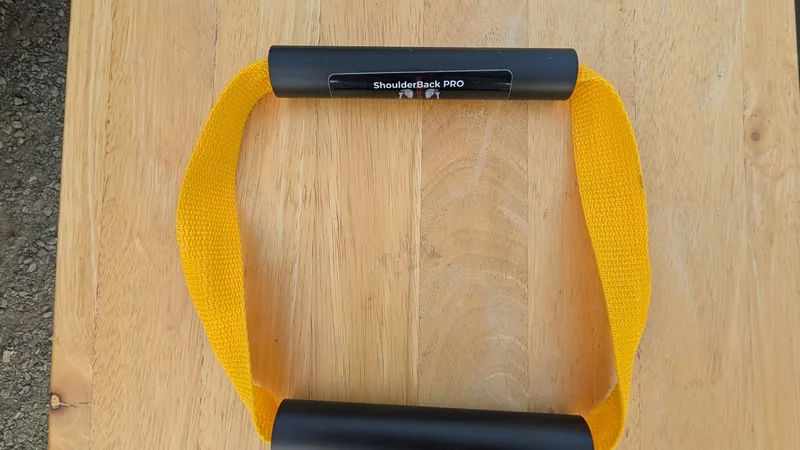 Essential guide: How ShoulderBack Pro Works: One Device, Two Connected Handles, Your Own Resistance
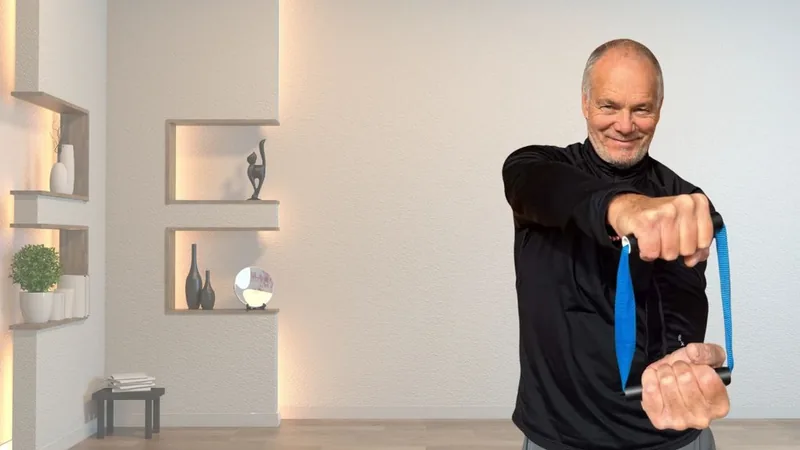 Pairing SBP With Walking: The Simplest Whole-Body Routine for Active Aging
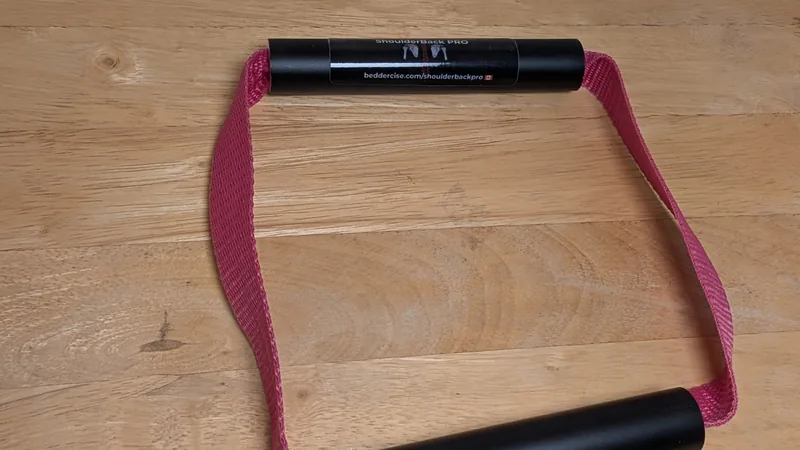 Locomotive: Rolling Circles for the Upper Back and Rear Cuff
 Overhead Press (High Shelf Reach): Trapezius and Deltoids Without a Weight