Comparisons, buyer's guides & honest product answers
Our Honest Answer to 'Will This Fix My Shoulder?'
6-minute read · Published November 4, 2026 · Updated November 4, 2026
What this question is really asking
Shoulder pain is wearing, frustrating and often confusing. You want to know whether something will make it go away. That is a fair question, and it deserves a straight answer rather than a sales pitch.
The honest answer is that the word "fix" assumes you know what is wrong. Shoulder pain can come from tendons, the bursa, the joint capsule, the nerves, or a mix. A clinician finds out which, and then plans what to do. We are not able to diagnose you from a website, and we would not want to.
Why this happens
Most shoulder pain is managed in primary care with advice and exercise. Acute, severe pain after an injury needs proper assessment first [R30].
Some shoulder problems need a different kind of answer. Frozen shoulder, for example, involves excess scar tissue in the joint capsule, which causes pain and loss of movement [R18]. The idea that frozen shoulder simply resolves by itself is not supported. Untreated cases improved only partly over one to four years in one systematic review [R19]. If your shoulder is getting stiffer, do not wait it out. See a clinician.
What the research says
- Progressive, resisted exercise probably helps rotator-cuff-related shoulder pain. Gentle, unloaded movement alone probably does not move the needle on pain [R01].
- In that same review, the resisted exercise benefit was about 15 points on a 0 to 100 scale. The authors said its clinical importance is uncertain [R01].
- Programs that teach control and coordination may reduce disability slightly more than generic exercise in the short and medium term. It is not clear whether this is due to control itself or to progression and tailoring [R02].
- A 2025 review found that mobilization and stretching improved function and pain over about two months. Scapular stabilization exercise also improved pain and function [R03].
- For middle-aged and older adults with this kind of pain, exercise-based interventions reduce pain and improve function and range of motion [R04].
Put simply: exercise helps many people, but the type, the dose and the progression all matter. No single product is the answer.
What you can do
- Get the right assessment first. Book a visit with a doctor or physiotherapist. Ask them to name the likely cause and explain why.
- Ask for a plan, not a product. Good questions: Which movements? How much? How will we progress? How will we know it is working?
- Start gently and only if cleared. A seated routine with slow, pain-tolerant reaches is a reasonable first stage for many people.
- Progress resistance over weeks. A band, light dumbbells or a clinician-led plan can add load. Seated band rows are one simple option.
- Track what you can do. Note reach, range and everyday tasks each week. A simple log beats memory.
- Stop anything that brings sharp pain. Back off, rest, and ask your clinician about it.
Where ShoulderBack Pro fits, and where it doesn't
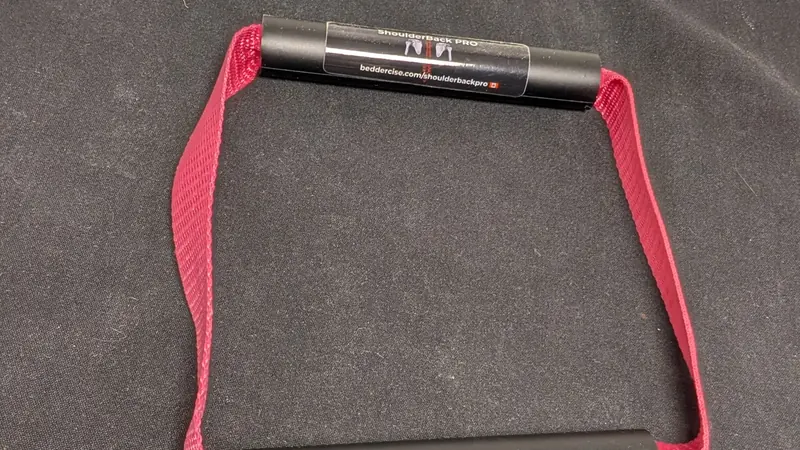
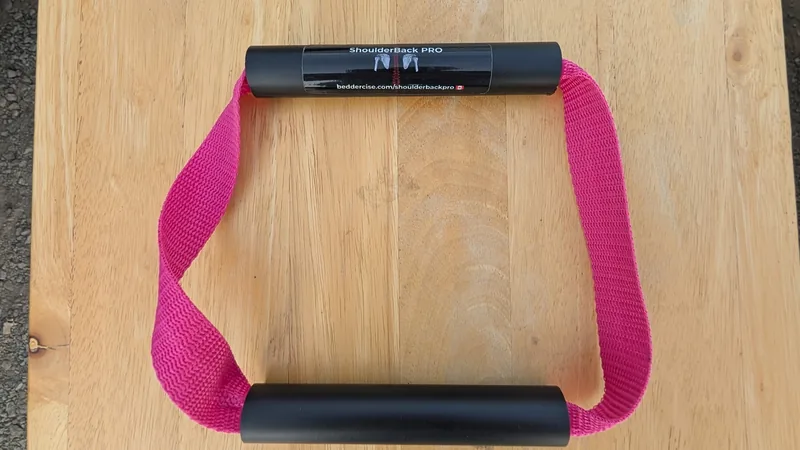
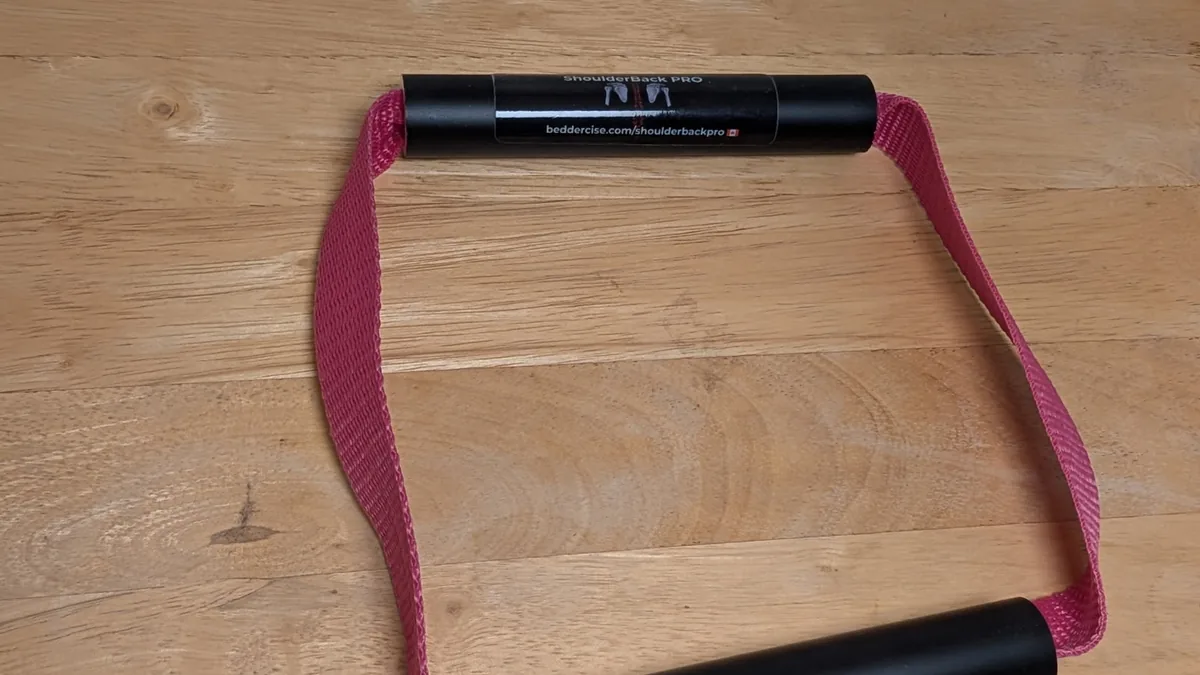
Two SBP lessons suit a cleared, gentle start. Open The Door works the infraspinatus and rhomboid major with your elbows at your sides, and Windshield Wipers uses slow side-to-side arcs for the rotator cuff muscles. Both can be done seated.
The resistance comes from your other arm, so it tops out at what one arm can resist. For heavier loading, a band or dumbbell plan set up with a clinician may suit you better, since resisted exercise that progresses is what the research supports [R01]. SBP is a wellness tool with no clinical trials.
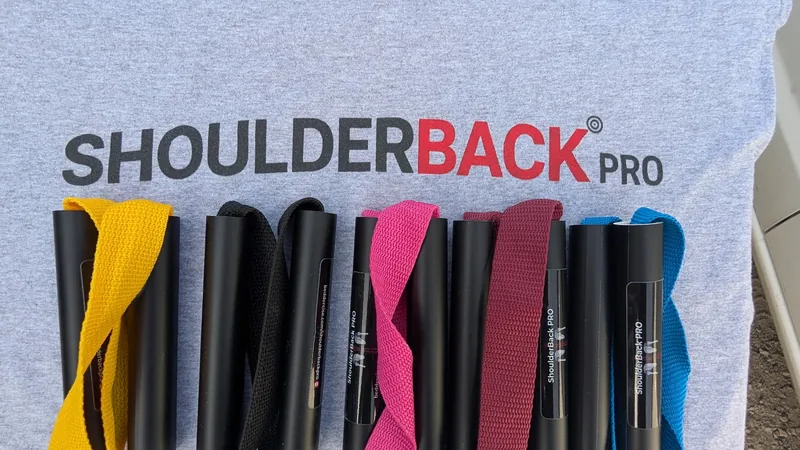
It costs $29 CAD and comes with a 30-day guarantee. You can see the trainer in the shop. All 16 video lessons are free to follow.
When to see a professional
See a doctor or physiotherapist promptly if you have: pain after a fall or injury with sudden weakness or loss of movement; a shoulder that looks deformed, very swollen or bruised; fever or feeling unwell alongside the pain; chest pain or breathlessness (call emergency services); constant pain that doesn't change with rest or activity; pain that wakes you most nights; numbness, tingling or weakness into the arm or hand; pain in several joints at once; or pain that hasn't improved after a couple of weeks of sensible self-care.
If your shoulder is stiff and getting worse, or you have any warning sign above, a clinician comes before any routine.
Try this movement
All 16 video lessons →Frequently asked questions
Will ShoulderBack Pro fix my shoulder?
No. It is not a treatment for diagnosed shoulder conditions. It is a trainer for controlled, two-arm movement, and some people find it a useful part of a routine.
How long until I notice a difference?
There is no reliable timeline that applies to everyone. One 2025 review looked at exercise over about two months and found gains in pain and function for several exercise types.
Do I need a clinician before I start?
If you have any warning sign, such as sudden weakness, numbness or night pain that wakes you, yes. If you are unsure, a visit is a good first step.
What if it doesn't help me?
Then you have useful information. Ask your clinician about other options.
Sources
- Naunton J et al. (2020). Effectiveness of progressive and resisted and non-progressive or non-resisted exercise in rotator cuff related shoulder pain: systematic review and meta-analysis of RCTs. Clinical Rehabilitation. https://search.pedro.org.au/search-results/record-detail/61404
- Dubé M-O et al. (2024). The Efficacy of Exercise Therapy for Rotator Cuff-Related Shoulder Pain According to the FITT Principle: Systematic Review With Meta-analyses. JOSPT. https://pubmed.ncbi.nlm.nih.gov/38848304/
- Frontiers in Bioengineering & Biotechnology (2025). Specific modes of exercise to improve rotator cuff-related shoulder pain: systematic review and meta-analysis. https://pmc.ncbi.nlm.nih.gov/articles/PMC12011739/
- BMC Musculoskeletal Disorders (2026). Exercise interventions for rotator cuff-related shoulder pain in middle-aged and older adults: systematic review and meta-analysis. https://link.springer.com/10.1186/s12891-026-10035-4
- Le HV, Lee SJ, Nazarian A, Rodriguez EK (2017). Adhesive capsulitis of the shoulder: review of pathophysiology and current clinical treatments. Shoulder & Elbow 9(2):75-84. https://pubmed.ncbi.nlm.nih.gov/28405218/
- Wong CK et al. (2017). Natural history of frozen shoulder: fact or fiction? A systematic review. Physiotherapy 103(1):40-47. https://pubmed.ncbi.nlm.nih.gov/27641499/
- NHS Greater Glasgow & Clyde, shoulder red flags; NHS MPFT self-help, shoulder pain; BESS/BOA pathway summary (2021). https://pmc.ncbi.nlm.nih.gov/articles/PMC7905504