Rotator cuff & shoulder strength
Rotator Cuff Exercises at Home: Strength, Control and Range — Without a Gym
11-minute read · Published February 3, 2026 · Updated February 3, 2026

If you want the research first, read Do Rotator Cuff Exercises Actually Work?. It covers the evidence in more detail. For a related read on the outward movement, see External Rotation Exercises.
What the rotator cuff is
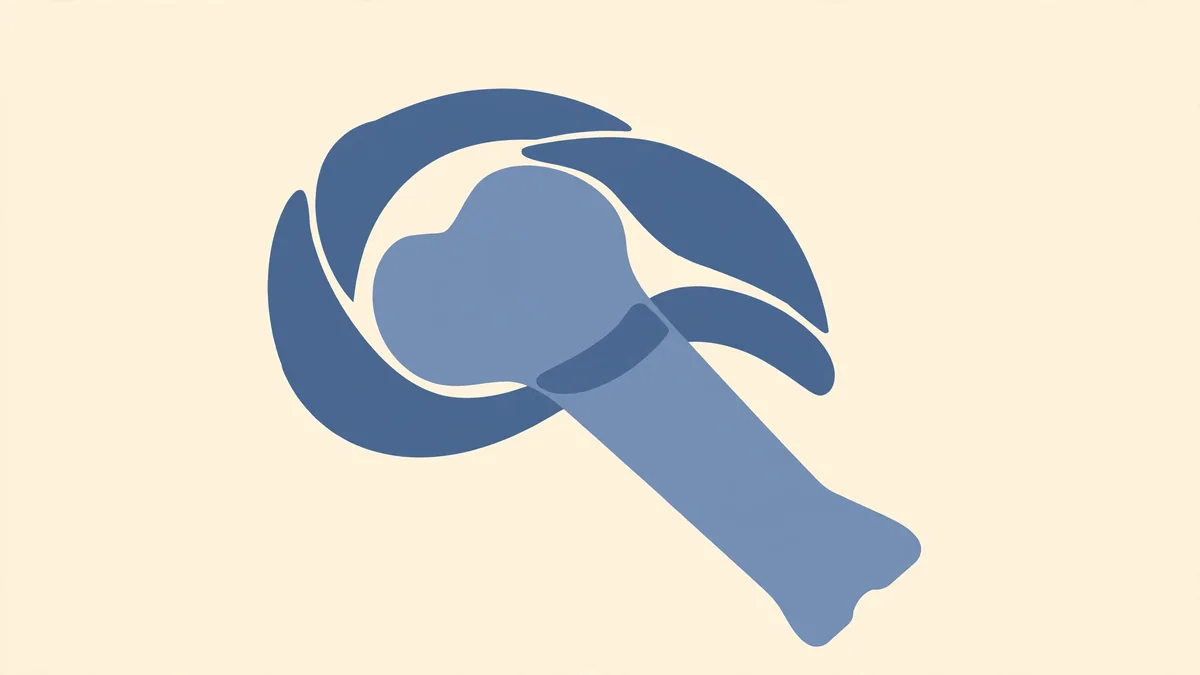
The rotator cuff is a group of four muscles and their tendons: the supraspinatus, infraspinatus, teres minor and subscapularis. Tendons are the tough cords that attach muscle to bone. Together, these muscles hold the ball of the upper arm bone in its socket while the larger muscles move the arm.
Shoulder pain is common, and the rotator cuff is one of the most frequent places it comes from. A 2025 review describes rotator cuff-related shoulder pain as the most common cause of shoulder pain overall. That category includes pain from irritated tendons (tendinopathy), pain from the space above the cuff (subacromial pain), and symptomatic tears [R03].
Why does this matter for exercise? Because the right plan depends on which of these is going on. A physiotherapist, doctor or other clinician diagnoses the cause after an examination. Only they can tell whether a tear is involved. Reading an article, including this one, cannot do that for you.
What the research says
The evidence is useful, but it is not a single clear answer. These are the main points:
- Resisted exercise that progresses over time probably helps with shoulder pain. Gentle, unloaded movement alone probably does not move the needle much on pain [R01]. The size of the benefit was about 15 points on a 0 to 100 scale, and the authors judged its clinical importance uncertain.
- Programs that teach control and coordination may reduce disability slightly more than generic exercise, at least in the short and medium term. The evidence on pain is less certain, and we do not fully know why this works [R02].
- A 2025 review found that mobilization and stretching improved function and pain over about two months. Scapular stabilization exercise, which trains the muscles that steady the shoulder blade, also improved pain and function [R03].
- In middle-aged and older adults, exercise-based programs reduced pain and improved function and range of motion [R04]. This review was checked from its abstract only, so read the result as a general finding.
- Resistance training is a recognized way for older adults to keep strength, mobility and independence. The same statement notes that fears and barriers should be addressed [R06].
Put simply, progressive, controlled strengthening seems to be the best-supported approach. Many clinicians suggest combining it with range of motion work and a gradual increase in effort. The research is still developing, and the specific exercises matter less than the pattern of gradual, controlled loading.
Why strength and control both matter
Strength is how much force a muscle can produce. Control is how well the muscles coordinate to move the arm smoothly. Both matter for the rotator cuff. A cuff that can produce force but cannot coordinate with the blade may not handle everyday reaching well. A cuff that moves well but cannot produce force may struggle with lifting a grandchild or a grocery bag.
That is why many programs combine short strength blocks with slow, controlled movement. Think of strength as the engine and control as the steering. You need both.
What you can do at home
Start with the gentlest option that feels comfortable. Each step has a seated version, and most have a standing version too. Stop if you feel sharp pain. Mild effort or a light stretch is normal.
- Seated external rotation, arms at sides. Sit tall with elbows bent at 90 degrees and tucked to your sides. Keep a small towel rolled between your elbow and your ribs if that helps. Slowly swing your forearm outward, then back to the start. Do eight repetitions. This targets the infraspinatus, which turns the arm outward.
- Seated shoulder blade slides. Sit with your arms relaxed. Draw your shoulder blades down and back gently. Hold for three seconds, then release. Eight repetitions.
- Wall or table slides, seated. Sit at a table with your forearm resting on a towel. Slide your hand forward a few centimetres, then back. This practises reaching with control and needs no weight. Eight repetitions.
- Standing external rotation with a light band. If a band feels appropriate and your clinician agrees, stand with your elbow tucked and rotate outward against light tension. Start with very light resistance. Eight repetitions.
- Supported forward raise. Sit with your back supported. Raise one arm forward only to a comfortable height, then lower slowly. Keep the movement smooth. Six repetitions.
- Controlled arm circles. Sit tall and make small, slow circles with a relaxed arm. Keep the shoulder down and the movement gentle. Five circles each way.
Use these on most days. Rest between sessions if your shoulder feels sore the next morning.

How to progress without pushing
Progress only when the current level feels easy for the full set and the shoulder is calm the next day. Make one change at a time. You can add a repetition, slow the lowering part of the movement, use a slightly stronger band, or move from seated to standing.
If pain rises during a set, reduce the effort or the range. If pain lingers beyond a day, go back to the last level that felt comfortable and ask a clinician for advice. Progress is not a race. A few weeks of steady, boring practice often beats a few days of intensity.
Where ShoulderBack Pro fits, and where it doesn't
Two of the 16 lessons line up with the cuff work above. Open The Door is designed to work the infraspinatus and rhomboid major, close to the external rotation in step 1. Windshield Wipers uses slow side-to-side arcs and is designed to work the subscapularis, infraspinatus and teres minor.
The resistance comes from your other arm, so you progress by resisting harder, moving through more range or doing longer sets. It is a wellness tool with no clinical trials, and it does not replace physiotherapy for a diagnosed problem. You can see ShoulderBack Pro here.
When to see a professional
See a doctor or physiotherapist promptly if you have: pain after a fall or injury with sudden weakness or loss of movement; a shoulder that looks deformed, very swollen or bruised; fever or feeling unwell alongside the pain; chest pain or breathlessness (call emergency services); constant pain that doesn't change with rest or activity; pain that wakes you most nights; numbness, tingling or weakness into the arm or hand; pain in several joints at once; or pain that hasn't improved after a couple of weeks of sensible self-care.
A doctor, physiotherapist or other clinician diagnoses rotator cuff problems and decides whether a tear is involved. Ask for a plan before starting any new routine if you have a suspected tear, a recent injury, or surgery in the past year.
Try this movement
Open the Door (infraspinatus, rhomboids) →Frequently asked questions
How often should I do rotator cuff exercises at home?
Many people do them on most days in short sessions, rather than once a week for a long session. The research does not give one perfect schedule, so start gently and adjust based on how you feel the next day.
Can I do these exercises if I have been diagnosed with a tear?
Ask your clinician first. Some people with a tear are guided into gentle, controlled movement, but the plan should come from the person who examined your shoulder.
Do I need weights?
No. Your own arm, a towel, a wall, or a resistance tool can all provide load. The key is that the effort increases gradually and you stay in control.
What if an exercise hurts?
A mild stretch or effort is normal. Sharp pain, pain that lingers into the next morning, or pain that spreads into the arm or hand are signs to stop and get advice.
Is a rotator cuff problem always a tear?
No. Many shoulder problems involve irritated tendons or swollen tissue without a tear. A clinician can tell the difference, usually through an exam and sometimes imaging.
Sources
- Naunton J et al. (2020). Effectiveness of progressive and resisted and non-progressive or non-resisted exercise in rotator cuff related shoulder pain: systematic review and meta-analysis of RCTs. Clinical Rehabilitation. https://search.pedro.org.au/search-results/record-detail/61404
- Dubé M-O et al. (2024). The Efficacy of Exercise Therapy for Rotator Cuff-Related Shoulder Pain According to the FITT Principle: Systematic Review With Meta-analyses. JOSPT. https://pubmed.ncbi.nlm.nih.gov/38848304/
- Frontiers in Bioengineering & Biotechnology (2025). Specific modes of exercise to improve rotator cuff-related shoulder pain: systematic review and meta-analysis. https://pmc.ncbi.nlm.nih.gov/articles/PMC12011739/
- BMC Musculoskeletal Disorders (2026). Exercise interventions for rotator cuff-related shoulder pain in middle-aged and older adults: systematic review and meta-analysis. https://link.springer.com/10.1186/s12891-026-10035-4
- Fragala MS, Cadore EL, Dorgo S et al. (2019). Resistance Training for Older Adults: Position Statement From the National Strength and Conditioning Association. J Strength Cond Res. https://pubmed.ncbi.nlm.nih.gov/31343601/
- NHS Greater Glasgow & Clyde — Shoulder red flags; NHS MPFT self-help — Shoulder pain; BESS/BOA pathway summary (2021). https://pmc.ncbi.nlm.nih.gov/articles/PMC7905504