Comparisons, buyer's guides & honest product answers
Resistance Bands vs ShoulderBack Pro: An Honest Comparison
10-minute read · Published April 7, 2025 · Updated April 7, 2025

Why this comparison matters
Many people want to strengthen their shoulders at home. The two tools most often considered are an elastic resistance band and a body-controlled trainer. They look different, and they feel different in the hands. Choosing between them is mostly a question of how you like to move and what you want to get out of your sessions.
This article is written to be fair to both. ShoulderBack Pro is our product, so we have tried to say plainly where a band is the better tool. You should also know that we are not aware of any study that compares the two directly. The comparison below is based on how each tool is built and how it is used, not on head-to-head trial results.
What each tool is
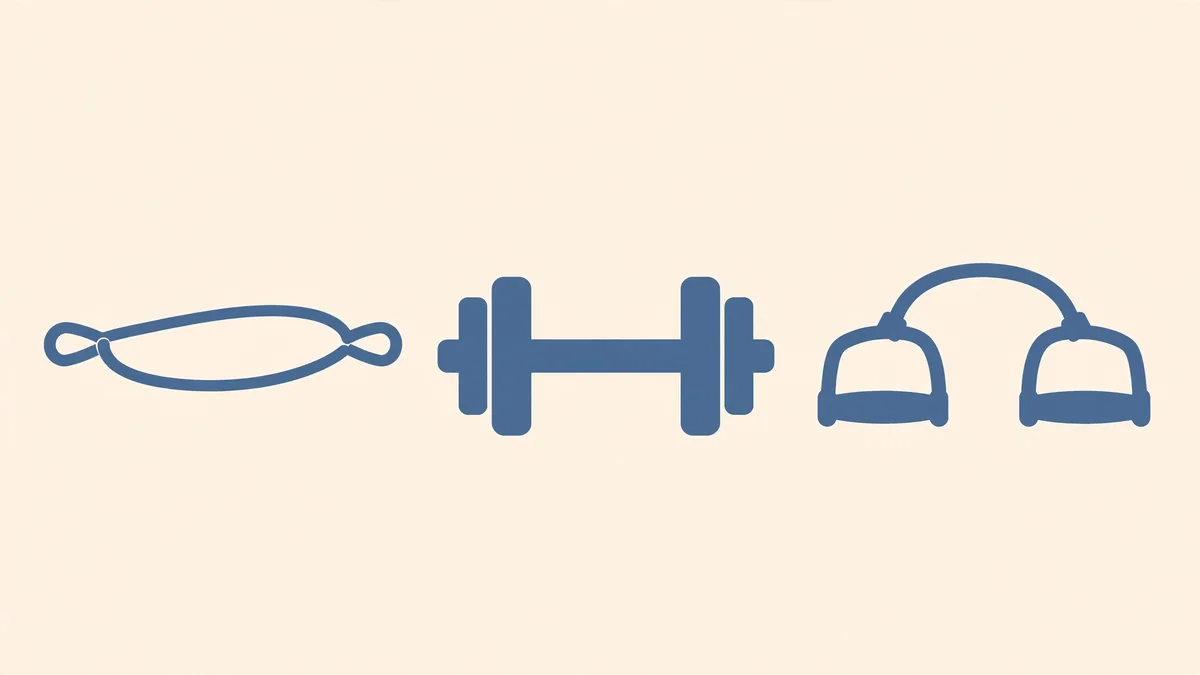
A resistance band is an elastic loop or strip. You pull it, and it pushes back. Its resistance grows as it stretches, so a further pull usually feels harder. Bands are often anchored to a door or a fixed point, or simply held in the hands.
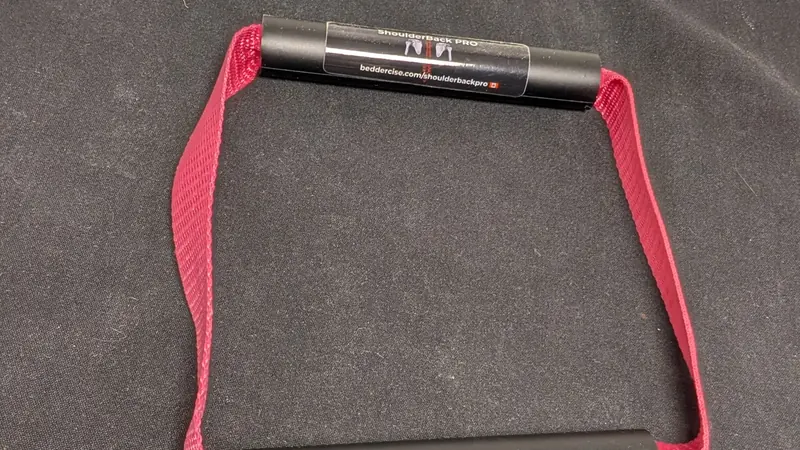
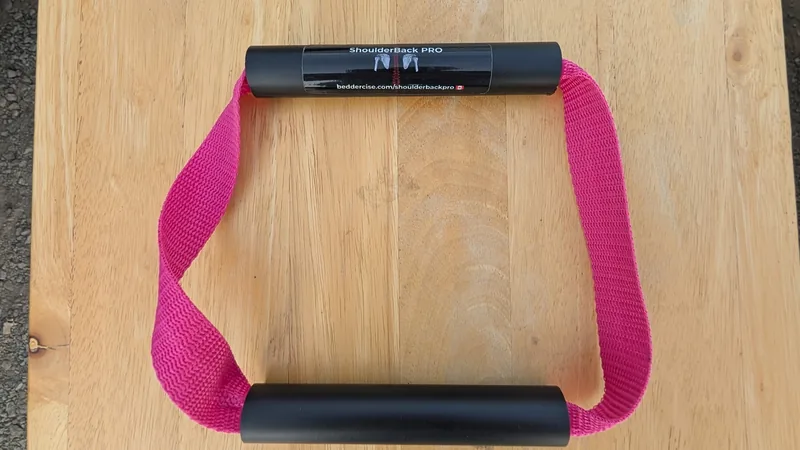
ShoulderBack Pro is a 160-gram, pocket-size trainer made in Canada. It has two handles joined by a fixed-length, non-elastic strap. Nothing stretches, snaps or drops. One arm assists while the other resists, and you set the effort, pace and range. It needs no door anchor and no weights, and you can use it seated in an armchair or standing.
Both are tools. Neither is a treatment for a shoulder condition.
How they differ
| Feature | Resistance band | ShoulderBack Pro |
|---|---|---|
| How resistance is made | The band stretches and pushes back | A fixed-length strap; one arm resists the other |
| Anchoring | Often needs an anchor or a fixed point, or is held in the hands | No anchor, no door, no weights |
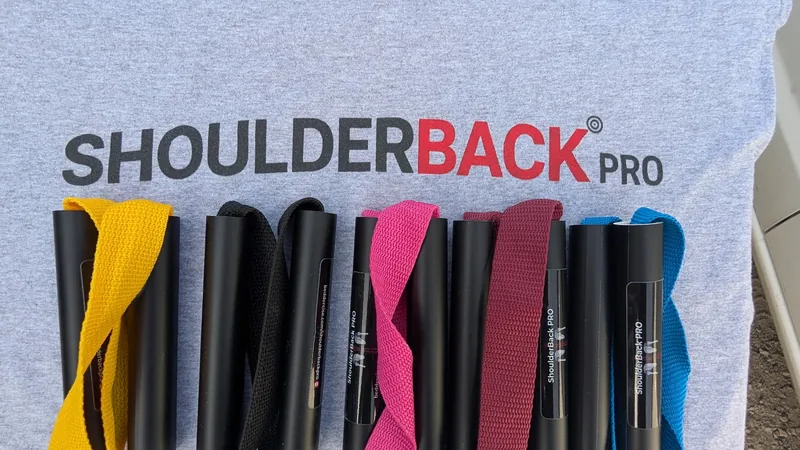
| Changing the challenge | Change band strength, grip or stretch distance | Change effort, pace and range yourself; all four strap colours feel the same |
| Guidance | Depends on the exercises you find | 16 guided video lessons taught by the inventor |
Use this table as a starting point, not a verdict. Many people do well with either.
What the research says
- Resisted exercise that gets a little harder over the weeks probably helps rotator cuff-related shoulder pain. Gentle movement with no load probably does not [R01].
- The evidence for motor-control programs suggests they may reduce disability a little more than generic exercise. The pain effect is uncertain [R02].
- Resistance training helps older adults keep the strength they need for daily life. The guidance also says that fears and barriers should be addressed [R06].
- Official guidance says adults should do muscle-strengthening activity at least two days a week, and that adults 65 and over should add activity that builds balance and strength [R07].
- In stroke rehabilitation, training both arms together gave greater shoulder-movement gains than single-arm training. This comes from stroke patients, not healthy adults, so it is an interesting idea rather than proof for any tool [R14].
Notice what these findings do not say. They do not show that bands are better than ShoulderBack Pro, or the reverse. They support resisted, progressive exercise in general.
Why this comparison matters for older shoulders
Some readers ask whether bands are bad for aging shoulders. We found no good evidence that bands cause harm. The practical concerns are about control. A band can slip from an anchor, snap if it is worn, or feel abrupt if you let it snap back. Those are safety points, not proof of injury.
A trainer with a fixed-length strap removes some of those concerns. Nothing stretches or snaps, and no anchor is needed. That makes it simpler to use in a chair. It also means you have to rely on your own control more, because the strap does not give you the same feel as an elastic loop.
Neither point is a reason to avoid one tool or the other. It is a reason to choose the tool you can use smoothly and safely.
What you can do
- Decide what you want. Are you building general strength, reaching better, or working on a specific shoulder goal? Write it down. Seated option: this planning can be done in your armchair.
- Follow your clinician's plan first. If a physiotherapist has given you exercises, use them as your starting point. Ask whether a band or a trainer suits your program.
- Choose a band if you want variety and progression. Many band moves can be done from a chair, and a band lets you progress across many exercises. Seated option: anchor the band under your foot, or simply hold it in both hands.
- Choose ShoulderBack Pro if you want a no-anchor, guided option. It suits people who want a small, seated trainer with lessons. Seated option: the trainer is designed to be used in an armchair.
- Go slowly with either. Smooth, controlled movement is easier to repeat than fast, forceful movement. Stop with sharp pain, numbness or sudden weakness.
- Track your sessions. Note the date, the tool, how long you practised and how your shoulder felt afterwards. Review the notes after a month.

Where ShoulderBack Pro fits — and where it doesn't
ShoulderBack Pro fits well if you want a simple, seated option with guided lessons. Bear Hugs Me draws the trainer toward your chest and is designed to work the middle trapezius and rhomboids, while Overhead Press (High Shelf Reach) practises reaching up without a weight. In both, your other arm provides the resistance, so you progress by resisting harder, moving through more range or doing longer sets. The video lessons page has all 16.
If your goal is heavy strength, a band or weights will suit you better. SBP is a wellness tool, not a treatment, and there are no clinical trials of it yet. Neither tool treats a tear or nerve symptoms. Frozen shoulder in particular does not reliably recover without treatment [R19], so a stiffening shoulder should be assessed by a clinician before you choose any tool. Details are in the shop.
Related reading: our piece on why resistance bands can feel hard on aging shoulders and our comparison of dumbbells and body-controlled resistance.
Who each tool suits
A band may suit you if you want many different strengthening exercises, you like to progress by changing the band, or a physiotherapist has already prescribed band work. Bands are also easy to pack. Because the resistance rises as the band stretches, a band can give a clear sense of progress when you add strength over time.
ShoulderBack Pro may suit you if you want a simple seated option, you do not want to set up an anchor, or you learn best from guided video. Its fixed strap gives the same feel from one session to the next, and you can change effort, pace and range without changing equipment. It is a poor fit if your main goal is to build heavy strength quickly.
Neither tool is the right first choice if your shoulder is newly injured, painful at night, or recovering from surgery. In those cases, your clinician should set the plan before you choose any tool.
Running a fair test
If you are unsure, try each tool for a few weeks. Use the same time of day and the same simple movements, such as a gentle reach and a slow pull. Keep a short note after each session. Write down how the shoulder felt during the session and the next morning.
Compare your notes, not your impressions in the moment. Shoulders often feel better or worse the day after, so the next-morning note is the more useful one. If one tool causes sharp pain, numbness or weakness, stop using it and book an assessment.
Questions to ask yourself before you buy
Before you choose, consider these questions. They matter more than any single feature.
- Do you have a space for an anchor? If not, a trainer with no anchor may be easier.
- Do you want to change the challenge quickly? Bands change by strength and stretch. ShoulderBack Pro changes by effort, pace and range.
- Do you prefer guided lessons or your own plan? ShoulderBack Pro includes 16 lessons. Bands usually come without guidance.
- Are you recovering from anything? If so, your clinician's advice comes before any product.
When to see a professional
See a doctor or physiotherapist promptly if you have: pain after a fall or injury with sudden weakness or loss of movement; a shoulder that looks deformed, very swollen or bruised; fever or feeling unwell alongside the pain; chest pain or breathlessness (call emergency services); constant pain that doesn't change with rest or activity; pain that wakes you most nights; numbness, tingling or weakness into the arm or hand; pain in several joints at once; or pain that hasn't improved after a couple of weeks of sensible self-care.
Only a doctor, physiotherapist or other qualified clinician can diagnose the cause of your shoulder pain. If you are choosing a tool to help with a diagnosed problem, ask your clinician which exercises and loads are right for you.
Try this movement
All 16 video lessons →Frequently asked questions
Are resistance bands bad for older shoulders?
There is no good evidence that bands harm shoulders. Bands can slip or snap, so set them up carefully and check them for wear.
Can I use a band and ShoulderBack Pro together?
Possibly, if your clinician agrees and you keep the effort gentle. Use one tool at a time at first so you can tell how each feels.
Does ShoulderBack Pro work better than bands?
We cannot say. Research compares resisted exercise with no resisted exercise, and none we know of compares a band with ShoulderBack Pro.
Which one costs less?
Prices vary by shop and by pack size. ShoulderBack Pro is $29 CAD, or $87 CAD for a four-pack with free shipping. Compare current prices for bands before you decide.
What if I am recovering from surgery?
Follow your surgeon's or physiotherapist's protocol first. Use either tool only if they approve.
Sources
- Naunton J et al. (2020). Effectiveness of progressive and resisted and non-progressive or non-resisted exercise in rotator cuff related shoulder pain: systematic review and meta-analysis of RCTs. Clinical Rehabilitation. https://search.pedro.org.au/search-results/record-detail/61404
- Dubé M-O et al. (2024). The Efficacy of Exercise Therapy for Rotator Cuff-Related Shoulder Pain According to the FITT Principle: Systematic Review With Meta-analyses. JOSPT. https://pubmed.ncbi.nlm.nih.gov/38848304/
- Fragala MS, Cadore EL, Dorgo S et al. (2019). Resistance Training for Older Adults: Position Statement From the National Strength and Conditioning Association. J Strength Cond Res. https://pubmed.ncbi.nlm.nih.gov/31343601/
- WHO (2020). Guidelines on physical activity and sedentary behaviour. https://www.sydney.edu.au/news-opinion/news/2020/11/26/new-global-guidelines-on-physical-activity-and-sedentary-behavio.html
- Wong CK et al. (2017). Natural history of frozen shoulder: fact or fiction? A systematic review. Physiotherapy. https://pubmed.ncbi.nlm.nih.gov/27641499/
- Journal of Physical Therapy Science (2016). The effects of bilateral movement training on upper limb function in chronic stroke patients. https://pmc.ncbi.nlm.nih.gov/articles/PMC5011582