Coordination, control & how ShoulderBack Pro works
How to Progress With SBP Over 12 Weeks: Range, Pace, Resistance
6-minute read · Published January 6, 2026 · Updated January 6, 2026
Why this happens / What this is
Strength and control improve when you gradually ask more of a muscle, with enough rest and consistent practice. For rotator cuff pain, research suggests that exercise which progresses over time probably helps more than gentle, unloaded movement alone [R01].
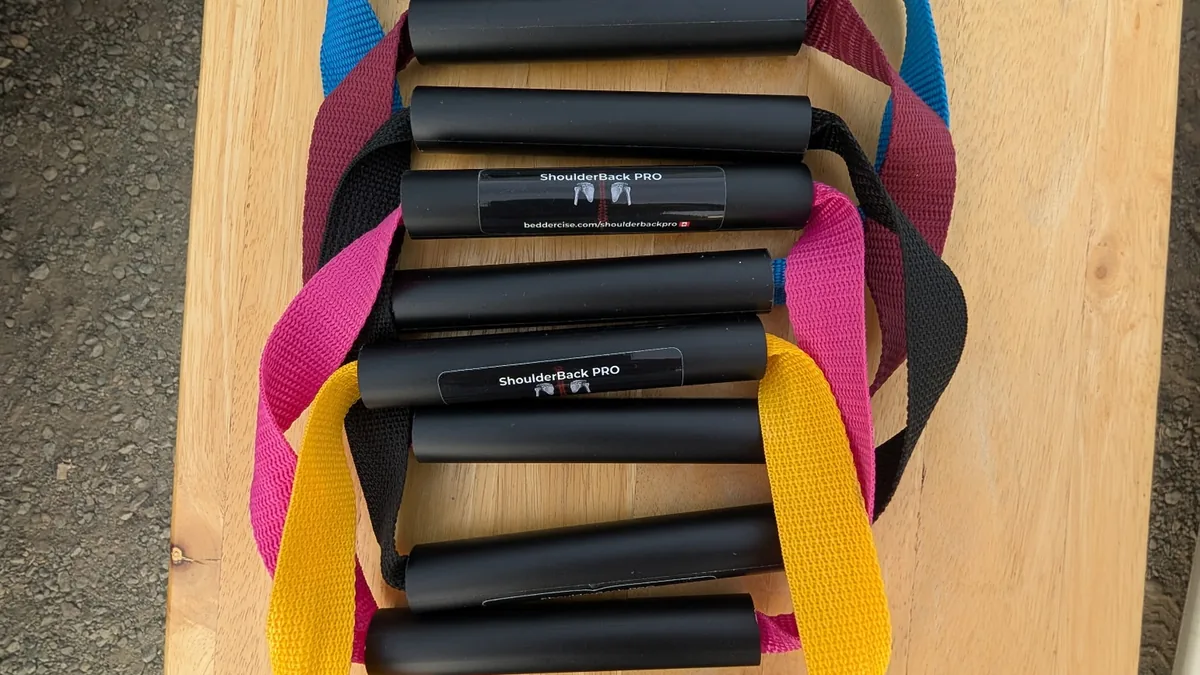
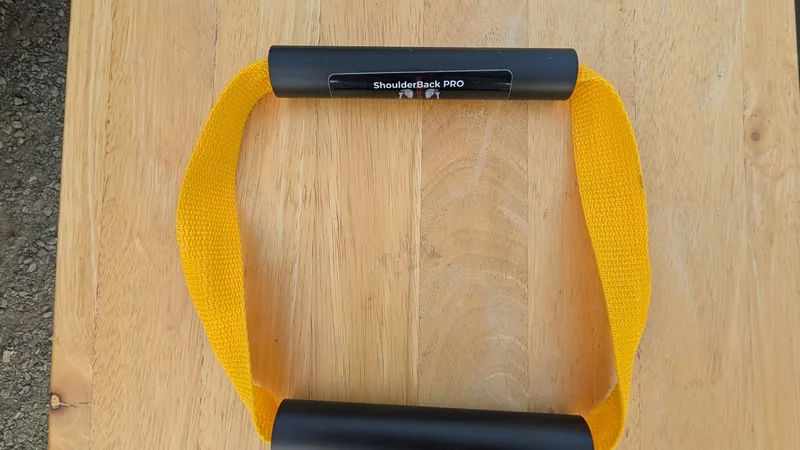
ShoulderBack Pro gives you three dials. Range is how far you move. Pace is how fast you move. Effort is how hard your working arm resists the guiding arm; the resistance comes from your other arm, so you can raise it by resisting harder, moving through more range, or doing longer sets. The handles are joined by a fixed-length, non-elastic strap, so nothing stretches, snaps or drops. You change the challenge through how you move, not by adding weights or bands.
Progress here means better control and better tolerance. It does not mean pushing into pain.
What the research says
- Exercise that adds resistance and progresses over time probably helps shoulder pain, while unloaded movement alone probably does not change pain much [R01].
- A 2025 review found that mobilization and stretching, along with scapular stabilization exercise, improved pain and function over about two months [R03].
- Programs that teach control and coordination may reduce disability slightly more than generic exercise. We do not fully know why [R02].
- Shoulder rehab usually moves in stages: range of motion, then strength, then control and proprioception (your sense of joint position), then coordination [R16]. A 12-week plan works well in that order.
- In stroke rehab, training that uses both arms improved shoulder movement more than training one arm alone [R14]. That is evidence from stroke patients, not healthy adults, and it does not prove anything about ShoulderBack Pro. It is one reason the two-arm approach is worth exploring.
What you can do: a 12-week approach
- Set a baseline. In your first session, note how far you can reach comfortably, how your shoulder feels at rest, and how well you sleep. Keep it to a few lines.
- Phase one: range and comfort (first few weeks). Use slow, comfortable movements with low effort. Start with the three 3-minute rituals: Refreshing Awareness, Greet the Morning and Vitality & Posture Perk. Seated option: every ritual can be done in an armchair.
- Phase two: pace and control (middle weeks). Keep the range the same, but slow down. Pause briefly at the end of each movement and return with the same smoothness.
- Phase three: effort (later weeks). Raise effort only when several sessions in a row feel smooth and your shoulder is settled the next morning. Change one dial at a time.
- Phase four: consolidate (final weeks). Keep what works. Repeat the movements you find most useful, and drop the ones that feel unhelpful.
- Log briefly. After each session, write one line: range (comfortable or limited), pace, effort (a rough 1 to 10 rating is fine), and any change in pain.
- Set rules before you start. Never push into sharp pain. If pain lasts into the next day more than you expect, step back one level.
- Review at week 12. Compare your notes with your baseline. Decide whether to continue, adjust or ask a clinician for a different approach.
Where ShoulderBack Pro fits — and where it doesn't
Steering suits the early weeks: you turn an imaginary wheel, ten-and-two, and can keep the movement small. Later, the Dumbbell Raise (Weightless Lateral Glide) gives you slow lifts out to the side where you decide how hard to resist. Choose your own order from the 16 video lessons. It is a wellness product, not a medical device, and no clinical trial has studied it; keep to any limits a clinician has given you. ShoulderBack Pro is $29 CAD, or $87 for the four-pack with free shipping.
When to see a professional
See a doctor or physiotherapist promptly if you have: pain after a fall or injury with sudden weakness or loss of movement; a shoulder that looks deformed, very swollen or bruised; fever or feeling unwell alongside the pain; chest pain or breathlessness (call emergency services); constant pain that doesn't change with rest or activity; pain that wakes you most nights; numbness, tingling or weakness into the arm or hand; pain in several joints at once; or pain that hasn't improved after a couple of weeks of sensible self-care. [R30]
Try this movement
All 16 video lessons →Frequently asked questions
How do I know when to make a step harder?
When your last several sessions felt smooth and your shoulder was settled the next morning, you can consider one small change. Change only one dial at a time.
What if I go backwards?
Step back to the last comfortable level for a week or two. A flare-up is a sign to ease off, not to push harder.
Do I need to do all 16 lessons?
No. Many people keep to a few favourite movements and repeat them. Choose what feels comfortable and suits your goals.
Is a 12-week plan enough to change my shoulder?
It is enough to build a habit and notice how your shoulder responds. It is not a treatment, and it does not replace a clinician's assessment.
Sources
- Naunton J et al. (2020). Effectiveness of progressive and resisted and non-progressive or non-resisted exercise in rotator cuff related shoulder pain: systematic review and meta-analysis of RCTs. Clinical Rehabilitation. https://search.pedro.org.au/search-results/record-detail/61404
- Dubé M-O et al. (2024). The Efficacy of Exercise Therapy for Rotator Cuff-Related Shoulder Pain According to the FITT Principle: Systematic Review With Meta-analyses. JOSPT. https://pubmed.ncbi.nlm.nih.gov/38848304/
- Frontiers in Bioengineering & Biotechnology (2025). Specific modes of exercise to improve rotator cuff-related shoulder pain: systematic review and meta-analysis. https://pmc.ncbi.nlm.nih.gov/articles/PMC12011739/
- Journal of Physical Therapy Science (2016). The effects of bilateral movement training on upper limb function in chronic stroke patients. https://pmc.ncbi.nlm.nih.gov/articles/PMC5011582
- Mureşan et al. (2022). Effects of a novel proprioceptive rehabilitation device on shoulder joint position sense, pain and function. Medicina. https://www.ncbi.nlm.nih.gov/pmc/articles/PMC9505091/
- NHS Greater Glasgow & Clyde, NHS MPFT self-help and BESS/BOA pathway summary (2021). Shoulder red flags and shoulder pain pathways. https://pmc.ncbi.nlm.nih.gov/articles/PMC7905504
More in this topic
 Essential guide: How ShoulderBack Pro Works: One Device, Two Connected Handles, Your Own Resistance
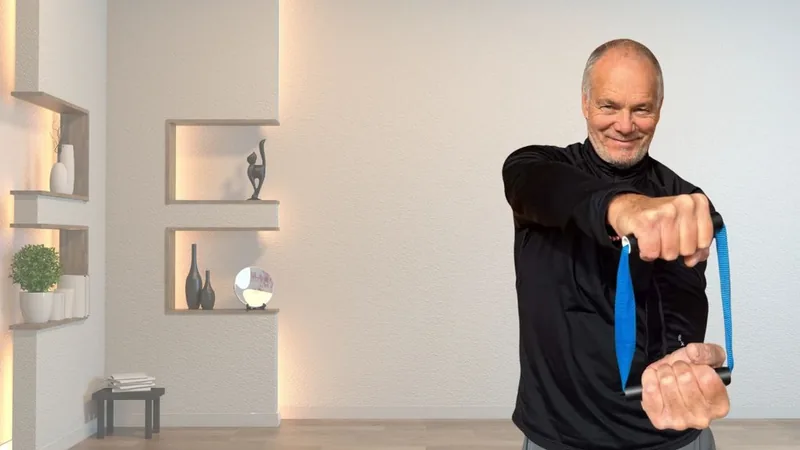 Pairing SBP With Walking: The Simplest Whole-Body Routine for Active Aging
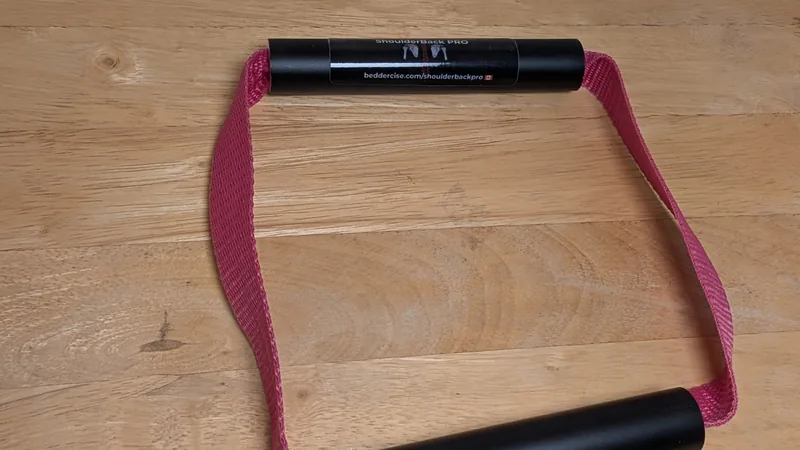 Locomotive: Rolling Circles for the Upper Back and Rear Cuff
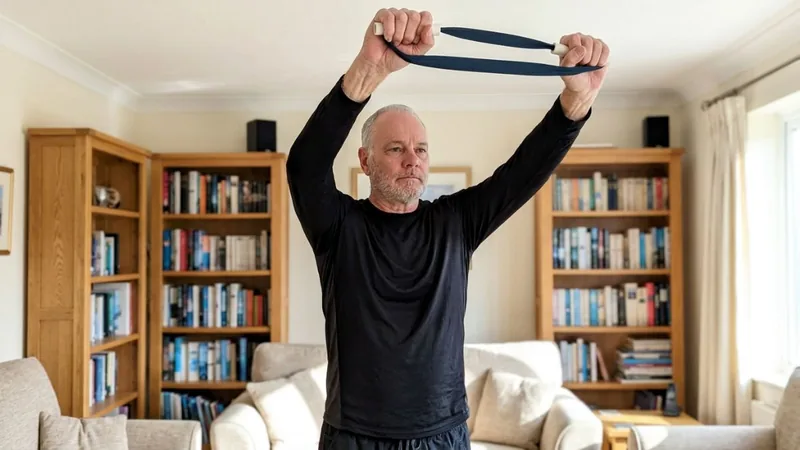 Overhead Press (High Shelf Reach): Trapezius and Deltoids Without a Weight