Comparisons, buyer's guides & honest product answers
Cable Machines vs Home Tools: Do You Need a Gym for Healthy Shoulders?
6-minute read · Published August 18, 2025 · Updated August 18, 2025
What this is
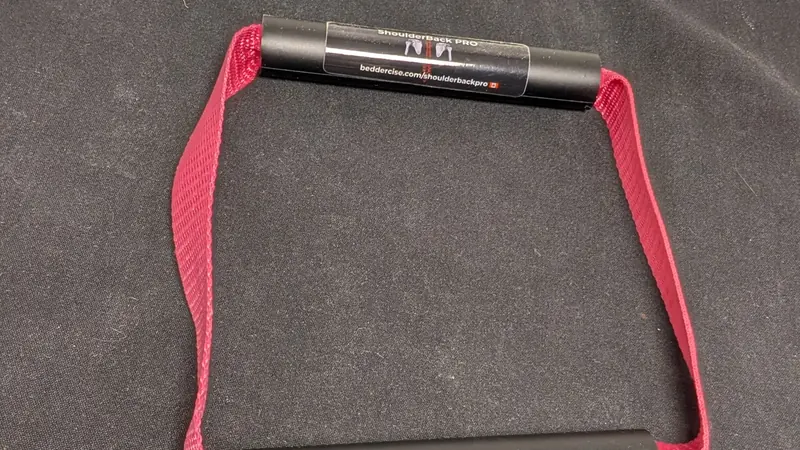
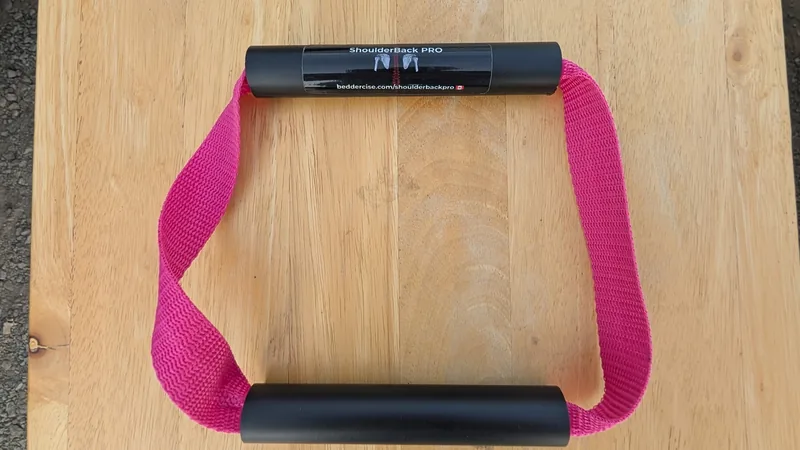
A cable machine uses a weight stack and a pulley to keep resistance on your arm through the whole movement. A resistance band stretches, so the load grows as you pull it further. A dumbbell pulls straight down, so its load changes with the angle of your arm. A body-controlled trainer lets one arm push or pull while the other arm resists, so you set the effort yourself.
Your shoulder does not know which machine you used. It responds to the demand placed on it: how hard the muscles work, how the load changes, and how well you control the movement. The shoulder blade muscles, which move the flat bone on your upper back, and the rotator cuff, a group of small muscles that hold the ball of the shoulder in its socket, both need steady, controlled work to stay useful.
Gym machines are convenient because they guide the path of the movement. Home tools ask more of your own control. For many people that control is part of the benefit, but it also means good form matters more.
What the research says
- Resisted exercise that gets a little harder over the weeks probably helps rotator-cuff-related shoulder pain. Gentle, unloaded movement alone probably does not change pain much [R01].
- A 2025 review of specific exercise types found that scapular stabilization exercise improved pain and function [R03].
- Public health guidance recommends muscle-strengthening activity at least two days a week for adults [R07].
- We did not find research that compares cable machines with home tools for shoulder health. That is a gap in the evidence, so nobody can say with confidence that one is better. Evidence varies, and your clinician can help you choose.
What you can do
- Choose a load you can control. Pick something that lets you finish each set with smooth, steady movement. If the last few reps look rushed or your neck tightens, the load is too heavy for now.
- Pick the tool you will actually use. A cable machine, bands, dumbbells or body weight can all build the habit. Reviewers of exercise for chronic back pain suggested choosing exercise you enjoy and will keep doing [R05].
- Increase slowly. When a set starts to feel easy, add a little resistance, time or range. Steady progress is easier to sustain than big jumps.
- Train on most weeks. Aim for muscle-strengthening work on at least two days a week [R07]. Two short sessions count for more than one long session you dread.
- Seated option. Sit in a sturdy armchair with your back supported. Use a light band or a body-controlled trainer for the same pulls, presses and reaches. Stand later, only if it feels comfortable.
Where ShoulderBack Pro fits, and where it doesn't
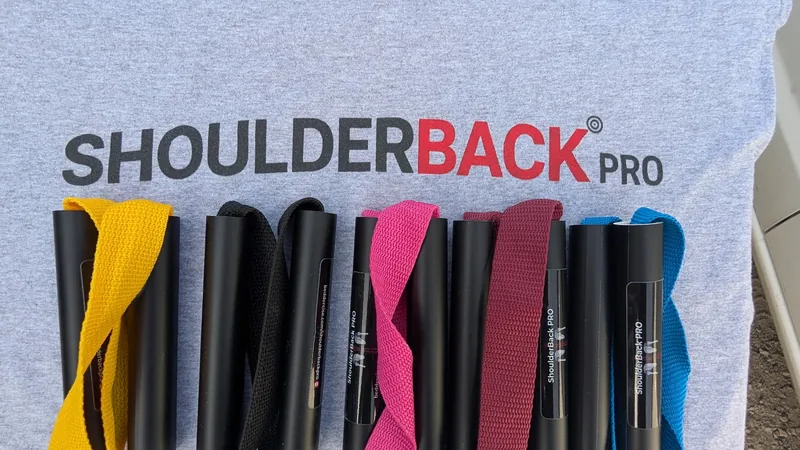
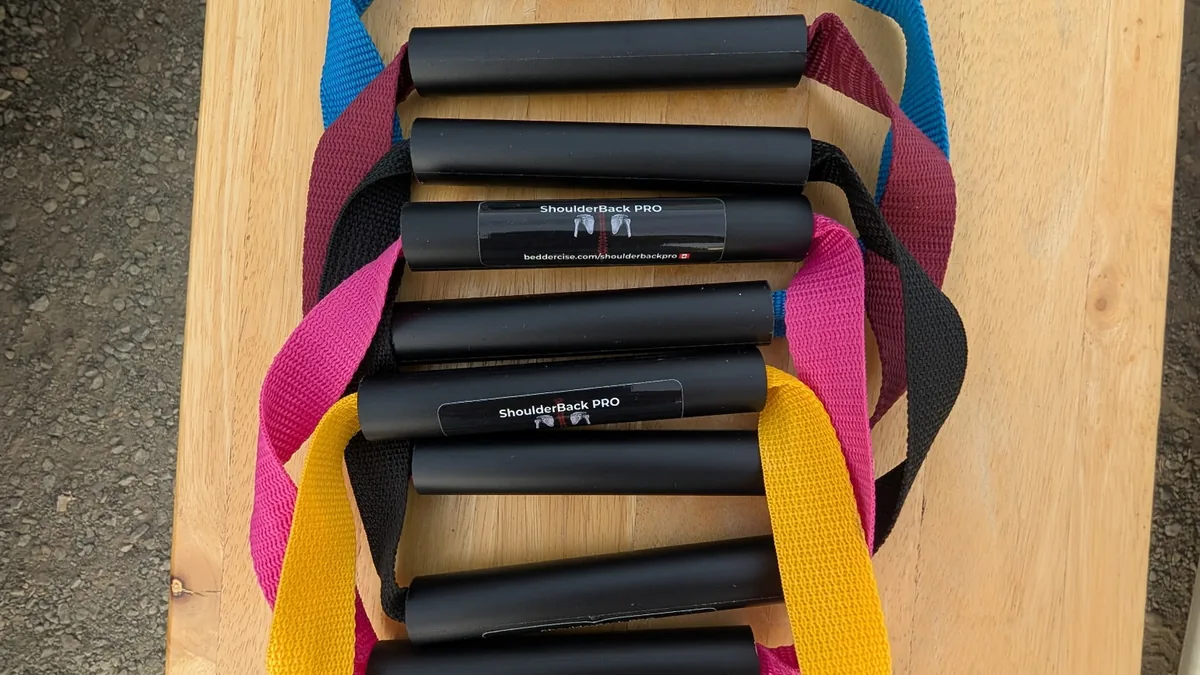
For a home routine, ShoulderBack Pro is a reasonable option because the resistance comes from your own other arm, so the effort is always yours to set. Arm Wrestler pivots the forearms inward with the elbow as a hinge, and Overhead Press (High Shelf Reach) lifts the arm as if placing a teacup on a high shelf; together they cover pressing and reaching. It is 160 g, works seated or standing, and costs $29 CAD with a 30-day guarantee, so you can browse ShoulderBack Pro or start with all 16 video lessons.
It won't replace a gym for heavy strength goals. It's a wellness product, not a medical device, and no clinical trial has studied it.
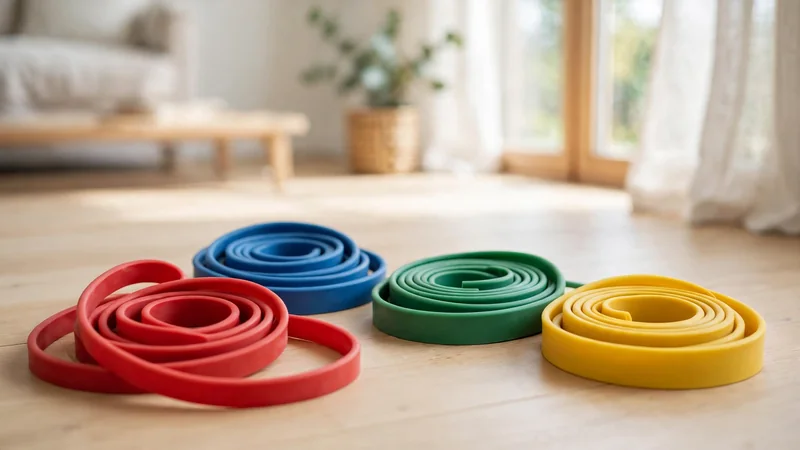
To compare tools side by side, read Resistance Bands vs ShoulderBack Pro: An Honest Comparison. For more on home options, see Dumbbells vs Body-Controlled Resistance for Shoulder Health and Why Resistance Bands Can Irritate Aging Shoulders.
When to see a professional
See a doctor or physiotherapist promptly if you have: pain after a fall or injury with sudden weakness or loss of movement; a shoulder that looks deformed, very swollen or bruised; fever or feeling unwell alongside the pain; chest pain or breathlessness (call emergency services); constant pain that doesn't change with rest or activity; pain that wakes you most nights; numbness, tingling or weakness into the arm or hand; pain in several joints at once; or pain that hasn't improved after a couple of weeks of sensible self-care.
A doctor, physiotherapist or other trained clinician is the person who can diagnose what is causing your shoulder pain.
Try this movement
All 16 video lessons →Frequently asked questions
Do I need a gym to build healthy shoulders?
No. Resistance work can be done at home. The key is controlled effort that increases gradually over time [R01][R07].
Are cable machines better than resistance bands?
We did not find research that compares them directly for shoulder health. Either can work if the load is controlled and increased slowly.
How often should I train my shoulders?
Public health guidance for adults suggests muscle-strengthening activity on at least two days a week [R07].
Can I do these exercises seated?
Yes. A sturdy armchair with back support works well. Start with a light load and focus on smooth, controlled movement.
Sources
- Naunton J et al. (2020). Effectiveness of progressive and resisted and non-progressive or non-resisted exercise in rotator cuff related shoulder pain: systematic review and meta-analysis of RCTs. Clinical Rehabilitation. https://search.pedro.org.au/search-results/record-detail/61404
- Frontiers in Bioengineering & Biotechnology (2025). Specific modes of exercise to improve rotator cuff-related shoulder pain: systematic review and meta-analysis. https://pmc.ncbi.nlm.nih.gov/articles/PMC12011739/
- Hayden JA et al. (2021). Exercise therapy for chronic low back pain. Cochrane Database of Systematic Reviews, Issue 9, CD009790. https://pmc.ncbi.nlm.nih.gov/articles/PMC8477273
- WHO (2020). Guidelines on physical activity and sedentary behaviour. https://www.sydney.edu.au/news-opinion/news/2020/11/26/new-global-guidelines-on-physical-activity-and-sedentary-behavio.html