Comparisons, buyer's guides & honest product answers
Dumbbells vs Body-Controlled Resistance for Shoulder Health
5-minute read · Published May 21, 2025 · Updated May 21, 2025
What each tool does
A dumbbell gives you a fixed weight. You make it harder by choosing a heavier one, or by slowing the lift. The load is clear and easy to measure.
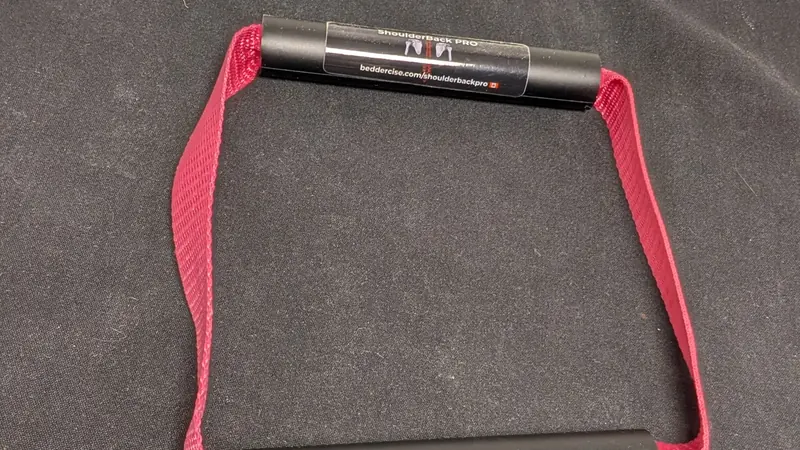
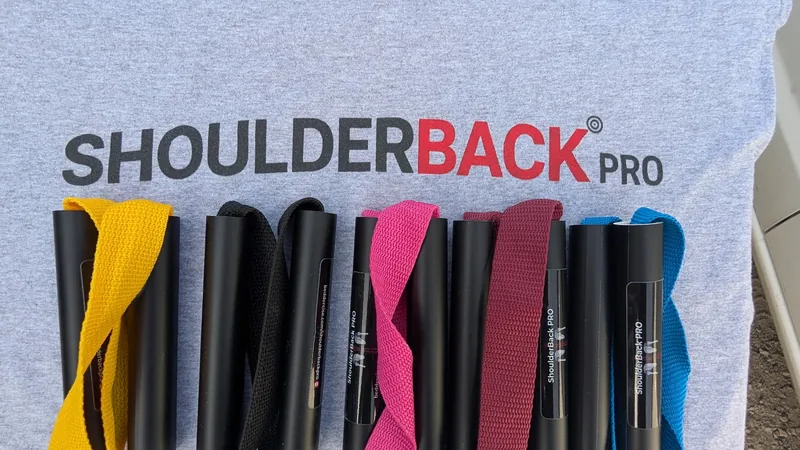
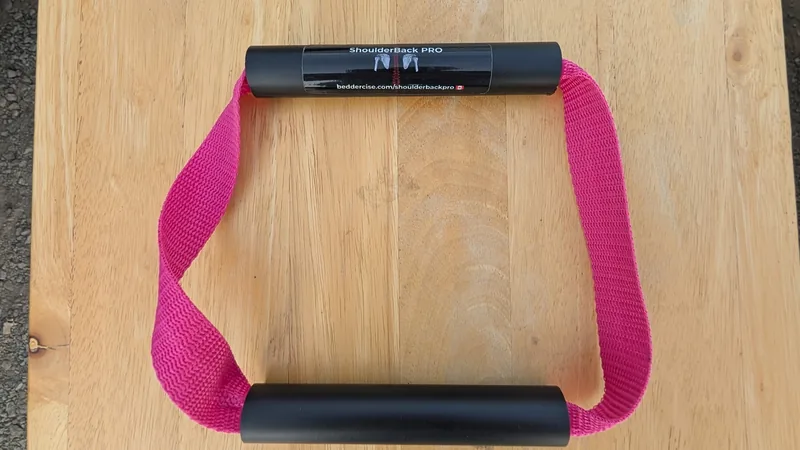
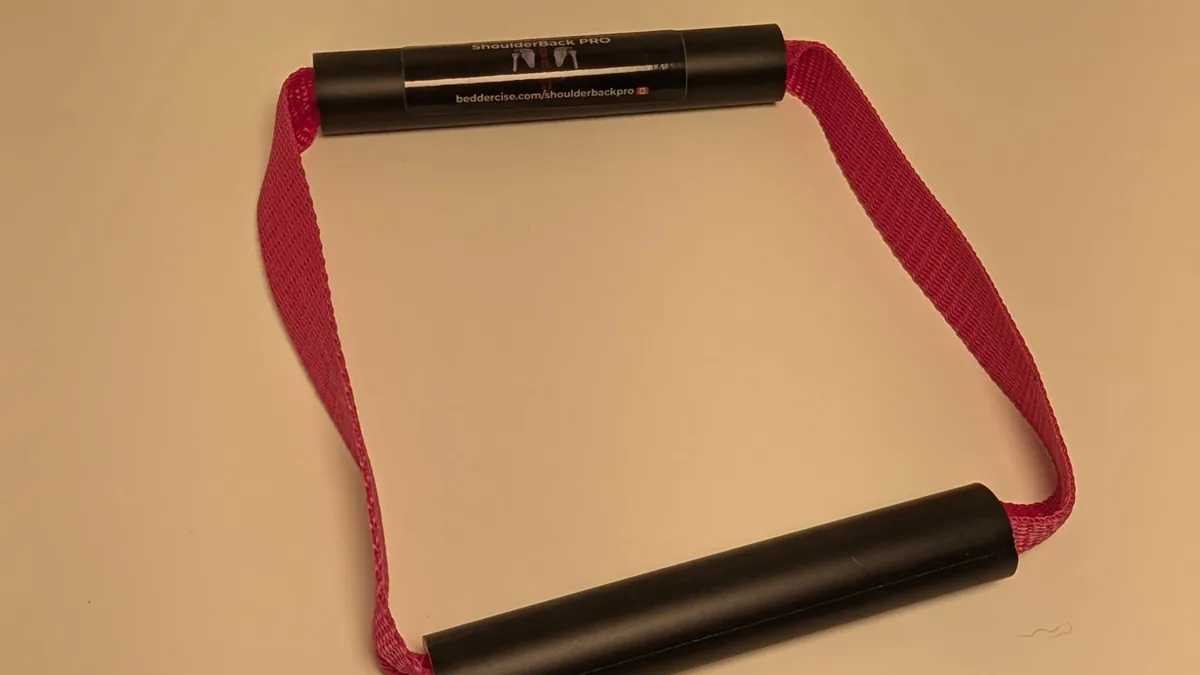
ShoulderBack Pro is a 160-gram trainer with two handles joined by a fixed-length, non-elastic strap. One arm assists while the other resists. You set the effort, pace and range. Nothing stretches, snaps or drops, and you can use it seated or standing. The load comes from your own body, not from a weight you can count.
That difference matters. Dumbbells are easier to progress in clear steps. Body-controlled resistance is easier to keep gentle and easier to control. Neither tool is right for everyone. The best choice depends on your goal, your comfort and your clinician's advice, and dumbbells also need a safe place to set them down.
What the research says
Exercise with resistance that builds gradually is the type most likely to help rotator cuff-related shoulder pain. Gentle, unloaded movement alone probably does not move pain much [R01]. Programs that focus on control and coordination may work a little better than generic exercise, though it is not yet clear why [R02].
For strength more broadly, resistance training helps older adults keep muscle strength, mobility and independence [R06]. Adults are advised to do muscle-strengthening activity at least two days a week [R07].
These findings are about resistance exercise in general. None of them compares dumbbells with ShoulderBack Pro directly.
What you can do
- Pick the goal first. If you want to get stronger under heavier load, dumbbells are the clearer tool. If you want controlled, low-load movement, body-controlled resistance may suit you better.
- Start light, in a chair. With dumbbells, sit with your back supported and use the lightest weight that feels easy to control.
- Keep your reps slow. With either tool, the lowering part of the movement matters as much as the lift.
- Stop at sharp pain. Discomfort that changes with the movement is one thing. Sharp pain, numbness or tingling is a reason to stop and get checked.
- Keep it regular. A short session you will repeat beats a long one you skip. A few short sessions a week is a reasonable starting point.
- Ask your clinician. If you have a diagnosed shoulder problem, ask which load is safe for you before you lift or resist.
Where ShoulderBack Pro fits — and where it doesn't
The closest match to a dumbbell side raise is the Dumbbell Raise (Weightless Lateral Glide), which is designed to work the supraspinatus and lateral deltoid with no weight in your hand. Bicep Tricep, one arm curling while the other extends, is a simple way to practise both-arm coordination. Because the resistance comes from your other arm, you progress by resisting harder, moving through more range or doing longer sets.
You cannot add a plate to it, so it won't replace dumbbells for heavier strength work. It's a wellness tool with no clinical trials, not a treatment. At $29 CAD with a 30-day guarantee, the shop page is there if you want to try it, and the free routines library has the lessons.
When to see a professional
See a doctor or physiotherapist promptly if you have: pain after a fall or injury with sudden weakness or loss of movement; a shoulder that looks deformed, very swollen or bruised; fever or feeling unwell alongside the pain; chest pain or breathlessness (call emergency services); constant pain that doesn't change with rest or activity; pain that wakes you most nights; numbness, tingling or weakness into the arm or hand; pain in several joints at once; or pain that hasn't improved after a couple of weeks of sensible self-care.
Only a doctor or physiotherapist can diagnose the cause of shoulder pain and decide which load is right for you. This article does not diagnose anything.
Try this movement
All 16 video lessons →Frequently asked questions
Are dumbbells better than body-controlled resistance for shoulder strength?
For building strength with heavier, steadily increasing load, dumbbells are the clearer choice. Body-controlled resistance is better for controlled, low-load movement that you adjust by effort.
Can I use both?
Yes. Many people use heavier tools a few days a week and controlled movement on the other days. Choose what you will keep doing.
Which is better if I have shoulder pain?
Neither is a treatment. Ask a clinician which kind of load is right for your shoulder, and start with the lightest option that feels comfortable.
Do I need equipment?
Dumbbells need a set of weights and room to lift them. ShoulderBack Pro weighs 160 grams and fits in a pocket, with no door anchors or weights needed.
Sources
- Naunton J et al. (2020). Effectiveness of progressive and resisted and non-progressive or non-resisted exercise in rotator cuff related shoulder pain: systematic review and meta-analysis of RCTs. Clinical Rehabilitation. https://search.pedro.org.au/search-results/record-detail/61404
- Dubé M-O et al. (2024). The Efficacy of Exercise Therapy for Rotator Cuff-Related Shoulder Pain According to the FITT Principle: Systematic Review With Meta-analyses. JOSPT. https://pubmed.ncbi.nlm.nih.gov/38848304/
- Fragala MS, Cadore EL, Dorgo S et al. (2019). Resistance Training for Older Adults: Position Statement From the National Strength and Conditioning Association. J Strength Cond Res. https://pubmed.ncbi.nlm.nih.gov/31343601/
- WHO (2020). Guidelines on physical activity and sedentary behaviour (University of Sydney summary of WHO 2020). https://www.sydney.edu.au/news-opinion/news/2020/11/26/new-global-guidelines-on-physical-activity-and-sedentary-behavio.html