Coordination, control & how ShoulderBack Pro works
Bicep Tricep: The Two-Way Arm Glide
4-minute read · Published March 3, 2025 · Updated March 3, 2025
What this is
The biceps sit at the front of the upper arm. They bend the elbow and help turn the forearm. The triceps sit at the back of the upper arm and straighten the elbow.
Coordination also depends on proprioception. Proprioception is your sense of where your joints are without looking at them. Shoulder problems are often linked with reduced proprioception [R16].
What the research says
- The two sides learn from each other. Training that challenged joint position sense improved the trained wrist, and the untrained opposite wrist also improved 24 hours later [R15]. This was a wrist study, not a shoulder study.
- Two-arm training helped in stroke rehab. In chronic stroke patients, bilateral, or two-arm, training improved shoulder movement more than single-arm training [R14]. That evidence comes from stroke rehab, not from healthy adults. It is an interesting reason to try two-arm work, not proof that it works for you.
What you can do
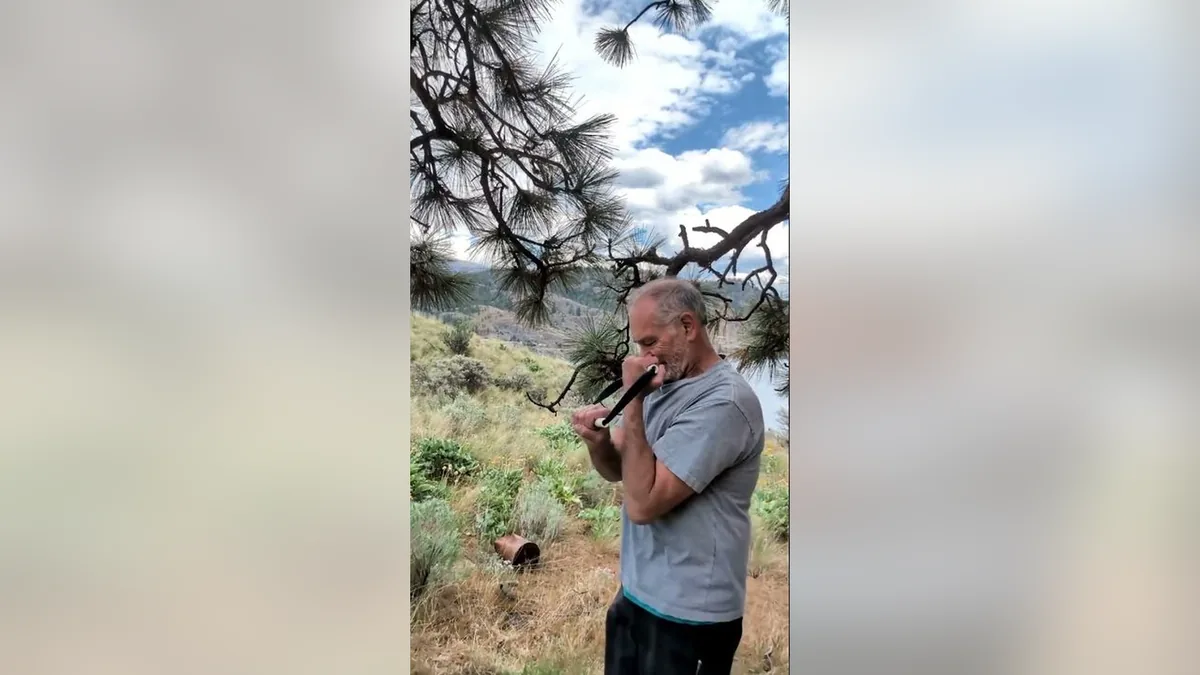
- Sit tall. Sit in an armchair with your back supported and feet flat. Keep your elbows close to your sides.
- Curl one arm. Slowly bend one elbow and bring that forearm up, like a gentle biceps curl.
- Extend the other arm. At the same time, let the other forearm move slightly forward or down, straightening the elbow a little.
- Hold and reverse. Pause briefly, then slowly switch so the other arm curls and the first extends.
Where ShoulderBack Pro fits, and where it doesn't
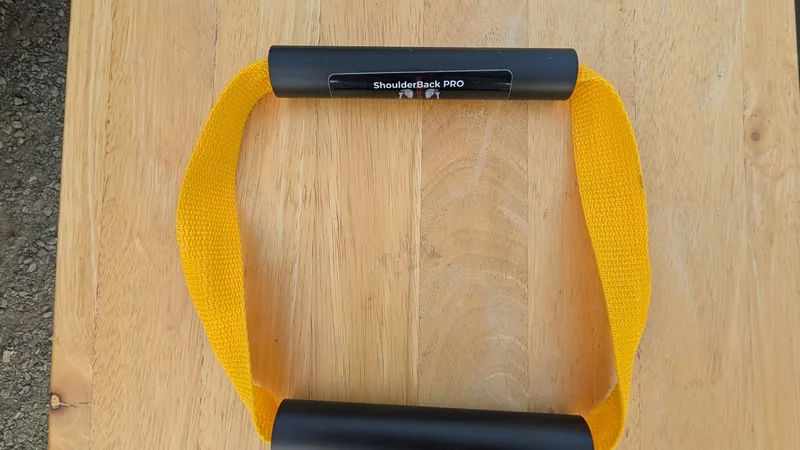
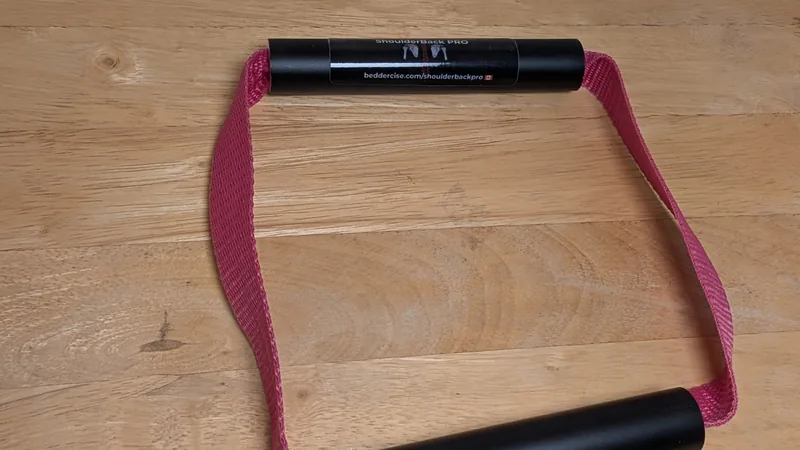
Bicep Tricep is the trainer's own take on this move, with the site listing the biceps and triceps as its targets. The fixed strap joins the handles, so the curling arm is resisted by the extending arm and the effort is yours to set. Resist a little harder, use more range or do longer sets as it gets easier. It works well for practising two-arm coordination, seated or standing. The full routine is in all 16 video lessons.
It is a wellness tool with no clinical trials behind it, so it is not a treatment for any condition. The trainer is on the shop page.
When to see a professional
See a doctor or physiotherapist promptly if you have: pain after a fall or injury with sudden weakness or loss of movement; a shoulder that looks deformed, very swollen or bruised; fever or feeling unwell alongside the pain; chest pain or breathlessness (call emergency services); constant pain that doesn't change with rest or activity; pain that wakes you most nights; numbness, tingling or weakness into the arm or hand; pain in several joints at once; or pain that hasn't improved after a couple of weeks of sensible self-care.
If you have numbness or tingling in the arm or hand, get it assessed before you start any arm exercise.
Try this movement
All 16 video lessons →Frequently asked questions
Is this a good way to build arm strength?
It moves the arms with control, but with self-resistance it is not a heavy strength exercise. Resistance training that progresses over time is the approach recommended for older adults.
Why use both arms at once?
Coordinating two arms challenges your sense of position and timing. Stroke research suggests two-arm training can improve shoulder movement, though that research was done in stroke rehab, not in healthy adults.
Can I do this seated?
Yes. Seated is a good starting point for most people, and standing can come later once the movement feels comfortable.
Sources
- Fragala MS, Cadore EL, Dorgo S et al. (2019). Resistance Training for Older Adults: Position Statement From the National Strength and Conditioning Association. J Strength Cond Res. https://pubmed.ncbi.nlm.nih.gov/31343601/
- Journal of Physical Therapy Science (2016). The effects of bilateral movement training on upper limb function in chronic stroke patients. https://pmc.ncbi.nlm.nih.gov/articles/PMC5011582
- Scientific Reports (2021). Proprioceptive-focused training transfers gains to the opposite, untrained limb. https://pmc.ncbi.nlm.nih.gov/articles/PMC7935923
- Mureşan et al. (2022). Effects of a novel proprioceptive rehabilitation device on shoulder joint position sense, pain and function. Medicina. https://www.ncbi.nlm.nih.gov/pmc/articles/PMC9505091/
More in this topic
 Essential guide: How ShoulderBack Pro Works: One Device, Two Connected Handles, Your Own Resistance
 Pairing SBP With Walking: The Simplest Whole-Body Routine for Active Aging
 Locomotive: Rolling Circles for the Upper Back and Rear Cuff
 Overhead Press (High Shelf Reach): Trapezius and Deltoids Without a Weight