Comparisons, buyer's guides & honest product answers
Wall Pulleys, Door Anchors and Why We Skipped Them
4-minute read · Published April 28, 2025 · Updated April 28, 2025
What this is
A wall pulley is a fitting on the wall that guides a cord or handle, so you pull against resistance. A door anchor loops a strap around a closed door, and you pull against that strap. Both create resistance from a fixed point.
A fixed point only works if it is solid. A door that does not close well, or a fitting that shifts, can change the load without warning. That is the main reason we chose not to build our trainer around an anchor.
What the research says
Resisted exercise that progresses over time probably helps rotator-cuff-related shoulder pain. Gentle movement with no added load probably does not move pain much [R01].
A review of specific exercise types found that scapular stabilization exercise improved pain and function [R03]. For older adults, resistance training supports function and independence, and its position statement says barriers and fears should be addressed [R06].
What you can do
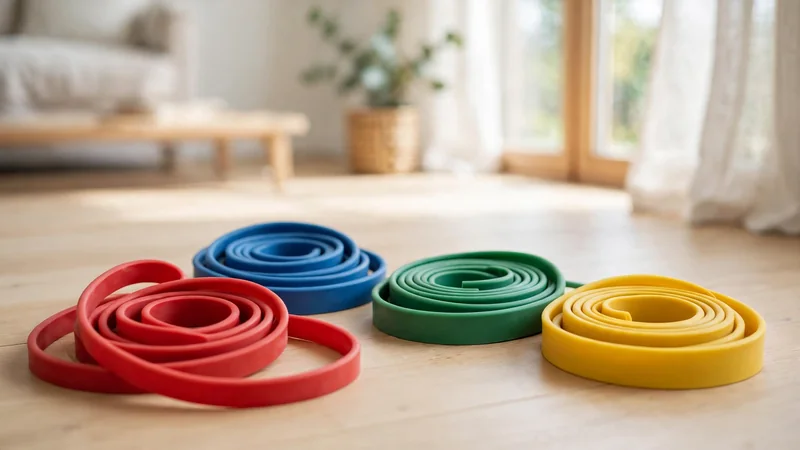
- Choose the resistance you will actually use. A light weight, a band, or a body-controlled trainer can all work. The best option is the one you will repeat.
- Check your set-up. If you use an anchor or pulley, confirm the fixing is solid before every session. If you are unsure, skip it.
- Start with low effort. Build slowly over weeks. Progressive, resisted work is the pattern the research supports [R01].
- Work seated when you can. Sit in a sturdy chair with your back supported.
- Stop if pain sharpens. Pain that gets worse during or after a session, or that wakes you at night, is a reason to see a clinician.
Where ShoulderBack Pro fits — and where it doesn't
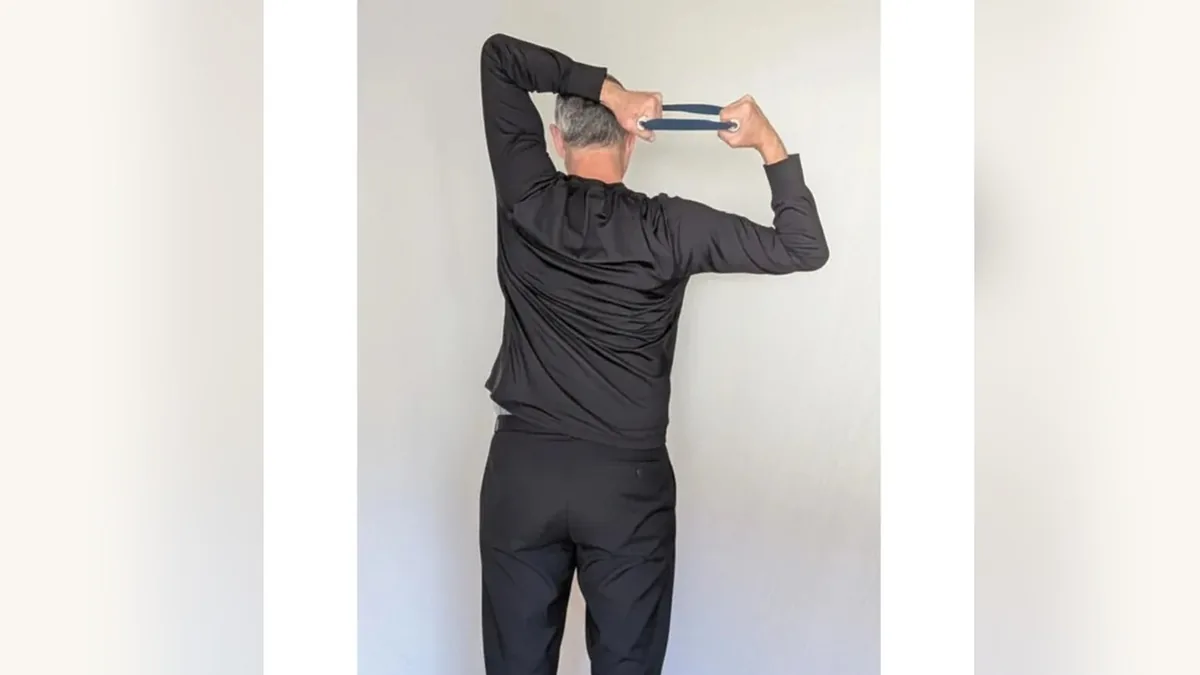
If you want resistance without fixing anything to a wall or door, two lessons are good starting points. SeeSaw alternates gentle reaches with one arm guiding the other, and Open The Door works the muscles at the back of the shoulder. Both are among the 16 video lessons.
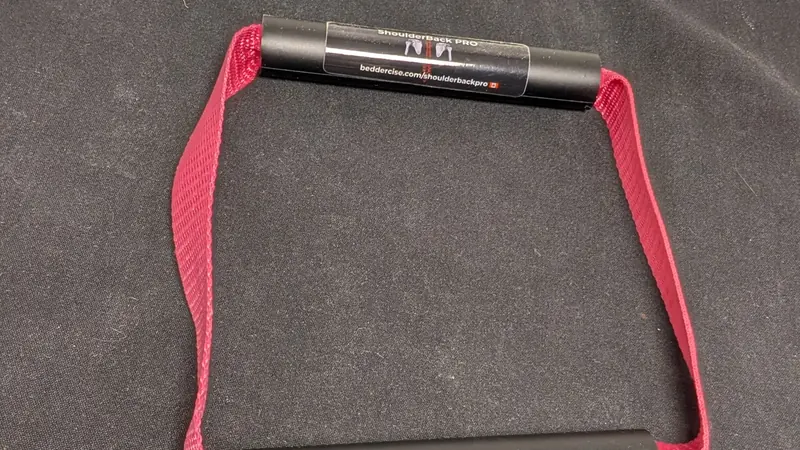
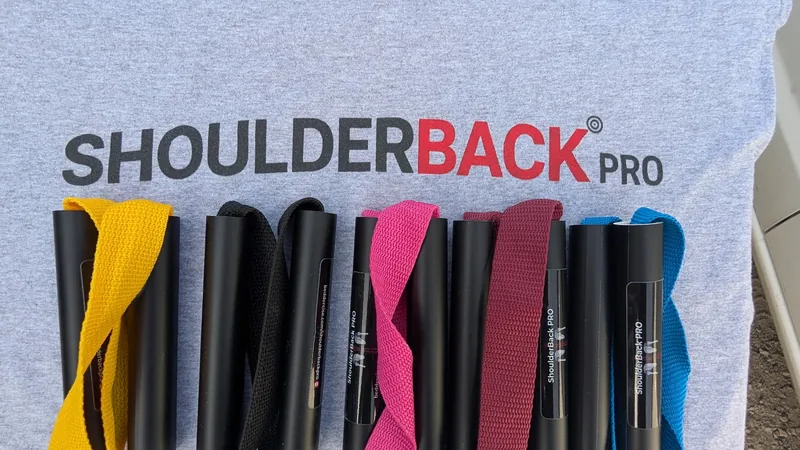
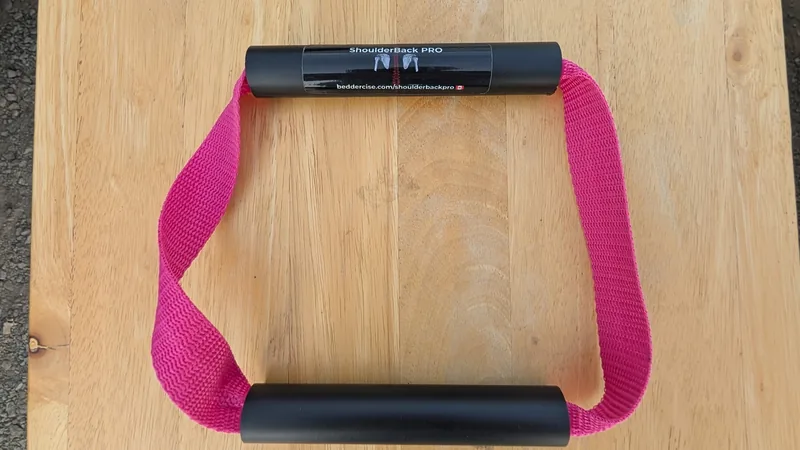
The resistance comes from your other arm, so you set the effort, pace and range, and progress by resisting harder, moving through more range or doing longer sets. Nothing stretches, snaps or drops. Skipping the anchor was a design choice, not proof it works better than one. It is a wellness tool rather than a treatment, and it has not been tested in clinical trials. The trainer is on the shop page.
When to see a professional
See a doctor or physiotherapist promptly if you have: pain after a fall or injury with sudden weakness or loss of movement; a shoulder that looks deformed, very swollen or bruised; fever or feeling unwell alongside the pain; chest pain or breathlessness (call emergency services); constant pain that doesn't change with rest or activity; pain that wakes you most nights; numbness, tingling or weakness into the arm or hand; pain in several joints at once; or pain that hasn't improved after a couple of weeks of sensible self-care.
Try this movement
All 16 video lessons →Frequently asked questions
Do I need a door anchor to build shoulder strength?
No. Resistance can come from a light weight, a band or a body-controlled trainer. Research supports progressive resisted exercise in general, not one piece of equipment.
Is a wall pulley safer than a band?
Not necessarily. A pulley is only as safe as its fixing point. If you are unsure whether your set-up is solid, ask a clinician or a qualified trainer.
Can I use ShoulderBack Pro seated?
Yes. In an armchair or standing, you set the effort and range, and nothing needs to be anchored.
Sources
- Naunton J et al. (2020). Effectiveness of progressive and resisted and non-progressive or non-resisted exercise in rotator cuff related shoulder pain: systematic review and meta-analysis of RCTs. Clinical Rehabilitation. https://search.pedro.org.au/search-results/record-detail/61404
- Frontiers in Bioengineering & Biotechnology (2025). Specific modes of exercise to improve rotator cuff-related shoulder pain: systematic review and meta-analysis. PROSPERO CRD42024550602. https://pmc.ncbi.nlm.nih.gov/articles/PMC12011739/
- Fragala MS, Cadore EL, Dorgo S et al. (2019). Resistance Training for Older Adults: Position Statement From the National Strength and Conditioning Association. J Strength Cond Res. https://pubmed.ncbi.nlm.nih.gov/31343601/