Ancient wisdom & traditional movement practices
The Gada (Mace): Why Wrestlers Swung It and What It Teaches About Shoulder Control
5-minute read · Published September 29, 2025 · Updated September 29, 2025
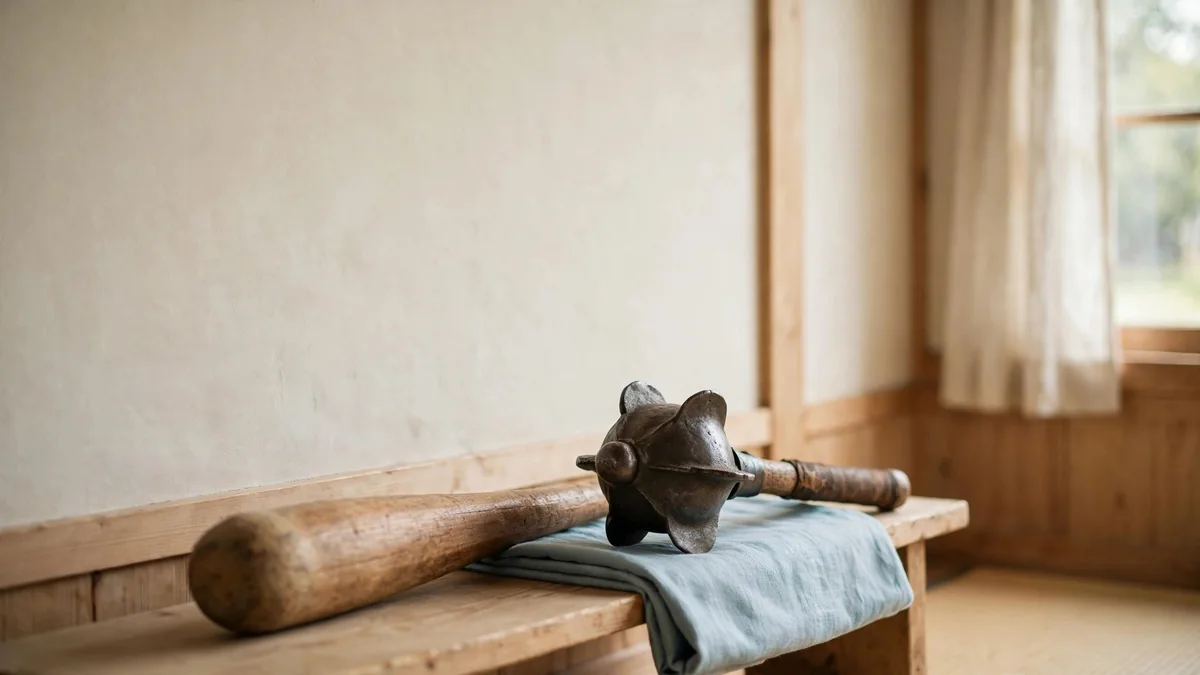
Why this is interesting
The gada is a heavy, club-like mace. Swinging it moves the arms through large arcs. It asks the grip, shoulders and trunk to hold a steady path while the weight travels. Wrestlers used it as part of their training for generations.
For a modern reader, the useful question is what this kind of training teaches about shoulder control. The honest answer is that history can point us toward ideas. It cannot tell us how well they work.
What the history says
Club swinging is described in the 12th-century Manasollasa and the 13th-century Malla Purana. The Persian meel was used by wrestlers. In the 19th century, British trainers adopted lighter clubs. Club swinging was an Olympic event in 1904 and again in 1932 [R35].
This is history, not evidence of health benefit. Ancient does not mean proven.
What the research says
- There isn't strong research on gada training specifically. Our historical source describes club swinging but does not show it improves shoulder health [R35].
- In one stroke rehabilitation study, two-arm training improved shoulder movement more than single-arm training. That evidence comes from stroke patients, not healthy adults. It is a reason for interest, not proof [R14].
- Training that challenges joint position sense in one limb improved the opposite, untrained limb in a 2021 study. The two sides of the body can learn from each other [R15].
- Proprioception, your sense of where a joint is in space, affects movement accuracy. Shoulder disorders are linked to reduced joint position sense [R16].
What you can do
Each step can be done seated.
- Start with control, not weight. Sit tall and move your arm in slow, controlled circles. Keep the path smooth.
- Move both arms together. Mirror the movement on each side. Notice any difference between the two sides.
- Keep loads light. A gada is heavy. If you have shoulder pain, skip heavy swings until a clinician or coach has checked your technique.
- Watch for warning signs. Stop for sharp pain, sudden weakness, numbness, tingling, or pain that wakes you at night.
- Build up gradually. Add range and speed slowly over several weeks, not all at once.
- Get a coach for traditional tools. A coach can show you the grip and stance. A clinician is the right person to diagnose any pain.
Where ShoulderBack Pro fits — and where it doesn't
The part of gada work a light trainer can echo is smooth, controlled arcs. Around the World is one large, unhurried circle that the site lists as working the serratus anterior and lower trapezius, and it can be done seated. Swinging a heavy mace is a different job: ShoulderBack Pro has no heavy load, and it is a wellness tool with no clinical trials, not a treatment. The shop page has details.
When to see a professional
See a doctor or physiotherapist promptly if you have: pain after a fall or injury with sudden weakness or loss of movement; a shoulder that looks deformed, very swollen or bruised; fever or feeling unwell alongside the pain; chest pain or breathlessness (call emergency services); constant pain that doesn't change with rest or activity; pain that wakes you most nights; numbness, tingling or weakness into the arm or hand; pain in several joints at once; or pain that hasn't improved after a couple of weeks of sensible self-care.
Any shoulder pain that comes on during heavy swinging needs a clinician's assessment before you go back to training.
Try this movement
Around the World (circles, both arms) →Frequently asked questions
Was the gada used for shoulder health?
The historical sources describe its use in wrestling training. They do not show that it improves shoulder health.
Is gada training safe for shoulders?
We cannot say from the evidence we use. If you have shoulder pain, get clearance from a clinician before swinging any heavy tool.
Can ShoulderBack Pro give the same benefit?
They are different tools. ShoulderBack Pro is light, controlled and works seated or standing. It does not provide the heavy load that gada training involves.
Why does two-arm work matter?
Some stroke rehabilitation research suggests two-arm training helps more than one-arm training. That is not proof for healthy adults, but it explains the interest [R14].
Sources
- Wikipedia, Indian club (history; secondary source). Used for history only, not health claims. https://en.wikipedia.org/wiki/Indian_club
- Journal of Physical Therapy Science (2016). The effects of bilateral movement training on upper limb function in chronic stroke patients. https://pmc.ncbi.nlm.nih.gov/articles/PMC5011582
- Scientific Reports (2021). Proprioceptive-focused training transfers gains to the opposite, untrained limb. https://pmc.ncbi.nlm.nih.gov/articles/PMC7935923
- Mureşan et al. (2022). Effects of a novel proprioceptive rehabilitation device on shoulder joint position sense, pain and function. Medicina. https://www.ncbi.nlm.nih.gov/pmc/articles/PMC9505091/
More in this topic
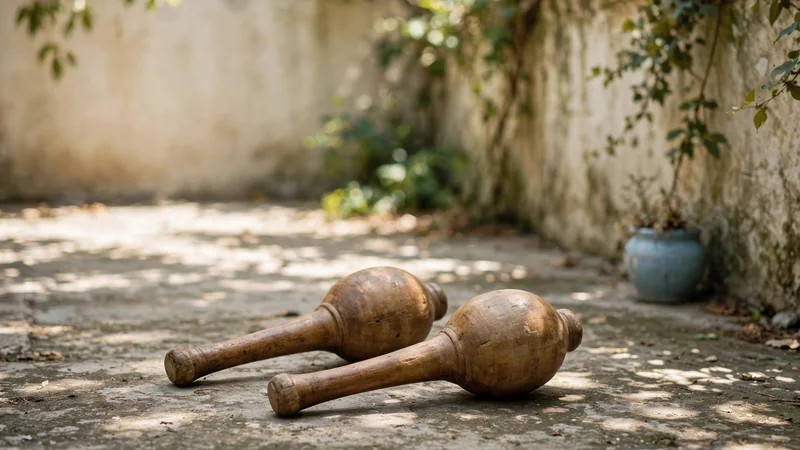 Essential guide: Ancient Wisdom for Strong Shoulders: What Traditional Movement Got Right (and What Science Adds)
 The Chinese Medicine Clock and Morning Movement: Fun Framing, Real Habit
 Cold Water and Shoulders: From Nordic Plunges to Modern Ice Baths
 Ancient Massage Traditions: Thai, Tui Na, Lomi Lomi — Comfort vs Proof