Comparisons, buyer's guides & honest product answers
Reviews vs Reality: How to Judge Any Fitness Gadget's Claims
6-minute read · Published November 19, 2025 · Updated November 19, 2025
Why reviews are not enough
Most reviews describe a personal experience. That experience is real, and it can be useful. A product can feel good, be easy to use, or fit into a routine. But a good feeling after one week does not tell you whether the product changes pain, strength or movement over time.
Ads and listings often borrow credibility from science in a loose way. They mention a muscle, a movement or a general study, and then imply the product has the same effect. A careful reader checks the link between the claim and the actual product.
The evidence ladder, in plain language
Think of evidence as a ladder with rungs of different strength.
- Personal stories. Real, but limited to one person's experience.
- Small trials. Useful for clues, but they can be unreliable. A Cochrane review of acupuncture for shoulder pain found nine small trials with improvements about the same as sham treatment at two to four weeks. Small trials give clues, not final answers [R24].
- Reviews that combine many studies. Stronger, but only as good as the studies inside them. One review found that resisted, progressive exercise probably helps rotator cuff pain, with a benefit of uncertain clinical importance, so a result can be real and still small [R01].
- Studies of the product itself. The strongest evidence for a product claim. Without one, a claim is only an inference.
What the research says
- Progressive, resisted exercise probably helps rotator cuff pain, though the size of the benefit is of uncertain clinical importance [R01].
- Programs that focus on control and coordination may improve function slightly more than generic exercise in the short and medium term, though we do not fully know why [R02].
- Acupuncture for shoulder pain has possible short-term benefit, but not enough evidence to say it works or is harmful [R24].
How to judge a claim
- Who was tested? Check the age, health and activity level of the people in the study. Are they like you?
- Was the product tested? Or was the claim based on general exercise research?
- How many people, and for how long? Small, short studies are clues, not final answers.
- What was measured? Pain, strength, range of motion, sleep or daily function? Each tells a different story.
- Compared with what? A study with a control group or a comparison is more informative than one without.
- Who funded it? Sponsorship does not make a study wrong, but it is worth knowing.
- Is there a fair trial? A clear return or refund policy lets you test the product in your own home.
What you can do
- Test any new gadget seated first. Keep short notes for a week or two.
- Name the result you want before you start. For example, easier reaching or less morning stiffness. Write it down.
- Choose products with a clear trial or refund policy. It lets you judge the product in your own home.
- Read the original study when a claim matters to you. Summaries often leave out the details that count.
- Ask a clinician whether a gadget fits your situation. This is especially important if you have a diagnosed condition.
Where ShoulderBack Pro fits, and where it doesn't
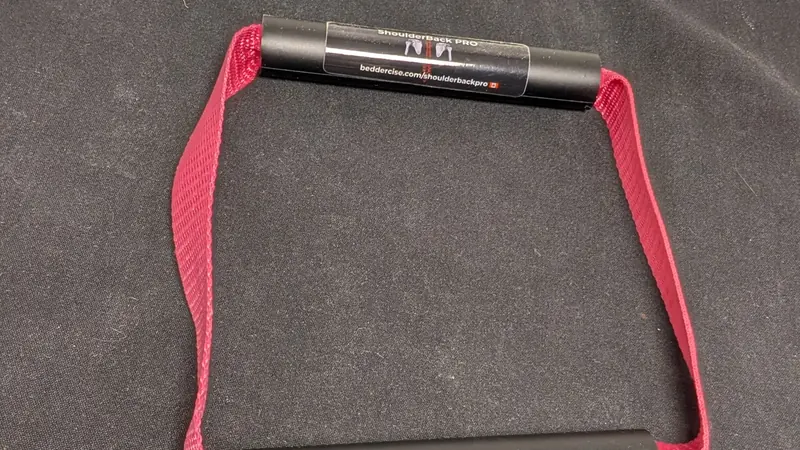
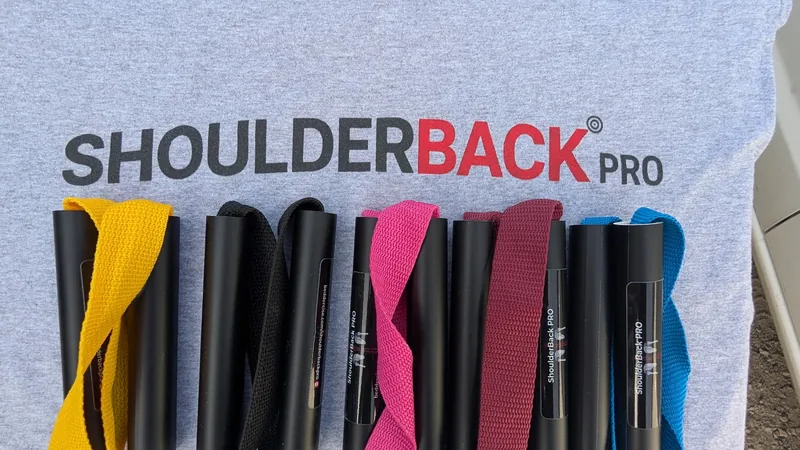
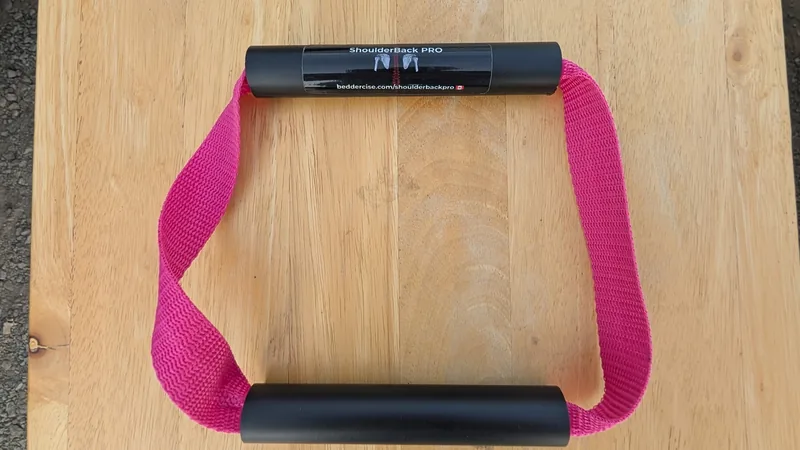
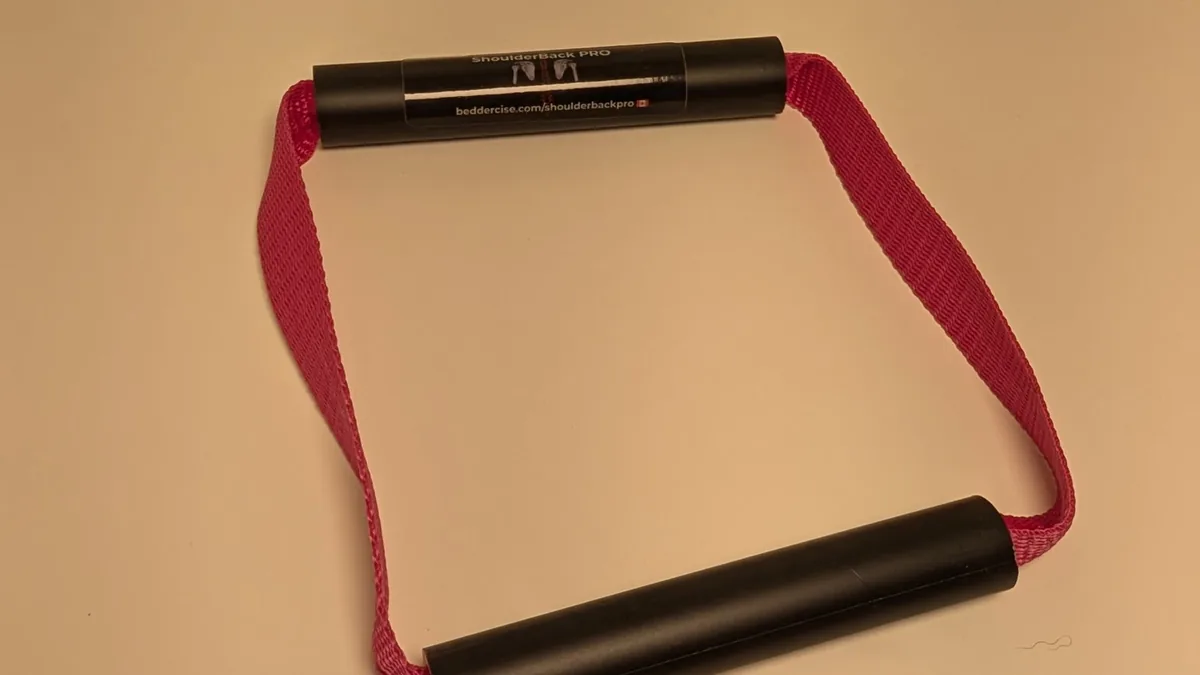
Apply the same checklist to ShoulderBack Pro. It is a simple trainer for controlled two-arm movement, where one arm resists the other. SeeSaw and Open The Door are good examples of what it asks of you, and the 16 free video lessons show exactly what you would be practising. It is a wellness tool, not a treatment, and no study has tested it yet, so read any claim about it as unproven. If you want to test it yourself, it's available online.
It cannot tell you whether a gadget is right for you. For a fair side-by-side look at bands and SBP, read the honest comparison of resistance bands and ShoulderBack Pro. You can also read why resistance bands irritate aging shoulders and the muscles of the shoulder blade.
When to see a professional
See a doctor or physiotherapist promptly if you have: pain after a fall or injury with sudden weakness or loss of movement; a shoulder that looks deformed, very swollen or bruised; fever or feeling unwell alongside the pain; chest pain or breathlessness (call emergency services); constant pain that doesn't change with rest or activity; pain that wakes you most nights; numbness, tingling or weakness into the arm or hand; pain in several joints at once; or pain that hasn't improved after a couple of weeks of sensible self-care.
No gadget, review or ad replaces an assessment. If a product seems to be the answer to a serious symptom, that is a reason to talk to a clinician first.
Try this movement
All 16 video lessons →Frequently asked questions
Are five-star reviews useful?
They can tell you about comfort, fit and how easy a product is to use. They do not show that a product changes pain, strength or movement.
What does "proven" actually mean in an ad?
It should point to a named study that tested the product, in people like you, with a clear outcome. If no study is named, read the word as marketing.
Is "may help" a red flag?
Not necessarily. Careful language is often a sign of honesty. Be cautious when claims are big, certain and unsupported.
Sources
- Naunton J et al. (2020). Effectiveness of progressive and resisted and non-progressive or non-resisted exercise in rotator cuff related shoulder pain: systematic review and meta-analysis of RCTs. Clinical Rehabilitation. https://search.pedro.org.au/search-results/record-detail/61404
- Dube M-O et al. (2024). The Efficacy of Exercise Therapy for Rotator Cuff-Related Shoulder Pain According to the FITT Principle: Systematic Review With Meta-analyses. JOSPT. https://pubmed.ncbi.nlm.nih.gov/38848304/
- Cochrane (Green S et al., 2005; edited, conclusions unchanged). Acupuncture for shoulder pain. CD005319. https://www.cochrane.org/evidence/CD005319