Comparisons, buyer's guides & honest product answers
Is a $29 Shoulder Trainer Worth It? What You Get and What You Don't
6-minute read · Published October 17, 2025 · Updated October 17, 2025
What this is
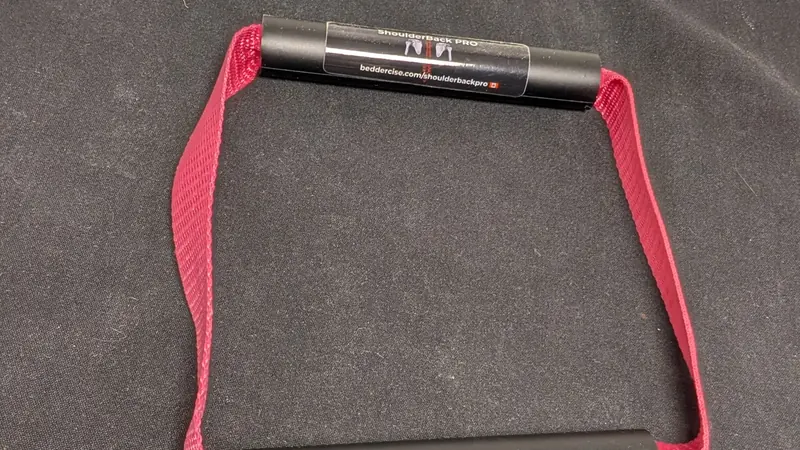
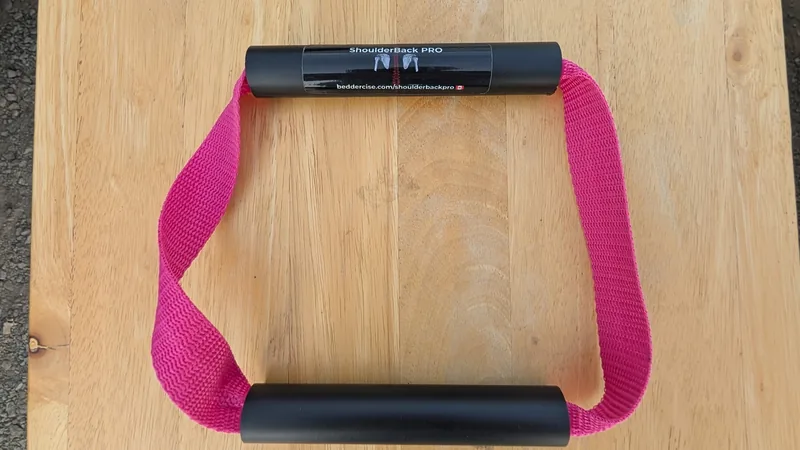
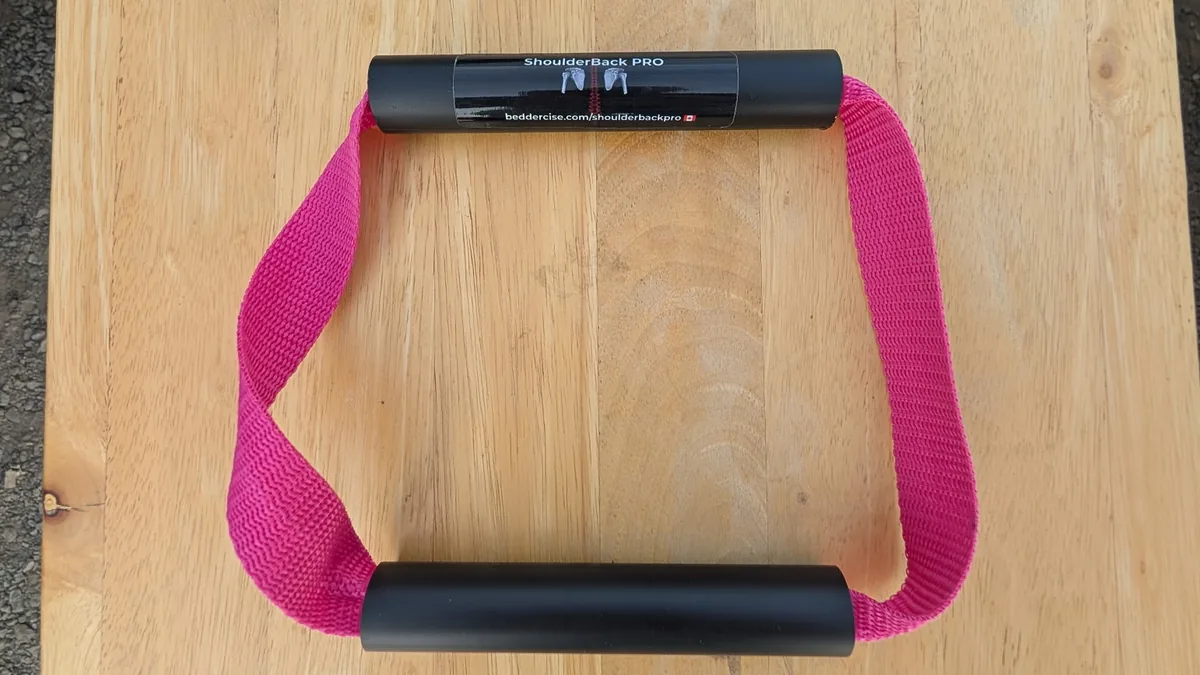
ShoulderBack Pro is a 160-gram, pocket-size movement trainer, designed and assembled in Canada. Two handles are joined by a fixed-length, non-elastic strap. One arm assists while the other resists. You set the effort, pace and range.
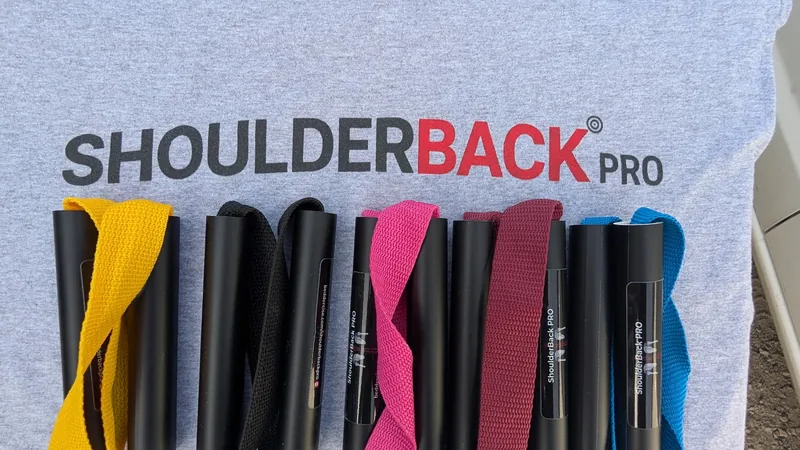
Nothing stretches, snaps or drops, and there are no door anchors or weights. You can use it seated in an armchair or standing. It comes with 16 free guided video lessons taught by its inventor, Van Hill. The strap comes in four colours, all with identical resistance.
The price is $29 CAD, or $87 for a four-pack (buy three, get one free, with free shipping).
What the research says
No study has tested ShoulderBack Pro, so no research can say it works for your shoulder. The research below is about exercise in general, not this product:
- Progressive resisted exercise probably helps. Gentle unloaded movement alone probably does not move pain much [R01].
- Control-focused programs may help a little more. Programs built around coordination may slightly outperform generic exercise in the short and medium term [R02].
- Resistance training supports strength and independence. For older adults, it supports function and quality of life, and fears and barriers should be addressed [R06].
- Muscle-strengthening counts. The WHO advises adults to do it on at least two days a week [R07].
A trainer that offers controlled resistance is a plausible tool. A plausible tool is not the same as a proven one.
What you can do
Before you decide, work through these questions:
- Name your goal. Is it everyday control, a routine you will keep, or building load over time? The answer changes what fits.
- Check your medical status. If you have a diagnosed shoulder condition or recent surgery, ask your clinician first.
- Compare your options. Resistance bands, light dumbbells, or a physiotherapist-guided program all add load that can progress. The research values progression [R01].
- Test it for real. Ask yourself whether you would reach for it on a busy weekday, not just on the day you bought it.
- Use the trial period. The 30-day Living Room Guarantee gives you a full refund if it is not for you.
Seated: every option here works from an armchair, which suits people who sit for long stretches.
Where ShoulderBack Pro fits — and where it doesn't
If you want a small, guided tool for controlled movement at home, it is a reasonable buy. Two of the 16 video lessons are good starting points. Around the World asks for one large, unhurried circle in front of you. Steering turns an imaginary wheel; the site lists the deltoids and rhomboids as its targets.
The resistance comes from your other arm, so you progress by resisting harder, moving through more range or doing longer sets. That is less measurable than adding weight, and it won't replace heavy loading. It's a wellness tool, not a treatment for a diagnosed condition. If it suits you, you can order it here.
When to see a professional
See a doctor or physiotherapist promptly if you have: pain after a fall or injury with sudden weakness or loss of movement; a shoulder that looks deformed, very swollen or bruised; fever or feeling unwell alongside the pain; chest pain or breathlessness (call emergency services); constant pain that doesn't change with rest or activity; pain that wakes you most nights; numbness, tingling or weakness into the arm or hand; pain in several joints at once; or pain that hasn't improved after a couple of weeks of sensible self-care.
Only a doctor, physiotherapist or other qualified clinician can diagnose a shoulder condition. If you have one, ask them whether any new home trainer suits you before you start.
Try this movement
All 16 video lessons →Frequently asked questions
Does ShoulderBack Pro have clinical proof?
No. There are no clinical trials of ShoulderBack Pro. The research we cite is about exercise in general, not this product.
Can I use it seated?
Yes. It works seated in an armchair or standing.
What if it isn't for me?
The 30-day Living Room Guarantee offers a full refund.
Should I buy resistance bands instead?
It depends on your goal. Progressive resisted exercise has the most support in the research, and bands and dumbbells can add load that increases over time.
Sources
- Naunton J et al. (2020). Effectiveness of progressive and resisted and non-progressive or non-resisted exercise in rotator cuff related shoulder pain: systematic review and meta-analysis of RCTs. Clinical Rehabilitation. https://search.pedro.org.au/search-results/record-detail/61404
- Dubé M-O et al. (2024). The Efficacy of Exercise Therapy for Rotator Cuff-Related Shoulder Pain According to the FITT Principle: Systematic Review With Meta-analyses. JOSPT. https://pubmed.ncbi.nlm.nih.gov/38848304/
- Fragala MS, Cadore EL, Dorgo S et al. (2019). Resistance Training for Older Adults: Position Statement From the National Strength and Conditioning Association. J Strength Cond Res. https://pubmed.ncbi.nlm.nih.gov/31343601/
- WHO (2020). Guidelines on physical activity and sedentary behaviour. https://www.sydney.edu.au/news-opinion/news/2020/11/26/new-global-guidelines-on-physical-activity-and-sedentary-behavio.html