Ancient wisdom & traditional movement practices
Hanging and Brachiation: Why Our Primate Shoulders Love to Reach
6-minute read · Published May 19, 2026 · Updated May 19, 2026
Why this happens
Brachiation is the arm-over-arm swinging that some primates use to move through trees. Humans can hang too, and many of us enjoy reaching overhead.
The shoulder is a shallow ball-and-socket joint. It gains a very wide range of motion by trading away some built-in stability. Muscles and ligaments around the joint, including the muscles on the shoulder blade (scapula), do much of the work of holding it steady.
When you hang, your body weight pulls the arm up and the shoulder blade has to stay controlled. That is a different demand from a gentle circle, and it is why hanging suits some shoulders and not others.
What the research says
- Exercise-based programs reduce pain and improve function and range of motion in middle-aged and older adults with rotator-cuff-related shoulder pain [R04].
- A 2025 review of specific exercise types found that scapular stabilization exercise improved pain and function [R03]. Hanging was not among the approaches it reported.
- Shoulder problems are often linked with weaker joint position sense. Rehab usually moves from range of motion, to strength, then to control and coordination [R16].
- There isn't strong research on dead hangs or brachiation for shoulder pain specifically, so ask your clinician.
What you can do
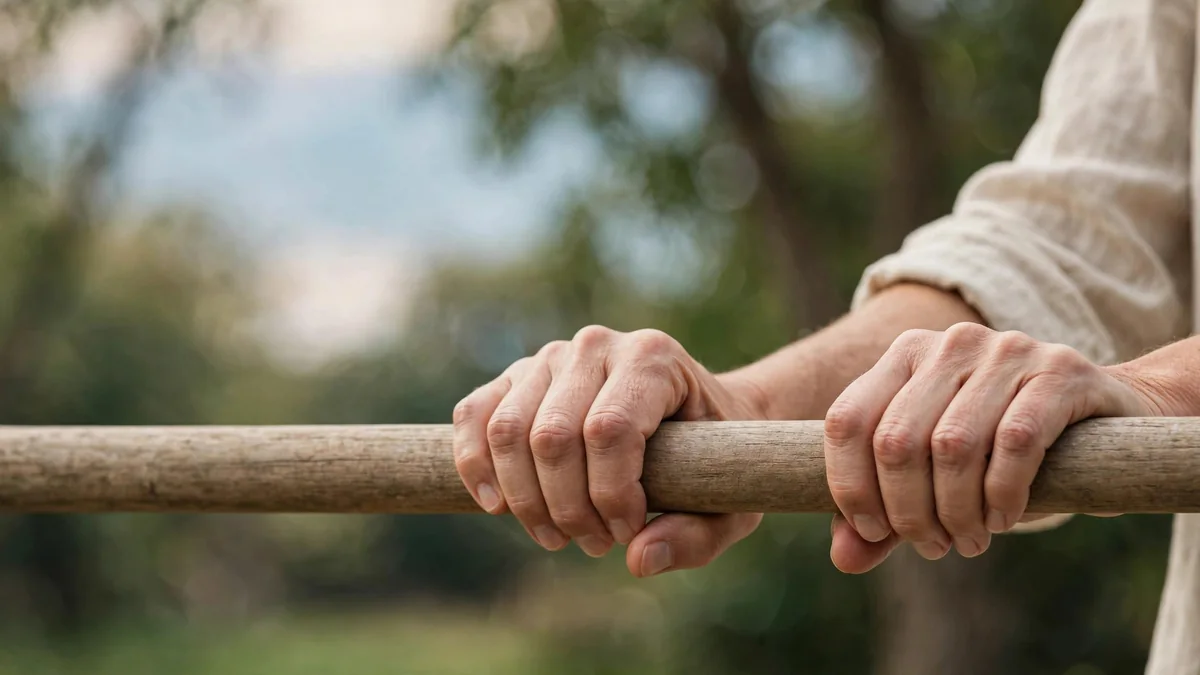
- Start with a seated reach. Sit tall and lift one arm overhead slowly, as if placing a cup on a high shelf, then lower it.
- Try a supported hang. Hold a sturdy counter or bar with your feet still on the floor so you control how much weight goes through your arms.
- If you feel comfortable, try a very short hang. Stop as soon as the shoulder aches, pinches or feels unstable.
- Keep the shoulder blades gently active. Do not let the joint dangle in a way that causes sharp pain.
- Skip hanging entirely if your shoulder is painful at rest, if you have sudden weakness, or if you have tingling in the arm or hand.
- Stop and rest if pain lingers the next day.
Where ShoulderBack Pro fits — and where it doesn't
The reaching part of this topic is where a trainer can help. Around the World draws one large, unhurried circle in front of you, and Overhead Press (High Shelf Reach) lifts the arms as if placing a teacup on a high shelf, with the other arm resisting and no weight. Both can be done seated or standing.
It does not load body weight or build hanging grip or the control brachiation needs. It is a wellness tool, not a treatment, and there are no clinical trials of it yet. If you want to try it, you can order ShoulderBack Pro.
When to see a professional
See a doctor or physiotherapist promptly if you have: pain after a fall or injury with sudden weakness or loss of movement; a shoulder that looks deformed, very swollen or bruised; fever or feeling unwell alongside the pain; chest pain or breathlessness (call emergency services); constant pain that doesn't change with rest or activity; pain that wakes you most nights; numbness, tingling or weakness into the arm or hand; pain in several joints at once; or pain that hasn't improved after a couple of weeks of sensible self-care. [R30]
Only a doctor, physiotherapist or other licensed clinician can diagnose why your shoulder hurts. Ask them whether hanging suits your shoulder before you start.
Try this movement
Around the World (circles, both arms) →Frequently asked questions
Is a dead hang good for shoulders?
It may suit some healthy shoulders, but the research on hanging for shoulder pain is thin. If your shoulder hurts, get it assessed before you try.
Can I brachiate like a primate at home?
Not safely, for most people. Brachiation is demanding. Start with a seated or standing reach, and build up slowly if your clinician agrees.
Does hanging stretch the shoulder?
Some people feel their shoulders loosen while hanging. That feeling is not proof of a lasting change in the joint, and our sources do not show that hanging reliably improves range.
Who should avoid hanging for now?
Anyone with a recent injury, sudden weakness, nerve symptoms or recent surgery should get medical advice first.
Sources
- Frontiers in Bioengineering & Biotechnology (2025). Specific modes of exercise to improve rotator cuff-related shoulder pain: systematic review and meta-analysis. https://pmc.ncbi.nlm.nih.gov/articles/PMC12011739/
- BMC Musculoskeletal Disorders (2026). Exercise interventions for rotator cuff-related shoulder pain in middle-aged and older adults: systematic review and meta-analysis. https://link.springer.com/10.1186/s12891-026-10035-4
- Mureşan et al. (2022). Effects of a novel proprioceptive rehabilitation device on shoulder joint position sense, pain and function. Medicina. https://www.ncbi.nlm.nih.gov/pmc/articles/PMC9505091/
- NHS Greater Glasgow & Clyde, Shoulder red flags; NHS MPFT self-help, Shoulder pain; BESS/BOA pathway summary (2021). https://www.nhsggc.scot/page_category/services/page/33
More in this topic
 Essential guide: Ancient Wisdom for Strong Shoulders: What Traditional Movement Got Right (and What Science Adds)
 The Chinese Medicine Clock and Morning Movement: Fun Framing, Real Habit
 Cold Water and Shoulders: From Nordic Plunges to Modern Ice Baths
 Ancient Massage Traditions: Thai, Tui Na, Lomi Lomi — Comfort vs Proof