Comparisons, buyer's guides & honest product answers
Gifts for Parents With Stiff Shoulders: A Thoughtful (Not Pushy) Guide
6-minute read · Published July 7, 2026 · Updated July 7, 2026

Why this happens
Stiffness in the shoulders is common as people get older, but it does not look the same for everyone. It can come from muscles that tire, joints with less movement than they used to have, or a condition that a clinician needs to diagnose.
The shoulder is a very mobile joint. It depends on the muscles around the shoulder blade (the scapula) to stay steady when the arm moves. When those muscles are weaker, or movement has been limited for a while, reaching overhead or behind the back may feel harder.
This is why a good gift fits the parent, not just the shoulder. Think about what they want to keep doing: gardening, pickleball, cooking, reaching a high shelf, or playing with grandkids.
What the research says
- Exercise helps many people. For shoulder pain related to the rotator cuff, resisted exercise that progresses over time probably helps. Gentle unloaded movement alone probably does not move the needle on pain [R01].
- Control and coordination may matter. Programs that teach control and coordination may reduce disability slightly more than generic exercise in the short and medium term. We do not fully know why [R02].
- Strength, mobility and posture are linked to shoulder function. In community-dwelling adults 60 and older, each is associated with shoulder pain and disability. Evidence for forward head posture specifically in older adults is limited [R28].
- Strength training is valuable for older adults. Resistance training supports function, mobility, independence and quality of life. The experts who wrote this guidance say barriers and fears should be addressed [R06].
What you can do
- Start with a conversation. Ask what they would like to do more easily: reach a shelf, garden, sleep better, or carry groceries. Their answer should shape your gift.
- Check with their clinician if there is a diagnosis. If they have been diagnosed with a shoulder condition or had surgery, ask whether a new routine is suitable before you buy equipment.
- Give time, not a fix. A walk, a gardening afternoon, or a class at a community centre is a gift they can enjoy. Many classes offer seated options, so ask first.
- Offer a comfort upgrade. A supportive cushion or footrest for their favourite armchair makes sitting easier and can be used every day.
- Consider resistance bands only with approval. Bands are a valid tool when a clinician or physiotherapist agrees the parent can do strength work.
- Offer to join in. Doing a short routine together often matters more than any object. It also takes the pressure off.
Where ShoulderBack Pro fits and where it doesn't
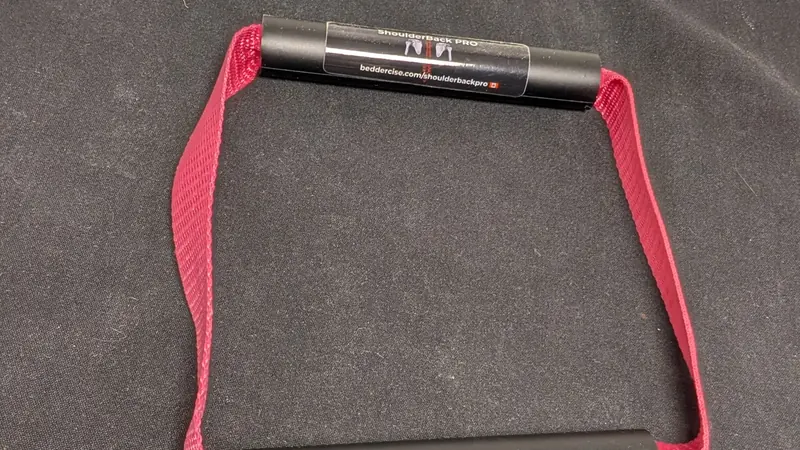
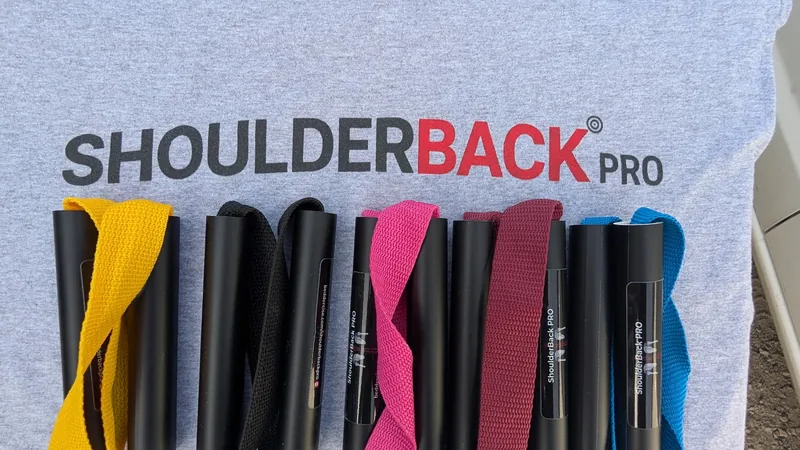
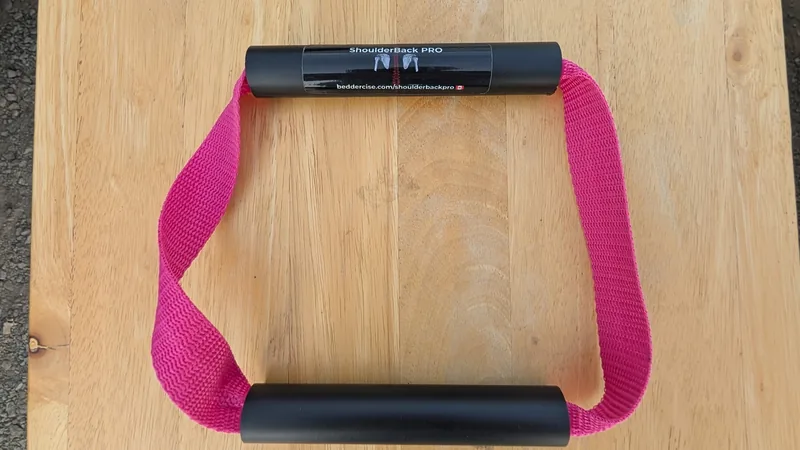
For a parent who has been cleared for gentle movement, ShoulderBack Pro is a simple at-home option. Two handles share a fixed strap, one arm assists while the other resists, and it works seated in an armchair. They set the effort, pace and range.
Two lessons suit a first week. SeeSaw uses gentle alternating reaches, designed to work the scapular stabilizers, and Around the World is one slow circle designed to work the serratus anterior and lower trapezius. Because the resistance comes from the other arm, they can progress by resisting a little harder or moving through more range. The 16 lessons are free and taught by the inventor, Van Hill.
The trainer is $29 CAD with a 30-day full-refund guarantee. It is a wellness tool, not a treatment, and there are no clinical trials of it yet.
When to see a professional
Only a doctor or physiotherapist can diagnose the cause of a parent's shoulder pain. Encourage them to book a visit rather than guessing or buying equipment to fix it.
See a doctor or physiotherapist promptly if you have: pain after a fall or injury with sudden weakness or loss of movement; a shoulder that looks deformed, very swollen or bruised; fever or feeling unwell alongside the pain; chest pain or breathlessness (call emergency services); constant pain that doesn't change with rest or activity; pain that wakes you most nights; numbness, tingling or weakness into the arm or hand; pain in several joints at once; or pain that hasn't improved after a couple of weeks of sensible self-care.
Try this movement
All 16 video lessons →Frequently asked questions
Is a movement trainer a good gift for someone with shoulder pain?
It may suit someone who has been cleared for gentle shoulder movement. Check with their clinician first, especially if they have a diagnosed condition, and never give it as a fix.
What if my parent says no?
Respect that. A gift is not a plan, and pressure usually backfires. Offer to try a short routine together instead, and let them decide.
Is there a refund if it doesn't suit them?
ShoulderBack Pro comes with a 30-day Living Room Guarantee for a full refund. Check the shop page for current terms before you order.
Can a movement trainer replace physiotherapy?
No. It is not a replacement for physiotherapy, and it is not a treatment for shoulder conditions that need a clinician's assessment.
Sources
- Naunton J et al. (2020). Effectiveness of progressive and resisted and non-progressive or non-resisted exercise in rotator cuff related shoulder pain: systematic review and meta-analysis of RCTs. Clinical Rehabilitation. https://search.pedro.org.au/search-results/record-detail/61404
- Dubé M-O et al. (2024). The Efficacy of Exercise Therapy for Rotator Cuff-Related Shoulder Pain According to the FITT Principle: Systematic Review With Meta-analyses. JOSPT. https://pubmed.ncbi.nlm.nih.gov/38848304/
- Fragala MS, Cadore EL, Dorgo S et al. (2019). Resistance Training for Older Adults: Position Statement From the National Strength and Conditioning Association. J Strength Cond Res. https://pubmed.ncbi.nlm.nih.gov/31343601/
- PMC narrative review (2026). Body composition, strength, mobility and posture associated with shoulder pain and disability in community-dwelling older adults. https://www.ncbi.nlm.nih.gov/pmc/articles/PMC13513864/