Comparisons, buyer's guides & honest product answers
Exercise Apps vs Printed Routines for Older Adults
4-minute read · Published November 11, 2024 · Updated November 11, 2024
Why this happens / What this is
Some older adults enjoy a tablet and video demonstrations. Others find screens tiring. The real question is which format helps you return to movement every day, not which one looks more modern.
Apps usually bring a phone or tablet, a login, a notification and sometimes a subscription. A printed routine brings a single page, a visible place to keep it, and no setup.
What the research says
- In chronic low-back pain, the review authors suggest people choose exercise they enjoy and will keep doing [R05]. The same logic is a reasonable guide for choosing a format, though it was not tested on apps versus paper.
- Fear, doubt and practical barriers are common reasons older adults stop exercising, and they should be addressed directly [R06].
- Adults are advised to do muscle-strengthening work on at least two days a week, and every move counts toward total activity [R07]. Any format that makes that schedule easier to follow is doing its job.
What you can do
Think about your own habits before you choose.
- Check your comfort with screens. If you already use a phone easily, an app's videos may help you learn a movement.
- Consider a printed reminder. A card on the fridge is visible every morning and needs no charging.
- Pick the simplest routine first. Two or three movements done daily beat a long plan you abandon. A seated option such as the Refreshing Awareness ritual (SeeSaw, Open The Door and Windshield Wipers) is a clear place to start.
- Use both if it helps. Watch a video once to learn a movement, then follow the printed card day to day.
- Review after two weeks. Ask whether you are still doing the routine. If not, change the format, not yourself.
Where ShoulderBack Pro fits — and where it doesn't
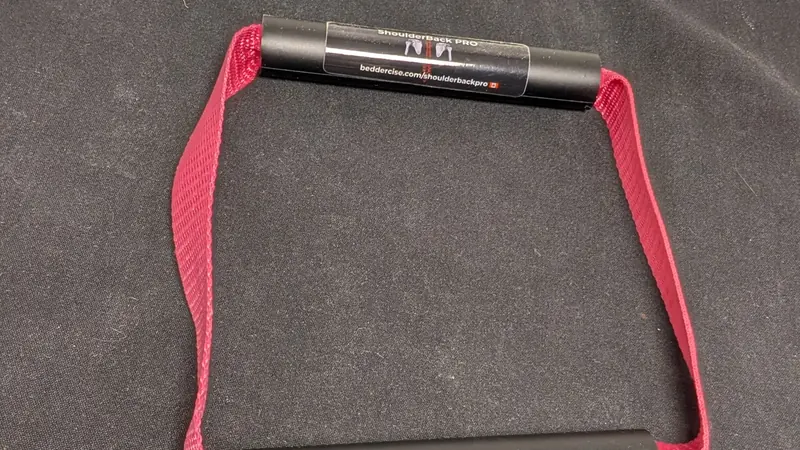
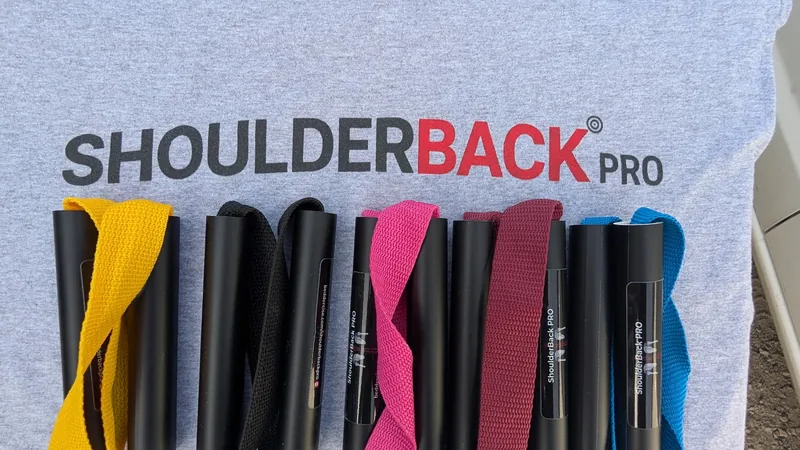
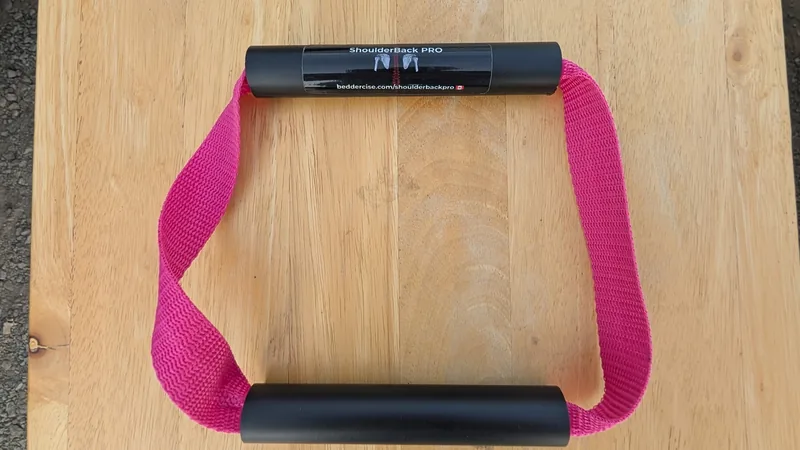
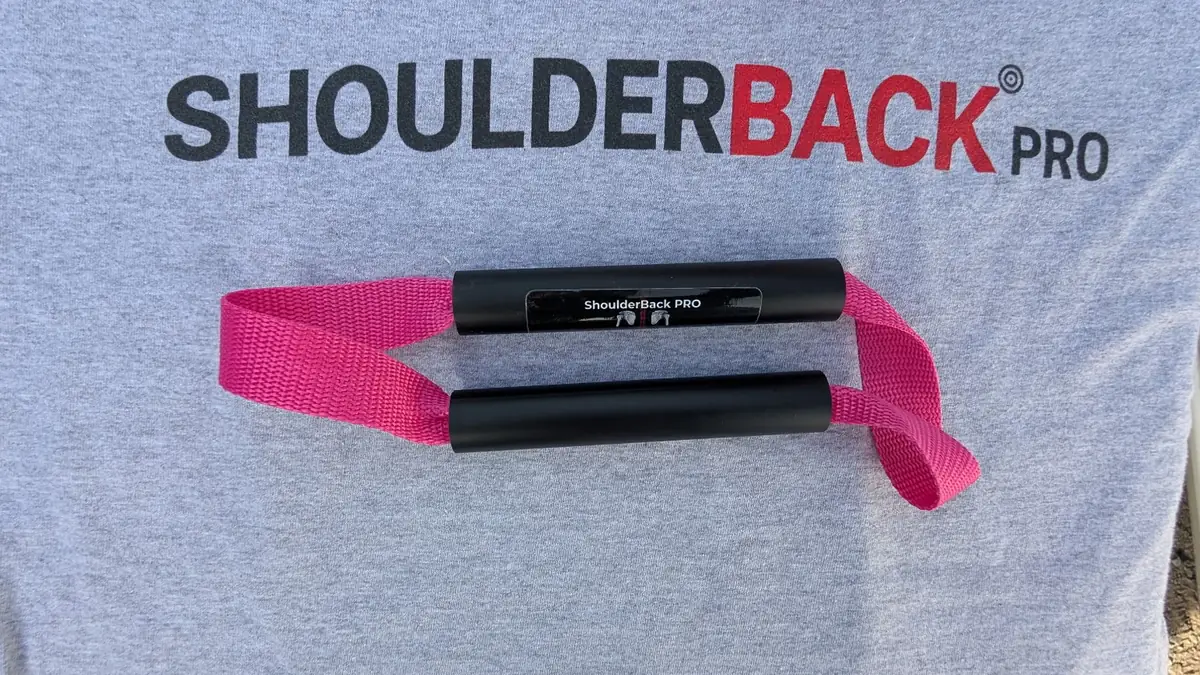
The trainer comes with 16 free video lessons taught by its inventor, so it suits people who like to learn from a demonstration. For a seated start, Refreshing Awareness (SeeSaw, Open The Door, Windshield Wipers) is designed to work the scapular stabilizers and rotator cuff muscles, with your other arm providing the resistance. It is not a medical device and not a treatment, and there is no trial evidence about it specifically. If you prefer paper, the printable card can sit on the fridge. The trainer is at ShoulderBack Pro when you are ready.
When to see a professional
See a doctor or physiotherapist promptly if you have: pain after a fall or injury with sudden weakness or loss of movement; a shoulder that looks deformed, very swollen or bruised; fever or feeling unwell alongside the pain; chest pain or breathlessness (call emergency services); constant pain that doesn't change with rest or activity; pain that wakes you most nights; numbness, tingling or weakness into the arm or hand; pain in several joints at once; or pain that hasn't improved after a couple of weeks of sensible self-care.
Only a clinician can decide which movements are safe for you. Before starting a new routine, especially after surgery or with a long-term condition, check with a clinician.
Try this movement
All 16 video lessons →Frequently asked questions
Are exercise apps better for older adults?
Not necessarily. Apps can help with reminders and video demonstrations, but the evidence does not show one format is better for everyone. The best format is the one you keep using.
Why might a printed card work better?
A printed card needs no screen, charging or login, and it can sit on the fridge where you see it. Many people find that easier to return to each day.
Can I use both?
Yes. Many people use a video for learning a movement and a printed card for the daily routine.
Sources
- Hayden JA et al. (2021). Exercise therapy for chronic low back pain. Cochrane Database of Systematic Reviews, Issue 9, CD009790. https://pmc.ncbi.nlm.nih.gov/articles/PMC8477273
- Fragala MS, Cadore EL, Dorgo S et al. (2019). Resistance Training for Older Adults: Position Statement From the National Strength and Conditioning Association. J Strength Cond Res. https://pubmed.ncbi.nlm.nih.gov/31343601/
- WHO (2020). Guidelines on physical activity and sedentary behaviour. University of Sydney summary of WHO 2020. https://www.sydney.edu.au/news-opinion/news/2020/11/26/new-global-guidelines-on-physical-activity-and-sedentary-behavio.html