Younger adults: desks, screens, lifting, parenting, travel
Students and Backpacks: Shoulder Habits That Last a Lifetime
4-minute read · Published June 9, 2025 · Updated June 9, 2025

Why this happens
A backpack pulls down on your shoulders and upper back. If the load is heavy or sits low, the muscles around your shoulder blades (the scapulae) work harder to keep you steady.
Carrying a bag on one side adds an uneven pull. Many people feel this as a dull ache or tiredness rather than sharp pain. Long study sessions in one position can make it worse. If you also game or work at a desk, the same habits may be adding up. Our guides on gamer shoulders and desk-based shoulder pain cover those patterns.
What the research says
- Backpack research is limited. We could not find a strong study on backpacks in our reference sources. Treat backpack advice as practical habits, not proven rules.
- Posture and pain are not simply linked. An umbrella review of 41 systematic reviews found no consensus that spinal posture causes low back pain [R25].
- Shoulder-blade exercise has some support. A 2025 review in rotator cuff-related shoulder pain found that scapular stabilization exercise improved pain and function [R03]. That is a different group from students, so treat it as a broad signal.
- Strength matters. The WHO recommends muscle-strengthening activity at least two days a week for adults [R07].
What you can do
- Carry less. Pack only what you need for the day. Many people find a lighter bag more comfortable, and it is the easiest change to make.
- Use both straps. Adjust them so the pack sits close to your back and does not hang low.
- Swap sides. If you carry on one shoulder, switch sides regularly. A rolling bag is another option if your school allows it.
- Move between classes. Roll your shoulders, reach up overhead, and stand for a minute or two.
- Sit well. Sit with your back supported, feet on the floor, and your screen near eye level. If you cannot sit upright for long, switch positions often.
- Build strength two or three days a week. Rows with a resistance band against a sturdy table work well for many people. Seated rows with a band count too.
Where ShoulderBack Pro fits and where it doesn't
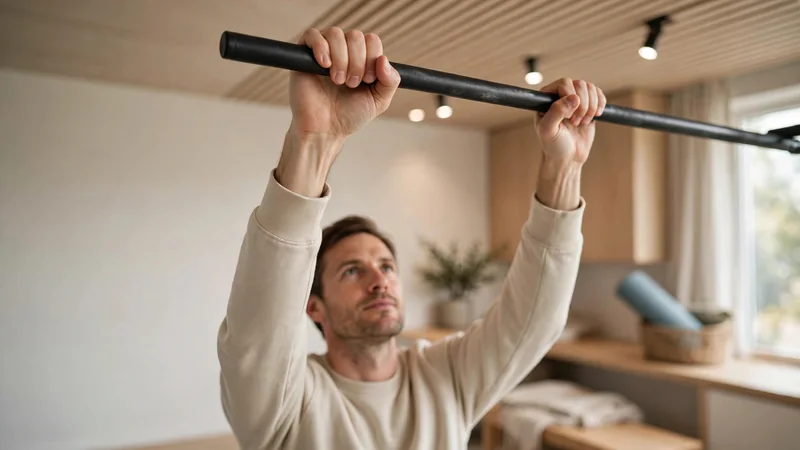
It can help with one part of this: short movement breaks. Steering, a ten-and-two wheel turn, is designed to work the deltoids and rhomboids, and it can be done seated at a library table. The other arm provides the resistance, so you choose the effort.
It will not lighten your bag or change your desk setup, and there are no clinical trials of the trainer yet.
When to see a professional
Only a doctor, physiotherapist or other clinician can diagnose the cause of shoulder pain. Book a visit rather than guessing if pain persists.
See a doctor or physiotherapist promptly if you have: pain after a fall or injury with sudden weakness or loss of movement; a shoulder that looks deformed, very swollen or bruised; fever or feeling unwell alongside the pain; chest pain or breathlessness (call emergency services); constant pain that doesn't change with rest or activity; pain that wakes you most nights; numbness, tingling or weakness into the arm or hand; pain in several joints at once; or pain that hasn't improved after a couple of weeks of sensible self-care.
Try this movement
Steering (deltoids, rhomboids) →Frequently asked questions
Can a heavy backpack cause shoulder pain?
It may contribute for some people, especially with heavy loads or carrying on one side. Research on backpacks specifically is limited, so a clinician is the best person to judge your situation.
Are rolling backpacks better for shoulders?
Some people find them easier on the shoulders, especially on long walks. The benefit is practical rather than proven by strong research in the sources we reviewed.
When should I get help?
If pain has not improved after a couple of weeks of sensible self-care, see a clinician. Get care sooner if you have numbness, tingling or weakness in the arm or hand.
Sources
- Frontiers in Bioengineering & Biotechnology (2025). Specific modes of exercise to improve rotator cuff-related shoulder pain: systematic review and meta-analysis. https://pmc.ncbi.nlm.nih.gov/articles/PMC12011739/
- WHO (2020). Guidelines on physical activity and sedentary behaviour. https://www.sydney.edu.au/news-opinion/news/2020/11/26/new-global-guidelines-on-physical-activity-and-sedentary-behavio.html
- Swain CTV et al. (2020). No consensus on causality of spine postures or physical exposure and low back pain: umbrella review of 41 systematic reviews. J Biomechanics. https://getfitcraft.com/guides/exercises-for-posture