Younger adults: desks, screens, lifting, parenting, travel
Rowing Machine Shoulder Pain: Technique and Balance
4-minute read · Published September 18, 2026 · Updated September 18, 2026
What this is
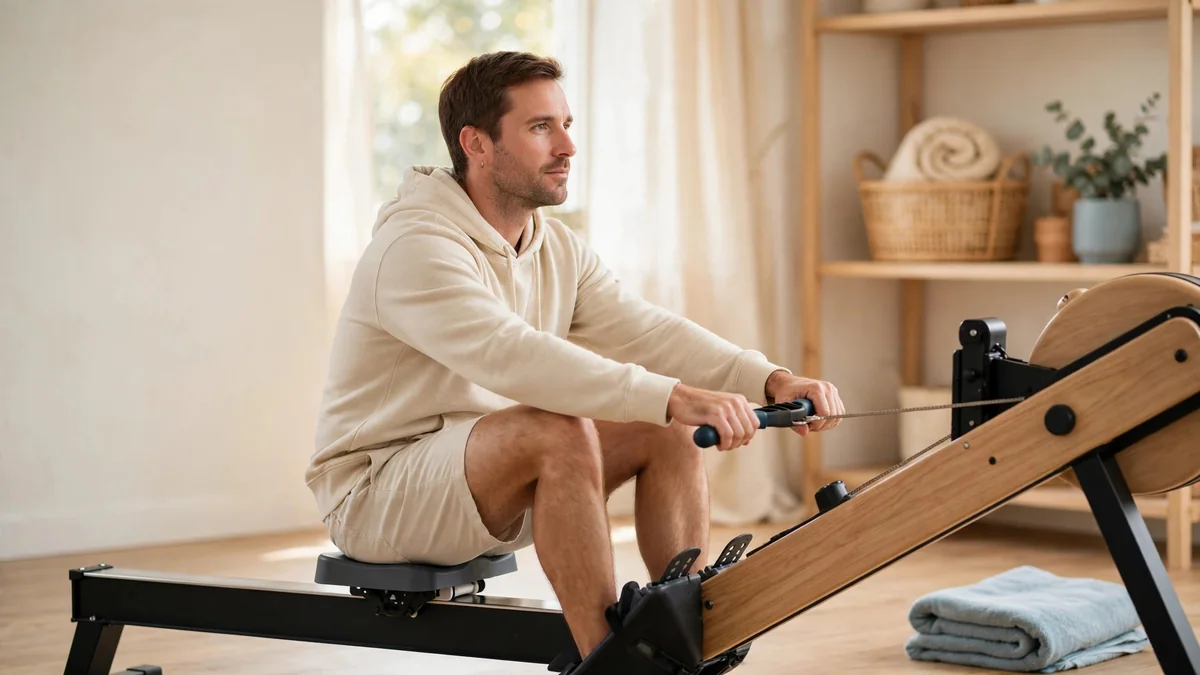
Rowing is a whole-body pull. Your legs push, your trunk hinges, and your arms finish the stroke. When the legs and trunk do less, the shoulders and arms often end up doing more.
Many people notice shoulder pain after long sessions, or after adding resistance too fast. The shoulder is not the only cause to check. Sequence and grip matter too.
What the research says
- The shoulder blade is the base for arm movement. Exercise that trains the muscles that steady it improved pain and function in rotator cuff-related shoulder pain [R03]. There isn't strong research on rowing specifically.
- Progressive, resisted exercise probably makes a modest difference shoulder pain more than gentle movement alone [R01].
- Most shoulder pain is managed in primary care with advice and exercise [R30].
What you can do
- Check the sequence. Think "legs, then trunk, then arms." The arms should finish the stroke, not start it.
- Keep the handle close. Let the handle travel close to your body through the pull, rather than reaching out in front of your chest.
- Don't shrug. Let your neck and shoulders stay soft at the catch and during the recovery.
- Ease the load while the shoulder settles. Lower the resistance and shorten sessions. Short, easy rows are a practical option.
- Do seated shoulder-blade work. Sit tall in a chair, draw your shoulder blades gently back and down, hold briefly, then release. Do a few slow repetitions.
- Balance your week. Include pushing and overhead work along with rowing, so the shoulders are not used in only one direction.
- Track how it feels. Note whether pain comes during the stroke, the next morning, or at night.
Where ShoulderBack Pro fits — and where it doesn't
ShoulderBack Pro may help with one part of this: balanced, controlled two-arm work for the shoulders and shoulder blades. Steering turns an imaginary wheel, ten-and-two, and the site lists it for the front and back deltoids and rhomboids.
It does nothing for rowing technique, machine setup or training load, and it is a wellness tool with no clinical trials. If a clinician is happy for you to add gentle movement, you can see the trainer.
Related reading: shoulder pain from working at a computer all day, shoulder pain from bench press, and shoulder pain after the gym.
When to see a professional
See a doctor or physiotherapist promptly if you have: pain after a fall or injury with sudden weakness or loss of movement; a shoulder that looks deformed, very swollen or bruised; fever or feeling unwell alongside the pain; chest pain or breathlessness (call emergency services); constant pain that doesn't change with rest or activity; pain that wakes you most nights; numbness, tingling or weakness into the arm or hand; pain in several joints at once; or pain that hasn't improved after a couple of weeks of sensible self-care [R30].
A doctor or physiotherapist diagnoses rowing-related shoulder pain. A coach can help with technique, but cannot diagnose an injury.
Try this movement
Steering (deltoids, rhomboids) →Frequently asked questions
Should I row through the pain?
No. Mild effort-related tiredness that settles is different from sharp or worsening pain. Ease off, and see a clinician if pain persists or changes [R30].
Is rowing good or bad for shoulders?
There isn't strong research on rowing specifically. Strength for the shoulder blades has been studied in shoulder pain in general, and it improved pain and function [R03].
Can a coach help with technique?
Yes. A coach can show you where the work is going and suggest changes. Pain that continues after technique changes needs a clinician's assessment [R30].
Sources
- Naunton J et al. (2020). Effectiveness of progressive and resisted and non-progressive or non-resisted exercise in rotator cuff related shoulder pain: systematic review and meta-analysis of RCTs. Clinical Rehabilitation. https://search.pedro.org.au/search-results/record-detail/61404
- Frontiers in Bioengineering & Biotechnology (2025). Specific modes of exercise to improve rotator cuff-related shoulder pain: systematic review and meta-analysis. https://pmc.ncbi.nlm.nih.gov/articles/PMC12011739/
- NHS Greater Glasgow & Clyde, Shoulder red flags; NHS MPFT self-help, Shoulder pain; BESS/BOA pathway summary (2021). https://www.nhsggc.scot/page_category/services/page/33