Younger adults: desks, screens, lifting, parenting, travel
Gamer Shoulders: Controller, Mouse and the Hunch
5-minute read · Published January 30, 2025 · Updated January 30, 2025
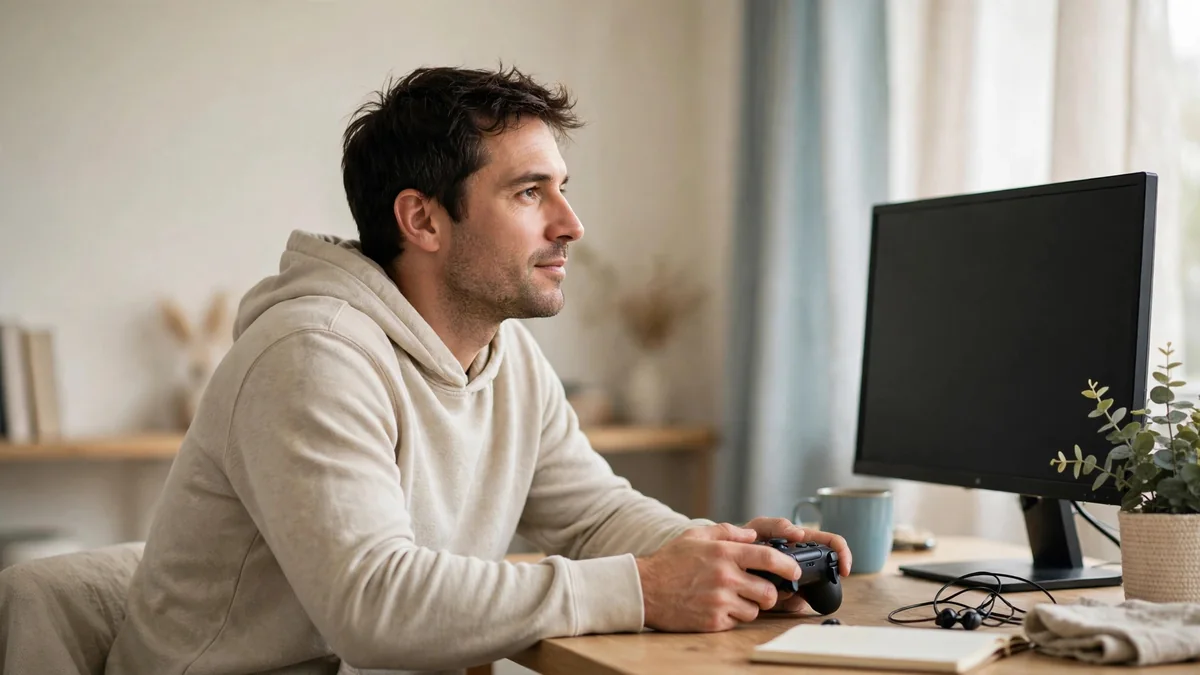
Ask any gamer about a late-night session and you will hear the same story. Shoulders up near the ears. Head forward toward the screen. Elbows tucked in tight. Hours later, the neck and upper back feel locked. This post looks at what may be happening, what helps and when to get checked.
For the wider desk picture, see our guide to shoulder pain from computer work. Gaming and desk work share many of the same habits.
Why gaming can tighten your shoulders
Gaming often means holding one posture for a long time. The head tends to lean forward. The shoulders rise, and the arms stay close to the body. The hands make small, fast, repeated movements on a controller or mouse.
Those small movements add up. Muscles that hold a position for hours get tired. Muscles that never get a full range can feel tight. The result is often a dull ache in the upper back, the top of the shoulder or the neck.
This is a common-sense picture. It is not a proven cause of injury. Many gamers have no pain at all, and some with pain have other causes entirely.
What the research says
- Forward head posture is linked to neck pain. Exercise-based programs are the main treatment studied for it [R27]. The research describes an association, not a cause.
- Adults are advised to do muscle-strengthening activity at least two days a week. Even short, regular sessions count toward that goal [R07].
- In rotator-cuff-related shoulder pain, programs that teach control and coordination may edge out generic exercise, though we do not fully know why [R02]. This is not gaming research.
- Shoulder problems go along with reduced joint position sense, and rehabilitation commonly moves from range, to strength, to control [R16].
Evidence on gaming itself is limited. We do not have strong studies that compare gaming set-ups or break habits. The advice below is sensible, low-risk and based on general shoulder research.
What you can do
- Break up the session. Pause for a few seconds of shoulder rolls between matches or levels. Seated option: stay in your chair and roll your shoulders back and down.
- Set the screen at eye level. This may reduce the forward head lean. Seated option: raise the monitor or move the chair so the screen sits at about eye height.
- Support your arms. Rest your forearms on armrests or a cushion so your shoulders can drop. Seated option: sit in a chair with armrests or use a cushion on your lap.
- Relax your grip. Hold the controller lightly, and let the fingers rest. Tension in the hands can travel up the arm. Seated option: this works from any chair.
- Glide your shoulder blades. Draw them back and down, then release, several times. Seated option: sit tall and do it slowly.
- Strengthen twice a week. Light band rows, bodyweight pulls or a short self-resisted shoulder routine are options. Progress by resisting harder, moving through more range or doing longer sets. Seated option: sit for every set.
- Stop if pain sharpens. Mild tightness is common. Sharp pain or numbness is not. Stop and get advice.
Where ShoulderBack Pro fits — and where it doesn't
A pocket-size trainer suits a quick reset between matches. Steering is a ten-and-two turn of an imaginary wheel that is designed to work the deltoids and rhomboids, and Grinders makes small circles aimed at the muscles between the shoulder blades. The other arm provides the resistance, so you pick the effort, and both work seated.
It does not fix posture, treat neck pain or address nerve symptoms, and it has no clinical trials. The trainer is $29 CAD if that fits your setup.
When to see a professional
See a doctor or physiotherapist promptly if you have: pain after a fall or injury with sudden weakness or loss of movement; a shoulder that looks deformed, very swollen or bruised; fever or feeling unwell alongside the pain; chest pain or breathlessness (call emergency services); constant pain that doesn't change with rest or activity; pain that wakes you most nights; numbness, tingling or weakness into the arm or hand; pain in several joints at once; or pain that hasn't improved after a couple of weeks of sensible self-care.
Tingling or numbness in the hand after long sessions needs an assessment, even if the pain itself is mild. A doctor or physiotherapist can check for nerve involvement.
Try this movement
Steering (deltoids, rhomboids) →Frequently asked questions
Is gaming causing my shoulder pain?
It may be contributing, but we cannot say for sure. Gaming posture and repetition are plausible factors, and a clinician can help you sort out the rest.
How often should I take breaks?
Short, frequent breaks are a sensible habit. Use natural pauses, like a level change or a new match, as your cue instead of a strict timer.
Can I game with a sore shoulder?
Use shorter sessions and stop at sharp pain. If pain grows, rest from long sessions and get it assessed.
Is the controller or the mouse the problem?
Often it is a mix of both, plus the chair and screen set-up. Changing one thing at a time makes it easier to see what helps.
Sources
- Healthcare (MDPI) 2023; 11(19):2604. Treatment of chronic neck pain in patients with forward head posture: systematic narrative review. https://www.mdpi.com/2227-9032/11/19/2604
- WHO (2020). Guidelines on physical activity and sedentary behaviour. https://www.sydney.edu.au/news-opinion/news/2020/11/26/new-global-guidelines-on-physical-activity-and-sedentary-behavio.html
- Dubé M-O et al. (2024). The Efficacy of Exercise Therapy for Rotator Cuff-Related Shoulder Pain According to the FITT Principle: Systematic Review With Meta-analyses. JOSPT. https://pubmed.ncbi.nlm.nih.gov/38848304/
- Mureşan et al. (2022). Effects of a novel proprioceptive rehabilitation device on shoulder joint position sense, pain and function. Medicina. https://www.ncbi.nlm.nih.gov/pmc/articles/PMC9505091/