Younger adults: desks, screens, lifting, parenting, travel
Pull-Ups and Shoulders: Earning the Hang
5-minute read · Published May 29, 2026 · Updated May 29, 2026
Why this happens / What this is
In a pull-up, the shoulder works from a hanging position. The shoulder blade has to move up and down and stay steady while the arm carries your full weight. If control is weak or range is limited, the joint and the tissues around it may take strain they are not ready for.
Pain can come from the tendons, the joint, the muscles around the shoulder blade or the neck. The location and feel of the pain do not tell you which one. A doctor or physiotherapist makes that diagnosis.
Younger adults often add pull-ups to a desk-heavy week, which can leave the upper back stiff and the shoulder blades under-used. That pattern is common, but it is not a diagnosis.
What the research says
- WHO guidance recommends muscle-strengthening activity for adults on at least two days a week [R07]. Pull-ups can be one part of that, but they are not the only option.
- Rehabilitation often moves from range to strength to control and coordination [R16]. For pulling, shoulder blade control is often the step that comes first.
- In athletes, a 12-week program improved shoulder proprioception (joint position sense) and pain [R17]. That is a reason to train control, not proof for pull-ups specifically.
- Evidence on pull-up injuries in younger adults is limited in these sources. Ask a clinician about your case.
What you can do
- Warm up the shoulder blades. Sit or hang, and gently draw your shoulder blades down and back, then release. Keep it slow and pain-free.
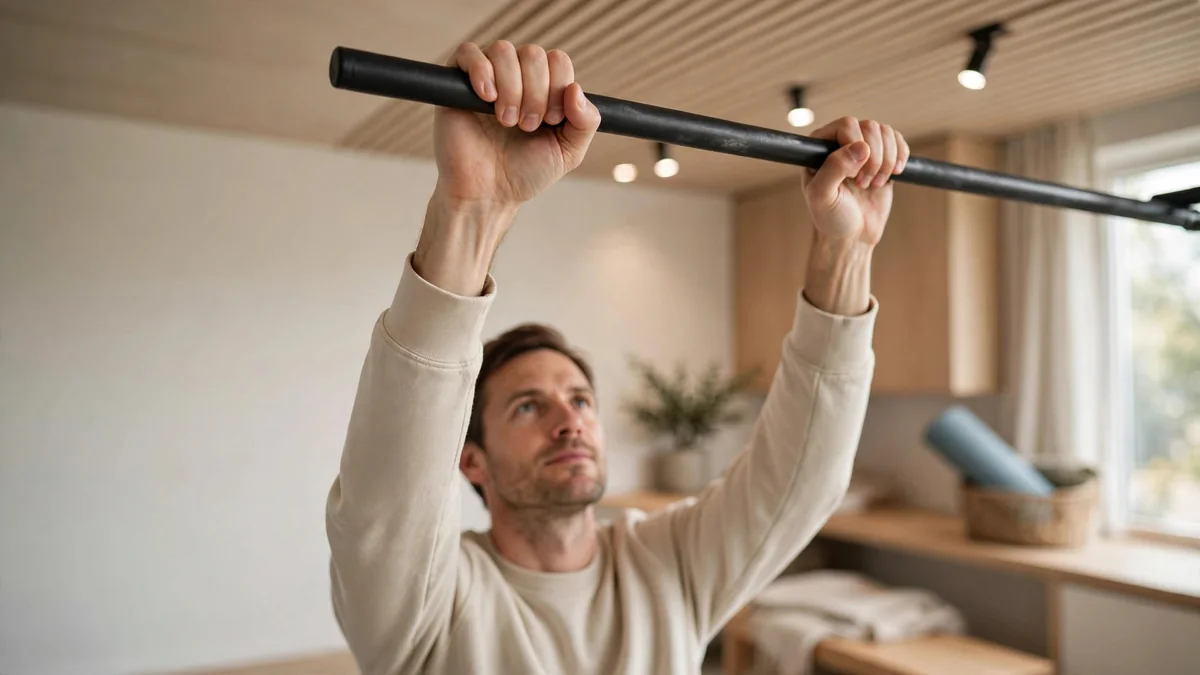
- Practise shoulder blade control. From a comfortable hang, gently lift and lower the shoulder blades. Seated option: sit tall, arms by your sides, and slide the shoulder blades down and back.
- Build pulling strength before full pull-ups. Use band rows, dumbbell rows or assisted pulls. Seated band rows are a good option.
- Add controlled lowering when hanging feels steady. Lower yourself slowly from the top. Keep the descent smooth.
- Rest between sessions. Pulling muscles need recovery to adapt.
- Stop at sharp, deep or lingering pain. Pain that is still there the next morning is worth checking.
Where ShoulderBack Pro fits — and where it doesn't
The trainer fits the warm-up, not the pulling. Steering turns an imaginary wheel at ten and two; the site lists it as working the deltoids and rhomboids, a gentle way to wake up the shoulder blades before you pull. Bear Hugs Me (middle trapezius, rhomboids) is a second option.
It does not build pulling strength or train hanging. It is a wellness tool with no clinical trials. The product page has the details.
When to see a professional
See a doctor or physiotherapist promptly if you have: pain after a fall or injury with sudden weakness or loss of movement; a shoulder that looks deformed, very swollen or bruised; fever or feeling unwell alongside the pain; chest pain or breathlessness (call emergency services); constant pain that doesn't change with rest or activity; pain that wakes you most nights; numbness, tingling or weakness into the arm or hand; pain in several joints at once; or pain that hasn't improved after a couple of weeks of sensible self-care.
Acute severe pain after a fall, or a sudden pop with weakness, needs proper medical assessment before any more training [R30].
Try this movement
Steering (deltoids, rhomboids) →Frequently asked questions
Is it normal to feel shoulder pain doing pull-ups?
Some effort and fatigue are normal. Sharp, pinching or lingering pain is not something to push through. Stop, reduce the load, and get it checked if it persists.
How do I know I am ready for full pull-ups?
You can hang and control your shoulder blades without pain, lower yourself slowly, and pull with steady form. If that is not yet true, build the base first.
Can ShoulderBack Pro replace pull-up training?
No. It does not train loaded pulling strength or hanging. It can be a warm-up for control and coordination, alongside a proper pulling plan.
Should I see a physio about pull-up pain?
Yes, if pain lasts, comes with weakness or numbness, or limits daily life. A physiotherapist or doctor can diagnose the cause and plan the return to training.
Sources
- WHO (2020). Guidelines on physical activity and sedentary behaviour. https://www.sydney.edu.au/news-opinion/news/2020/11/26/new-global-guidelines-on-physical-activity-and-sedentary-behavio.html
- Mureşan et al. (2022). Effects of a novel proprioceptive rehabilitation device on shoulder joint position sense, pain and function. Medicina. https://www.ncbi.nlm.nih.gov/pmc/articles/PMC9505091/
- Kim et al. (2020). Effect of a 12-week rehabilitation exercise program on shoulder proprioception, instability and pain in baseball players. https://www.ncbi.nlm.nih.gov/pmc/articles/PMC7554390/
- NHS Greater Glasgow & Clyde — Shoulder red flags; NHS MPFT self-help — Shoulder pain; BESS/BOA pathway summary (2021). https://www.nhsggc.scot/page_category/services/page/33