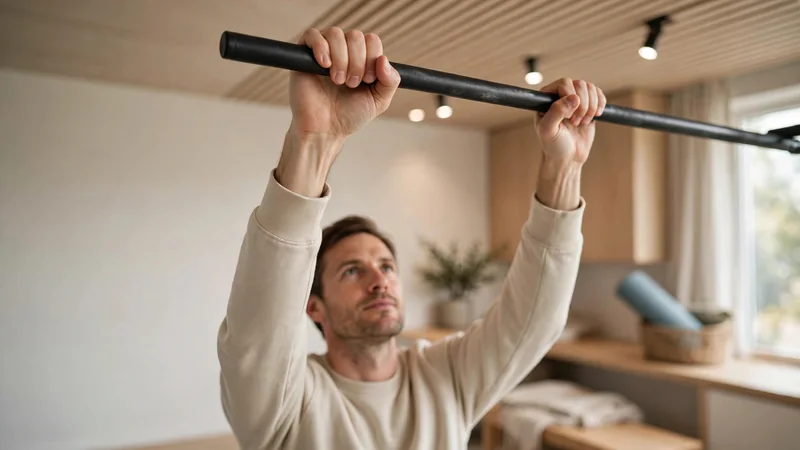
Younger adults: desks, screens, lifting, parenting, travel
Remote Work and Shoulders: The Kitchen-Table Office Problem
6-minute read · Published December 23, 2025 · Updated December 23, 2025

Why this happens / What this is
A kitchen table was built for meals, not for eight hours of typing. The chair is often too low or too hard, the table is at the wrong height for a keyboard, and the laptop screen sits far below eye level. To see the screen, you tilt the head forward. To type, you reach the arms forward and keep the shoulders lifted.
Over a workday, the shoulder blades can stay still, the upper back can round, and the muscles at the front and back of the shoulder can work at a low level for hours. Many people feel that as tightness, heaviness or a dull ache.
It helps to know what the research can and cannot say. Forward head posture is linked with neck pain, but that is an association, not proof that posture alone causes the pain [R27]. There is also no consensus that a particular spinal posture causes low back pain [R25]. That is why this article leans on varied positions and regular breaks rather than one perfect posture.
For background on the shoulder blade itself, read about the shoulder blade and how it moves. For a broader view of desk life, see the desk setup guide.
What the research says
- Forward head posture is linked with neck pain, and exercise-based programs are the main studied treatment [R27].
- Public activity guidance says every move counts, which fits short, frequent breaks [R07].
What you can do
- Raise the screen. Put the laptop on a stack of books, a box or a stand, so the top of the screen sits near eye level. Use an external keyboard and mouse if you can.
- Bring the keyboard close. Keep your elbows near your sides and your forearms supported. Avoid reaching forward for long stretches.
- Use a supportive chair. A dining chair with a back is usually better than a couch for long work sessions. Keep your feet on the floor or on a footrest.
- Set a movement timer. Stand up or change position every 30 to 60 minutes. Walk to refill your water, or do a few shoulder rolls and arm reaches.
- Do a short seated reset. Draw the shoulder blades gently back and down, then let them rest. Repeat slowly for about a minute.
- Plan the day around breaks. Put the hardest typing in short blocks, and take a longer break after each one.
Where ShoulderBack Pro fits — and where it doesn't
Between calls, Steering is a good fit: you turn an imaginary wheel at ten-and-two, which is designed to work the deltoids and rhomboids, while the other arm resists. Bear Hugs Me follows well, drawing the trainer to your chest to work the middle trapezius. Both take a minute or two seated, and pressing harder or going for more reps is how you build up.
ShoulderBack Pro is a pocket-size wellness tool ($29 CAD, 30-day guarantee), not a posture corrector or a treatment, and there are no clinical trials of it yet. It won't change your chair or screen.
When to see a professional
See a doctor or physiotherapist promptly if you have: pain after a fall or injury with sudden weakness or loss of movement; a shoulder that looks deformed, very swollen or bruised; fever or feeling unwell alongside the pain; chest pain or breathlessness (call emergency services); constant pain that doesn't change with rest or activity; pain that wakes you most nights; numbness, tingling or weakness into the arm or hand; pain in several joints at once; or pain that hasn't improved after a couple of weeks of sensible self-care.
If the pain has been going on for a few weeks despite changes at the desk, a physiotherapist can look at your workstation and your movement together.
Try this movement
Steering (deltoids, rhomboids) →Frequently asked questions
Is a laptop on the kitchen table really that bad?
It can be, mainly because the screen and keyboard are usually too low and too close together. The problem is less the table and more how long you stay in one position.
How often should I move during a workday?
Many people find short movement breaks every 30 to 60 minutes helpful. Even one minute of movement counts, and regular movement is more useful than one long session at the gym.
What if my shoulder is sore after a long workday?
Mild, short-lived soreness is common, but pain that persists, wakes you at night or comes with numbness or weakness needs a clinician's look.
Sources
- Swain CTV et al. (2020). No consensus on causality of spine postures or physical exposure and low back pain: umbrella review of 41 systematic reviews. J Biomechanics. https://getfitcraft.com/guides/exercises-for-posture
- Healthcare (MDPI) 2023; 11(19):2604. Treatment of chronic neck pain in patients with forward head posture: systematic narrative review. https://www.mdpi.com/2227-9032/11/19/2604
- WHO (2020). Guidelines on physical activity and sedentary behaviour. https://www.sydney.edu.au/news-opinion/news/2020/11/26/new-global-guidelines-on-physical-activity-and-sedentary-behavio.html