Food, nutrition & eating for joints and muscle
Glucosamine and Chondroitin: Why the Evidence Is So Mixed
4-minute read · Published April 28, 2026 · Updated April 28, 2026
Why this happens / What this is
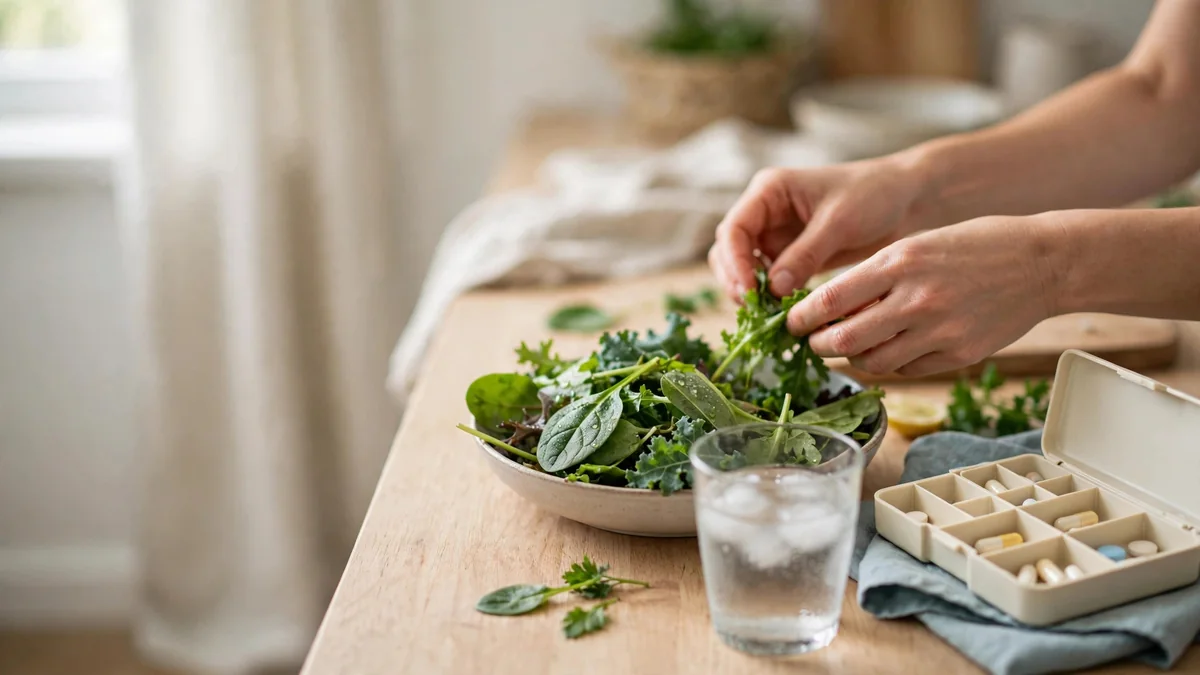
Glucosamine and chondroitin are sold as supplements to support joints. Chondroitin is a component of cartilage, the smooth tissue that covers joint surfaces. Glucosamine is a sugar-based compound. Both are often marketed for osteoarthritis, a wear-and-tear joint condition.
Supplements do not always go through the same checks as medicines, and products can differ. Check labels and ask your pharmacist about what is in the bottle.
What the research says
Evidence levels for common joint supplements, from the sources we checked. Evidence is older for some items, so read the table as a snapshot, not a verdict:
| Item | Evidence level | What our sources say |
|---|---|---|
| Omega-3 | Limited | Some evidence of modest benefit in rheumatoid arthritis [R20]. A 2009 review could not recommend it for osteoarthritis [R22]. Newer trials may exist that we have not reviewed. |
| Turmeric / curcumin | Insufficient | Lab promise, insufficient clinical evidence [R20]. |
| Ginger | Unclear | Evidence unclear [R20]. Not recommended for osteoarthritis in a 2009 review [R22]. |
| Glucosamine and chondroitin | Not rated | No source we checked rates them. Evidence is described as mixed, so ask your clinician. |
- Eating patterns look more promising. Whole-diet patterns, such as Mediterranean or plant-based eating, are linked to less pain and better function in osteoarthritis [R21]. The word is "linked", not "proven".
- Diet complements care. An anti-inflammatory diet can complement treatment, but it never replaces it [R23].
What you can do
Related reading: Anti-inflammatory diet for joint pain: what's proven, what's promising, what's hype and Do you need an MRI for shoulder pain?.
All of these can be done seated.
- Talk to your pharmacist or doctor first. Bring a list of every supplement and medicine you take. If you take blood thinners or other medication, check with your pharmacist or doctor before taking any supplement.
- Ask what is causing the pain. A clinician can say what is going on before you choose a product.
- Focus on eating patterns. Build meals around vegetables, legumes, fish and whole grains, a pattern linked to less joint pain [R21].
- Add seated strength work. Gentle seated arm and leg exercises can build strength, and resistance training supports function in older adults [R06].
- Keep a simple log. Note your pain, your activity and any products you try, then share it with your clinician. Bring the log to each visit so changes in pain, sleep or appetite can be matched with anything new you started.
Where ShoulderBack Pro fits — and where it doesn't
ShoulderBack Pro does not fit this topic. It is a movement trainer, not a supplement. Ask your pharmacist or doctor about supplements, and a clinician about joint pain. General movement ideas are on the routines page once you are cleared.
When to see a professional
See a doctor or physiotherapist promptly if you have: pain after a fall or injury with sudden weakness or loss of movement; a shoulder that looks deformed, very swollen or bruised; fever or feeling unwell alongside the pain; chest pain or breathlessness (call emergency services); constant pain that doesn't change with rest or activity; pain that wakes you most nights; numbness, tingling or weakness into the arm or hand; pain in several joints at once; or pain that hasn't improved after a couple of weeks of sensible self-care. [R30]
Try this movement
Refreshing Awareness 3-minute ritual →Frequently asked questions
Do glucosamine and chondroitin work?
The evidence is unclear, and none of the sources we checked rate them directly. Ask your clinician or pharmacist about your own situation.
Are supplements safe to take with my medication?
They can interact with medicines. Talk to your pharmacist or doctor before starting any supplement, especially if you take blood thinners or other medication.
Is turmeric worth it?
Laboratory studies are promising, but clinical evidence for musculoskeletal inflammation is insufficient [R20].
What helps most for joint pain?
Regular, progressive exercise and a whole-food eating pattern are the best-supported habits in our sources [R06, R21].
Sources
- Fragala MS, Cadore EL, Dorgo S et al. (2019). Resistance Training for Older Adults: Position Statement From the National Strength and Conditioning Association. J Strength Cond Res. https://pubmed.ncbi.nlm.nih.gov/31343601/
- NCCIH (US National Center for Complementary and Integrative Health). Nutritional Approaches for Musculoskeletal Pain and Inflammation. https://www.nccih.nih.gov/health/providers/digest/musculoskeletal
- PMC narrative review (2025/26). Nutritional Interventions in Osteoarthritis: Mechanisms, Clinical Evidence, and Translational Opportunities. https://www.ncbi.nlm.nih.gov/pmc/articles/PMC12844890/
- Rosenbaum CC et al. (2010). Antioxidants and antiinflammatory dietary supplements for osteoarthritis and rheumatoid arthritis. Altern Ther Health Med. https://pubmed.ncbi.nlm.nih.gov/20232616/
- EBSCO Health Notes. Exploring anti-inflammatory diets in rheumatology. https://about.ebsco.com/blogs/health-notes/exploring-anti-inflammatory-diets-rheumatology
- NHS Greater Glasgow & Clyde, Shoulder red flags; NHS MPFT self-help, Shoulder pain; BESS/BOA pathway summary (2021). https://pmc.ncbi.nlm.nih.gov/articles/PMC7905504