Food, nutrition & eating for joints and muscle
Fish Twice a Week: The Simplest Omega-3 Habit
4-minute read · Published September 23, 2026 · Updated September 23, 2026
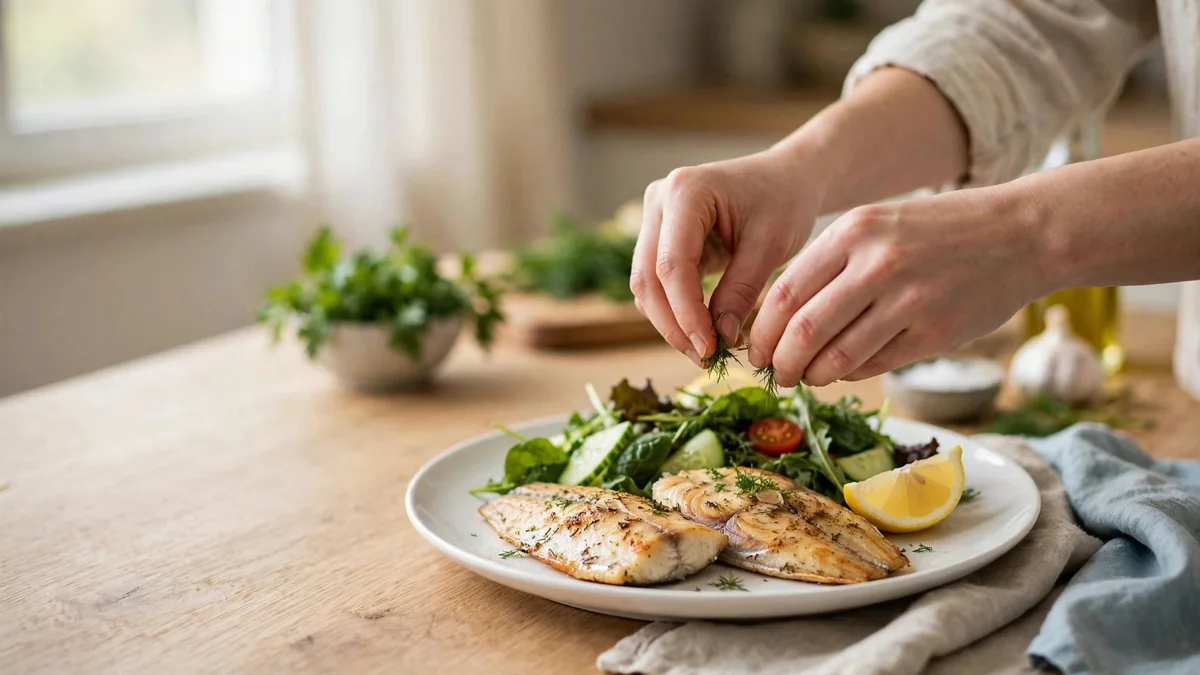
What this is
Omega-3 fats are a type of fat found in fatty fish and some plant foods. Researchers study them because they may affect inflammation, which is the body's response to irritation or injury.
Most of the studies here concern supplements, not fish meals, so they do not tell us how much fish to eat. Twice a week is an easy habit to try. It is not a number these sources prove.
What the research says
- Omega-3 may give a modest benefit in rheumatoid arthritis, though the evidence is limited. Two studies support it for that condition [R20][R22].
- For osteoarthritis, an older review could not recommend omega-3 based on the evidence available up to 2009 [R22].
- Whole-diet patterns, such as Mediterranean or plant-based eating, are linked to less pain and better function in osteoarthritis [R21]. "Linked to" is the right phrase here. It is not the same as proven.
- Anti-inflammatory diet components are associated with lower inflammatory markers in rheumatoid arthritis. A diet complements treatment; it never replaces it [R23].
Evidence levels for common joint remedies
We use four levels: strong, moderate, limited and insufficient.
| Item | Evidence level | What the sources say |
|---|---|---|
| Omega-3 supplements, rheumatoid arthritis | Limited | Some evidence of a modest benefit [R20][R22] |
| Omega-3 supplements, osteoarthritis | Insufficient | Not recommended on the evidence to 2009 [R22] |
| Whole-diet patterns (Mediterranean, plant-based), osteoarthritis | Limited | Linked to less pain and better function; an association, not proof [R21] |
| Turmeric (curcumin) | Insufficient | Promising in the lab, not enough clinical evidence [R20] |
| Ginger | Insufficient | Evidence is unclear [R20][R22] |
What you can do
- Pick a fish habit you can keep. Start with one or two meals a week. Canned fish can be a practical option too.
- Swap rather than add. Replace one meat meal with fish, or add fish to a salad or wrap.
- Set up your kitchen for sitting. If standing at the stove is hard on your shoulders, sit at the table to prepare food, and keep heavy pans on a low shelf.
- Eat a varied diet. Whole-diet patterns are linked to better outcomes than any single food [R21].
- Check before taking supplements. If you take blood thinners or other medication, talk to your pharmacist or doctor before you start any omega-3 or herbal supplement.
- Track how you feel. Note changes over several weeks, and bring the notes to your clinician.
Where ShoulderBack Pro fits — and where it doesn't
A movement trainer has no part in what you eat, so ShoulderBack Pro does not fit this topic. A dietitian or pharmacist can help with food and supplements, and a clinician can assess any shoulder pain. If gentle movement is cleared for you, the routines are there.
When to see a professional
See a doctor or physiotherapist promptly if you have: pain after a fall or injury with sudden weakness or loss of movement; a shoulder that looks deformed, very swollen or bruised; fever or feeling unwell alongside the pain; chest pain or breathlessness (call emergency services); constant pain that doesn't change with rest or activity; pain that wakes you most nights; numbness, tingling or weakness into the arm or hand; pain in several joints at once; or pain that hasn't improved after a couple of weeks of sensible self-care [R30].
A doctor or rheumatologist diagnoses the cause of joint pain. Diet and supplements do not replace that assessment.
Try this movement
Refreshing Awareness 3-minute ritual →Frequently asked questions
Is fish enough to help joint pain?
Fish can be part of a balanced diet. The evidence that it eases joint pain on its own is limited, so food works best alongside your clinician's plan [R20][R23].
Should I take fish oil instead of eating fish?
Some people use supplements, but the evidence is mixed. Supplements can interact with medicines, so ask your pharmacist or doctor first [R22].
How do I know if a food is helping?
It is hard to tell from one food. Track how you feel over several weeks, and see a clinician if pain persists [R30].
Sources
- NCCIH (US National Center for Complementary and Integrative Health). Nutritional Approaches for Musculoskeletal Pain and Inflammation. https://www.nccih.nih.gov/health/providers/digest/musculoskeletal
- PMC narrative review (2025/26). Nutritional Interventions in Osteoarthritis: Mechanisms, Clinical Evidence, and Translational Opportunities. https://www.ncbi.nlm.nih.gov/pmc/articles/PMC12844890/
- Rosenbaum CC et al. (2010). Antioxidants and antiinflammatory dietary supplements for osteoarthritis and rheumatoid arthritis. Altern Ther Health Med. https://pubmed.ncbi.nlm.nih.gov/20232616/
- EBSCO Health Notes. Exploring anti-inflammatory diets in rheumatology. https://about.ebsco.com/blogs/health-notes/exploring-anti-inflammatory-diets-rheumatology
- NHS Greater Glasgow & Clyde, Shoulder red flags; NHS MPFT self-help, Shoulder pain; BESS/BOA pathway summary (2021). https://www.nhsggc.scot/page_category/services/page/33
More in this topic
 Essential guide: Anti-Inflammatory Diet for Joint Pain: What's Proven, What's Promising, What's Hype
 What to Eat Before and After a Short Movement Session
 Spices in the Canadian Kitchen: Turmeric, Ginger, Garlic — Flavour First, Claims Second
 Weight and Shoulder Pain: Does Body Weight Affect a Non-Weight-Bearing Joint?